How to Compare Renters Insurance Quotes
Comparing renters insurance quotes is easy and helps you get the coverage you need at the cheapest price.

- Renters insurance costs an average of $18 a month, or $216 a year, nationwide.
- You might pay more or less than that amount based on factors like your ZIP code and how much coverage you need.
- Renters insurance covers your personal property, liability, medical payments and temporary living expenses.
How do I compare renters insurance quotes?
To compare renters insurance quotes, start with a few companies. Use the same info to get quotes from them and then look at their quotes side by side.
Choose renters insurance companies
Start by choosing three or four companies to compare. Not sure where to begin? See our picks for the best renters insurance companies in different areas. The more companies you get quotes from, the better chance you have of finding the best price.
Review customer satisfaction ratings
Check reviews and ratings to see how happy customers are with each company. For example:
- J.D. Power scores companies based on cost, coverage options, how well claims are handled and trust.
- The National Association of Insurance Commissioners (NAIC) looks at the number of complaints compared to the company’s size.
- LendingTree rates companies by price, coverage, discounts and customer service.
By comparing these ratings, you can get a clearer view of how well a renters insurance company treats its customers.
Use the same coverage limits and deductible amounts
Make sure you use the same coverage amounts and deductibles for each company you get a quote from. This lets you make the most accurate comparisons possible.
Compare the quotes you receive side by side
By using the same or similar coverages and deductibles for each quote, you can quickly see how they compare. Although the one with the cheapest rate is usually the best, reviews and ratings can make a difference, too.
Compare renters insurance quotes by company
The average cost of renters insurance is $18 a month, or $216 a year. State Farm has the most affordable average rate of $11 a month, or $133 a year.
American Family has the most expensive renters insurance rates, on average, at $27 a month, or $328 a year.
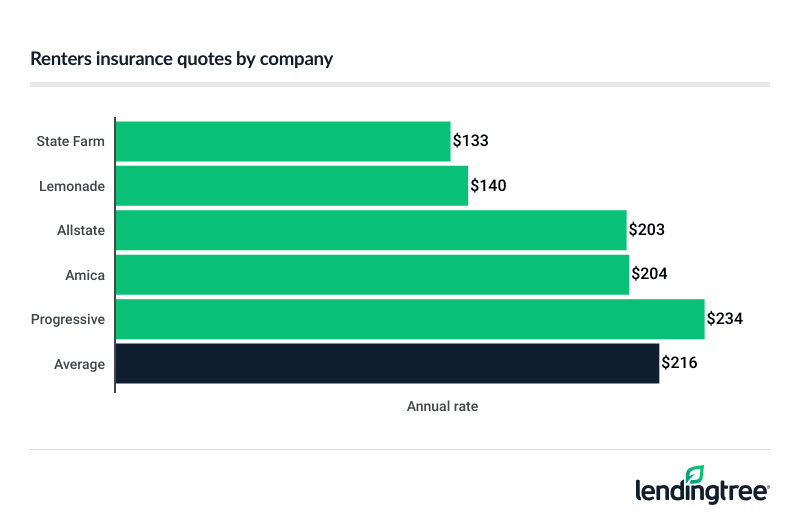
Renters insurance quotes by company
| Company | Average annual rate | |
|---|---|---|
 | State Farm | $133 |
 | Lemonade | $140 |
 | Allstate | $203 |
 | Amica | $204 |
 | Progressive | $234 |
 | Assurant | $267 |
 | Farmers | $274 |
 | American Family | $328 |
Sample renters insurance quote comparison
Your renters insurance quotes can change depending on factors like the personal property coverage limit or deductible you choose for your policy. Here’s how different limits can affect your rate.
Renters insurance quotes by personal property coverage amounts
| Quote A | Quote B |
|---|---|
| Personal property coverage: $20,000 | Personal property coverage: $30,000 |
| Deductible: $500 | Deductible: $500 |
| Personal liability: $100,000 | Personal liability: $100,000 |
| Guest medical protection: $1,000 | Guest medical protection: $1,000 |
| Loss of use: $9,000 | Loss of use: $9,000 |
| Price: $216 a year ($18 a month) | Price: $276 a year ($23 a month) |
What does renters insurance cover?
Renters insurance coverage includes your personal property, liability, medical expenses and additional living expenses.
Personal property
Renters insurance covers your belongings, including:
- Clothing
- Electronics
- Furniture
- Appliances
If you want your renters policy to cover high-value items such as art or jewelry, they may have a lower coverage limit than other belongings. Talk to insurers about these items when choosing your coverage limits.
Personal liability
Personal liability helps cover legal costs and medical bills related to injuries or property damage you cause to others. It can also cover dog bites.
Medical expenses
Medical expenses coverage helps pay the medical bills of someone injured in your rental home, regardless of who’s at fault.
Loss of use (LOU)
Also known as “additional living expenses,” or ALE, LOU coverage pays the extra costs that may come up if you need to relocate while your rental home is repaired. This normally includes hotel rentals, food and extra commute costs.
Named peril vs. open peril renters insurance
There are two types of renters insurance coverage — “named peril” and “open peril.” Named peril coverage insures against events listed by name in your policy. Open peril coverage insures against all events unless they’re listed as exclusions in the policy.
Some common covered perils:
- Smoke and fire damage
- Theft and vandalism
- Damage due to the weight of ice or snow
- Wind and hail
- Water damage
Open peril coverage can cost more than named peril, but can be worth it for the broader range of coverage. The perils your renters insurance covers are listed on your policy’s declaration page.
Compare renters insurance quotes by state
North Dakota has the cheapest renters insurance rate of around $13 a month, or $155 a year. North Carolina, Montana and Maine renters also pay less than $160 a year for coverage, on average.
Louisiana pays the highest renters insurance rates in the U.S., at $29 a month, or $349 a year.
Renters insurance quotes by state
| State | Average annual rate |
|---|---|
| Alabama | $304 |
| Alaska | $223 |
| Arizona | $257 |
| Arkansas | $317 |
| California | $191 |
| Colorado | $206 |
| Connecticut | $171 |
| Delaware | $190 |
| Florida | $242 |
| Georgia | $305 |
| Hawaii | $227 |
| Idaho | $197 |
| Illinois | $210 |
| Indiana | $225 |
| Iowa | $191 |
| Kansas | $226 |
| Kentucky | $241 |
| Louisiana | $349 |
| Maine | $159 |
| Maryland | $224 |
| Massachusetts | $179 |
| Michigan | $282 |
| Minnesota | $192 |
| Mississippi | $344 |
| Missouri | $254 |
| Montana | $158 |
| Nebraska | $209 |
| Nevada | $211 |
| New Hampshire | $171 |
| New Jersey | $176 |
| New Mexico | $202 |
| New York | $177 |
| North Carolina | $156 |
| North Dakota | $155 |
| Ohio | $260 |
| Oklahoma | $289 |
| Oregon | $197 |
| Pennsylvania | $203 |
| Rhode Island | $187 |
| South Carolina | $207 |
| South Dakota | $195 |
| Tennessee | $232 |
| Texas | $242 |
| Utah | $228 |
| Vermont | $164 |
| Virginia | $194 |
| Washington | $167 |
| West Virginia | $191 |
| Wisconsin | $182 |
| Wyoming | $163 |
You can trust LendingTree
25+ years in business. Over 1 million shoppers served per month.
Security
Instead of sharing information with multiple insurance companies, fill out one simple, secure form in five minutes or less.
Savings
Compare quotes from our online partners as well as our network of more than 3,000 local insurance agents.
Support
We provide ongoing support with unbiased insights and recommendations from experienced industry analysts to help you save.
Factors that affect your renters insurance quote
Your renters insurance quote is calculated based on several factors, including your:
- ZIP code
- Building age and construction
- Security systems installed
- Coverage limits
- Deductible
- Claims history
- Credit score (in some state)
- Pets you own
Each renters insurance company looks at these factors differently when setting your rate. For example, one company might think your ZIP code is riskier than another company does and charge you more because of it.
That’s one of the main reasons it’s smart to compare renters insurance quotes from several companies before you buy or renew.
How do I get a renters insurance quote?
To get a renters insurance quote, visit an insurance company’s website or call one of its agents and have this information handy:
- Your full name
- Date of birth
- Email address
- Number of family members living in the rental home
- Rental home address
- Coverage limits you want
- Policy start date
The renters insurance companies you contact will use this info to come up with your quote.
Once you’ve compared the quotes you get and chosen a company, you can sign up online or talk with an agent.
The effective coverage date for your renters insurance can be the day you get the policy, or a later date of your choosing.
How do I get cheap renters insurance quotes?
To get the cheapest renters insurance, compare quotes from different companies, bundle with other policies (like car insurance), choose a higher deductible and ask about discounts.
Compare quotes
Renters insurance coverage offerings are usually the same from company to company. Their prices often differ because each insurer weighs your risk factors differently. This is why it’s important to compare quotes from several insurance companies.
Bundle insurance policies
Bundling insurance policies under the same company can help lower your rates. If you bundle your renters insurance policy with an auto or life insurance policy, you may save money on both policies.
Raise your renters insurance deductible
Your deductible is the amount you agree to pay before your renters insurance company pays the rest of a claim. The higher you raise your deductible, the cheaper your premium will be. Just make sure you can afford the deductible amount you choose.
Look for discounts
Most insurance companies offer discounts to be competitive. When shopping for a renters insurance policy, see which discounts each company offers. If you’re unsure, talk with an agent.
Pay in full
Renters insurance companies often offer a discount if you pay your entire annual premium up front. It’s a good way to save money if your budget allows it.
Keep a good credit score
Your credit score can be used as a renters insurance risk factor in many states. Keeping a good credit score can help keep your rate down.
How do I choose a renters insurance company?
To find your best renters insurance company, look at more than just the price. Look at how good their customer service is and how happy their customers are, too.
There are resources that can clue you in to how happy customers are with their insurers, thankfully. These include ratings from LendingTree, J.D. Power and the NAIC.
Renters insurance company ratings
| Company | J.D. Power score* | NAIC rating** | LendingTree score |
|---|---|---|---|
| Allstate | 639 | 0.64 |  |
| American Family | 660 | 1.18 | |
| Amica | 695 | 2.67 |  |
| Assurant | Not rated | 11.75 |  |
| Farmers | 638 | 2.97 | |
| Lemonade | 682 | 0.09 | |
| Progressive | 619 | 2.52 | |
| State Farm | 679 | 3.42 |  |
**NAIC complaint index 2024. Average is 1.0. Lower is better.
How to compare renters insurance companies with specific needs
Finding the best renters insurance company for you depends on your personal needs. If you’re in college, the military, have a pet or are retired, different companies may be better suited for you.

USAA’s renters insurance also covers flood and earthquake damage, which isn’t typically covered by competitors. Note that USAA only provides insurance to current and retired military members, as well as their families.
- Top-grade customer satisfaction ratings from J.D. Power
- Covers damage from floods and earthquakes
- Only available to military members and veterans, as well as their spouses and children
- No local agencies
- Offers a few discounts such as a security system or fire alarm discount
- Has excellent reviews for their app
- Received an above average score of 842 out of 1,000 points in J.D. Power’s home insurance study
- Doesn’t offer renters insurance in all 50 states
- Average customer satisfaction ratings from J.D. Power
- Can save just by enrolling in Allstate’s Easy Pay Plan and scheduling your monthly payment
- Available nationwide
- Has below-average customer satisfaction ratings from J.D. Power
Expert insights into renters insurance
To get the most out of your renters insurance, keep in mind that your policy covers your stuff anywhere, but it doesn’t often cover damage from natural disasters.
Your belongings can be covered anywhere
Many renters insurance companies protect your stuff not just at home but also when you travel. For example, if your suitcase gets stolen while you’re overseas, it’s probably covered. Items kept in a storage unit are often covered, too.
Your expensive stuff may need an endorsement
Expensive things like art, jewelry and furs are usually only covered up to about $1,500 with regular renters insurance. To fully protect these items, you may need extra coverage called an endorsement.
Renters insurance doesn’t cover natural disasters
Standard renters insurance usually doesn’t cover natural disasters like floods and earthquakes. But many renters insurance companies offer flood or earthquake insurance as an add-on.
Frequently asked questions
Renters insurance isn’t required by law, but your landlord might make you get it as part of your lease. They do this to protect themselves from lawsuits if something happens in your rental home.
Sometimes, your landlord may ask to be listed as an “interested party” on your policy. This means they’ll get a notice if you cancel your insurance or if it ends.
Even if you don’t have to buy it, renters insurance is still a smart choice. You can get thousands of dollars of protection for just a few dollars a month, which helps keep your money safe.
The amount of renters insurance you need depends on three main things: personal property, liability, and additional living expenses (ALE).
- Personal property: Get enough personal property coverage to replace everything you own if there’s a total loss. Make a list of your belongings and write down how much it would cost to replace them. This helps you avoid paying too much or too little for renters insurance.
- Personal liability: Most renters insurance policies start with $100,000 of liability coverage. But if there’s a big accident, that amount may not be enough. If you can afford it, think about raising your limit to $300,000. It usually doesn’t add much to your monthly rate.
- Additional living expenses (ALE): This covers extra costs if you can’t live in your home while it’s repaired after a covered peril. The ALE limit is usually 30% of your personal property coverage. To raise your ALE limit, you have to raise your personal property limit, too. Remember, ALE only covers extra costs, not your regular everyday expenses.
Renters insurance does not cover the building structure, because your landlord is responsible for that. Instead, the landlord has their own insurance for the structure, while your renters insurance covers your stuff inside the home.
Your renters insurance policy won’t cover the theft of a vehicle. For that, you need a car insurance policy with comprehensive coverage. Your renters policy will cover any personal items stolen from your car, though.
Renters insurance covers moving if you need to temporarily relocate because of a covered event or peril. Otherwise, moving expenses are not covered.
Some renters insurance companies let you add roommates to your policy, but it’s not recommended to take them up on it. Sharing your renters insurance policy means sharing its personal property limit, as well. In the event of a total loss, such as a fire, you may not have enough coverage to replace all your belongings if you share a policy. It also can be hard to change the policy if you or your roommate moves out.
Methodology
LendingTree collected thousands of renters insurance quotes from the largest insurance companies in each state, based on data availability.
We used thousands of renters insurance quotes from across the U.S. for a 30-year-old single woman who has no recent renters insurance claims. Your rates may vary. Coverage limits include:
- Personal property coverage: $20,000
- Deductible: $500
- Personal liability: $100,000
- Guest medical protection: $1,000
- Loss of use: $9,000