More Consumers Stealing From Self-Checkout, With Many Blaming Higher Prices


Self-checkout can be a handy tool, especially when regular lines are too long or you have only a few items.
While the convenience is great, self-checkout also provides more opportunities for theft without detection. In fact, 27% of self-checkout users have purposefully taken an item without scanning, according to a LendingTree survey of 2,050 U.S. consumers. Alarmingly, unaffordable essentials (47%) and price increases tied to tariffs (46%) are the main motivations for doing so.
Here’s a closer look.
- Self-checkout registers remain popular. While 55% of Americans like self-checkouts for their speed and convenience, 69% of people who use them believe they make it easier to steal. Older self-checkout users are the most likely to think people could take advantage of them, at 77% among baby boomers and 70% among Gen Xers.
- Many self-checkout users admit to theft, whether intentionally or unintentionally. 27% have purposefully taken an item without scanning — a massive 12 percentage point increase from 15% in 2023. Millennial (41%) and Gen Z (37%) self-checkout users are the most likely age groups to have stolen purposefully at least once. Additionally, 36% of users admit they’ve accidentally left with an unscanned item, including 22% in the past year. 61% who’ve accidentally taken something say they kept it the last time.
- Sticky fingers are dealing with tighter systems. 42% of self-checkout users who’ve purposefully stolen something say it’s become more difficult in the past year, citing more employee monitoring (61%), cameras or AI‑assisted monitoring near kiosks (49%) and weight/scale verifications being more sensitive (42%).
- Sticker shock is driving theft. Self-checkout users who’ve purposefully stolen an item are often motivated by the current financial climate making essentials unaffordable (47%), price increases tied to tariffs (46%) and prices feeling unfair or too high (39%). Those who think they’ll steal again say they’re most likely to take essentials like food, water and health care products (60%).
- Remorse is mixed, but repeat intent is real. 46% of self-checkout users who’ve purposefully taken an item say they’ve been caught, yet 31% don’t feel remorseful. In fact, 55% of those who’ve deliberately stolen at self-checkout say they think they’ll do it again.
Self-checkout is popular among consumers
More than half (55%) of Americans like self-checkouts for their speed and convenience. However, 1 in 5 (20%) feel using self-checkout is like doing free labor for the store and 14% say using self-checkout makes them feel like they’re costing someone a job.
Meanwhile, 11% are indifferent toward self-checkout.
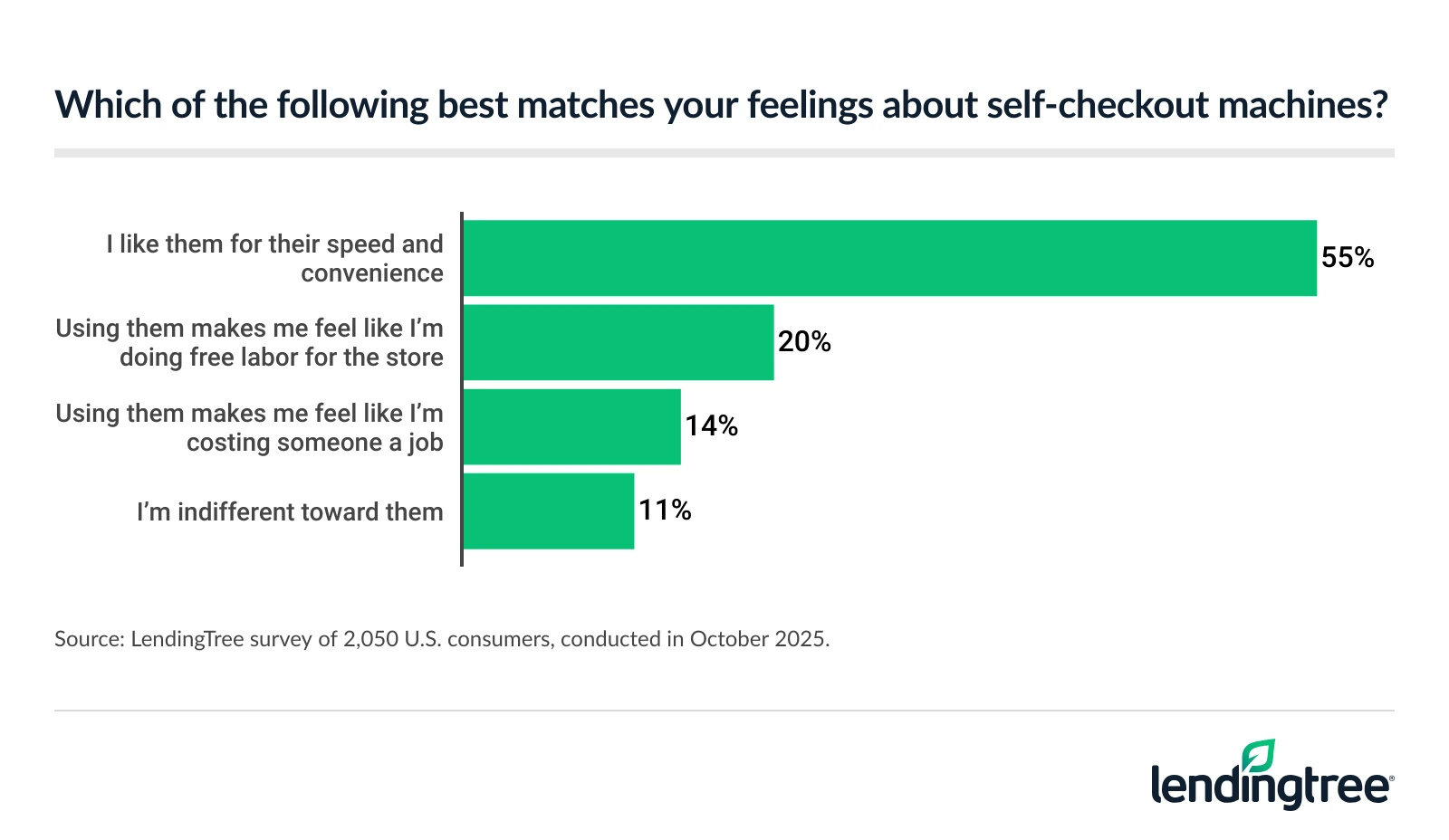
Regardless of their feelings, 69% of people who use self-checkout believe these systems make it easier to steal. This belief is especially common among older self-checkout users, at 77% among baby boomers ages 61 to 79 and 70% among Gen Xers ages 45 to 60.
Those concerns may not be unfounded, particularly as 35% of users have witnessed someone steal at a self-checkout, with 23% reporting such an incident in the past year.
Among those who witnessed theft, 42% notified someone in charge, 29% did nothing, 20% tried to stop the person and 7% called the police.
Not all theft is intentional
It’s not just about witnessing theft — many users also commit theft. In fact, 27% of self-checkout users have intentionally taken an item without scanning it. When we conducted this study in 2023, the figure was 15%, indicating that intentional theft has risen by a massive 12 percentage points in just two years.
By age group, millennials ages 29 to 44 (41%) and Gen Zers ages 18 to 28 (37%) are the most likely to have stolen intentionally at least once. Those with children younger than 18 (44%) and six-figure earners (40%) are also among the most likely to steal. And men (38%) are more than twice as likely to do so as women (16%).
Beyond intentional theft, 36% of self-checkout users admit they’ve accidentally left with an unscanned item, including 22% in the past year. Although they didn’t intentionally steal, a whopping 61% who’ve accidentally taken something say they kept it the last time. Meanwhile, 33% returned it and 6% don’t remember, at least specifically regarding the last time.
Although a significant portion of self-checkout users have accidentally swiped something, a majority (54%) consider themselves very diligent when scanning.
Theft is one thing, but accusations are another. Among self-checkout users, 14% say they’ve been accused of taking an item without scanning, even though they didn’t take anything. Meanwhile, 9% say they were accused and had taken something, and 7% say they weren’t accused despite having taken items.
Among those who’ve been rightfully accused of stealing, 87% say they put the items back, while 14% say they left with the items. (These percentages add to more than 100% due to rounding.)
Some believe stealing has become more difficult
Self-checkout theft may be on the rise, but some believe corporations are making it harder to swipe something. Of the self-checkout users who’ve purposefully taken an item, 42% say it’s become more difficult in the past year.
More employee monitoring (61%), cameras or AI‑assisted monitoring near kiosks (49%) and weight/scale verifications being more sensitive (42%) are the top reasons for believing in increased difficulty.
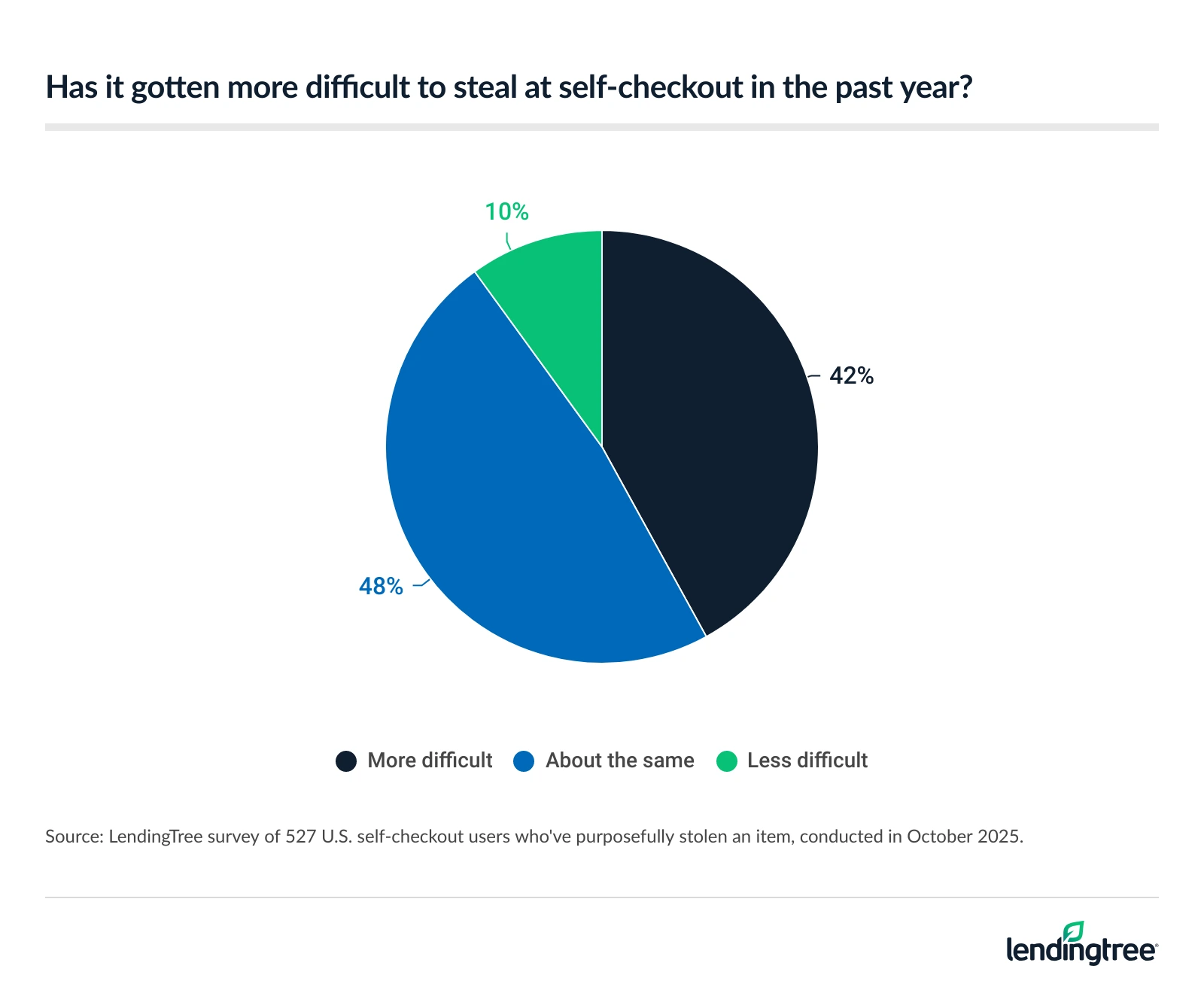
Meanwhile, 10% say it has become easier to steal.
High prices drive theft
Concerningly, theft is driven by necessity more than greed. Of intentional self-checkout swipers, 47% say they were motivated to steal because the current financial climate makes essentials unaffordable. Following that, 46% cite price increases tied to tariffs and 39% say prices feel unfair or too high.
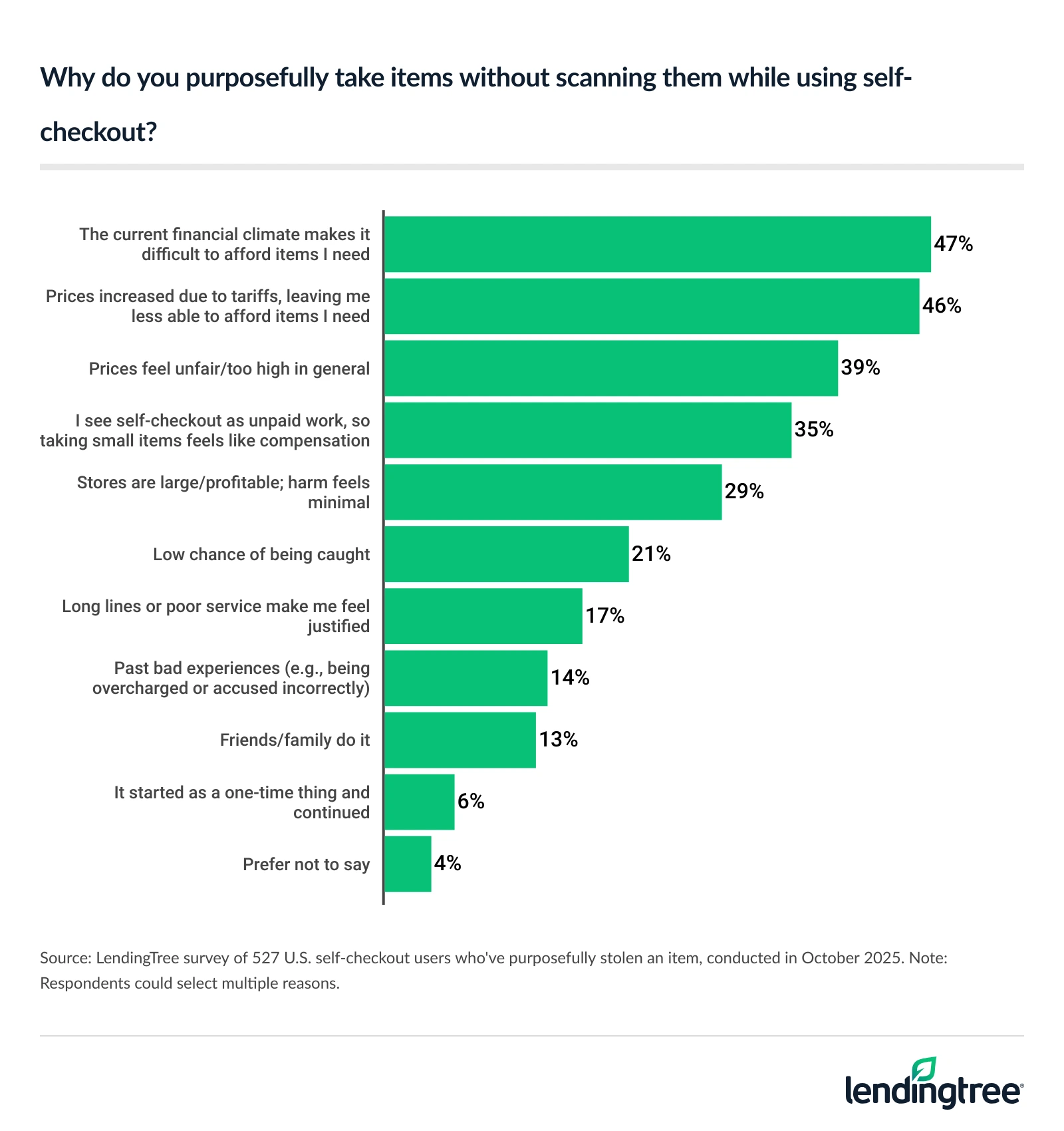
Matt Schulz — LendingTree chief consumer finance analyst and author of “Ask Questions, Save Money, Make More: How to Take Control of Your Financial Life” — says that indicates many people are struggling and are looking for ways to make their lives a little more affordable.
“Largely unattended self-checkouts provide a potential opportunity for folks to help themselves,” he says. “Even though people know that stealing is wrong and most understand the risk they’re taking, tough times require tough choices, and lots of people are clearly willing to take a risk.”
Even though people know that stealing is wrong and most understand the risk they’re taking, tough times require tough choices, and lots of people are clearly willing to take a risk.

Thieves are also most likely to take what they need, not just what they want. Of those who think they’ll steal again, 60% say they’re most likely to take essentials like food, water and health care products. Meanwhile, 33% say they’d steal the most expensive item in their cart.
Getting caught doesn’t always deter sticky fingers
Not everyone feels bad for stealing, even with the risk of getting caught. Among those who’ve intentionally stolen at self-checkout, 46% say they’ve been caught.
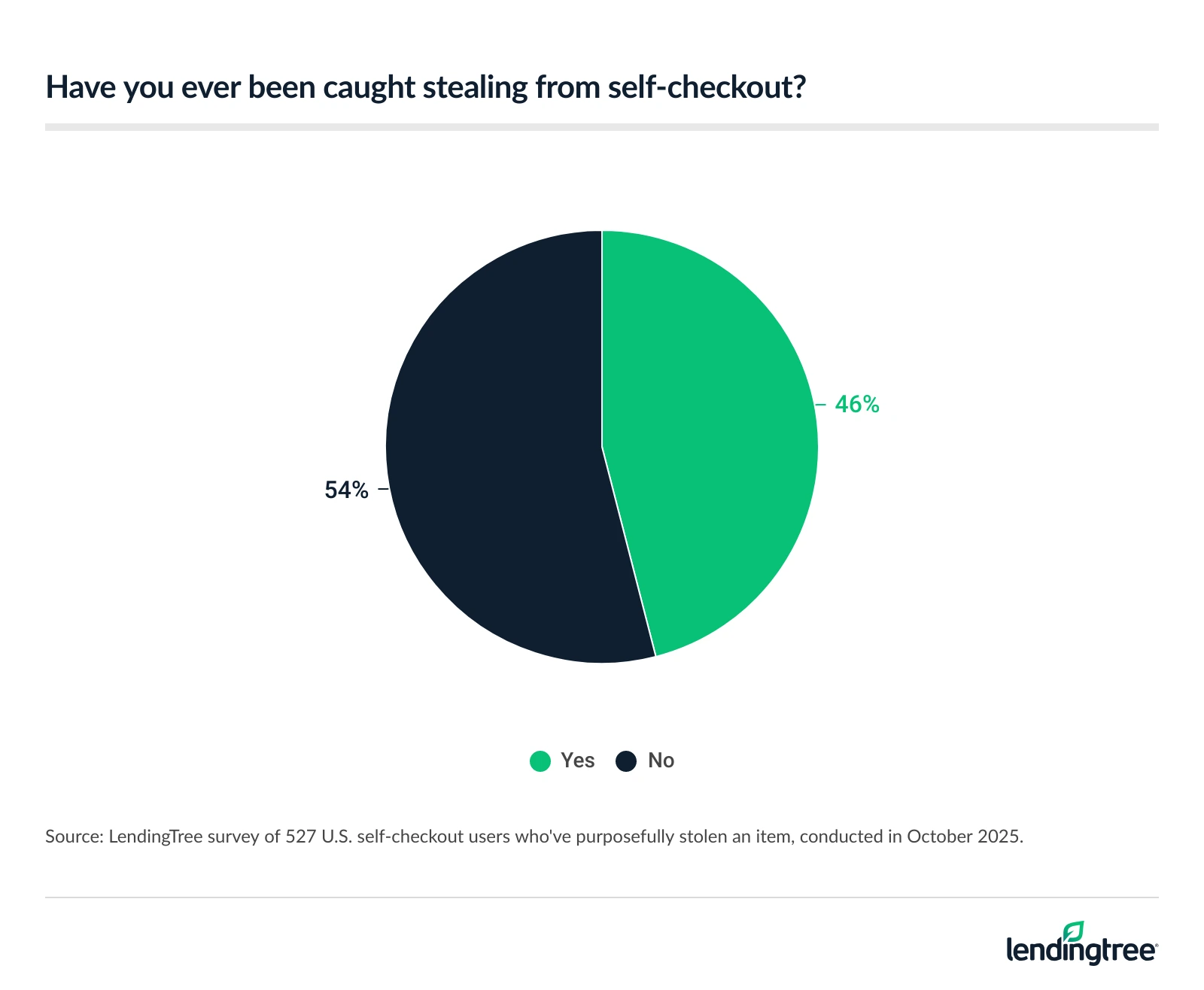
However, 31% of those who’ve stolen intentionally don’t feel remorseful. In fact, 55% say they think they’ll do it again.
Schulz says that may boil down to ongoing frustration with how expensive life is today, and how little hope people have that things will dramatically improve.
“People have watched prices rise for years, and often see retailers’ profits continue to rise, too,” he says. “They feel like if they walk out of a store without paying for a loaf of bread or a pint of ice cream that it won’t even amount to a rounding error for that company, but it could help make their life a little easier.”
Staying afloat amid high prices: Expert tips
With prices so high, it’s tempting to let an item slip by the scanner at self-checkout. For those struggling to make ends meet, Schulz recommends the following:
- Remember that stealing is wrong. “I get that people are frustrated, but no one should encourage people to walk away from a retailer without paying for something,” he says. “It just isn’t right.”
- Seek help in your community. “It can be hard to make yourself vulnerable in this way, but taking advantage of services in your community can help,” he says. “For example, a food bank near you can offer a much-needed helping hand in a difficult time.”
- Consider consolidating your debt. “If interest payments are wrecking your budget, take some steps to reduce them,” he says. “A 0% balance transfer credit card can work wonders if you have good credit. If you don’t, a debt consolidation personal loan can also help you. You can even call your card issuer and ask if they’d lower your interest rate on your credit card. It works more than you’d realize.”
Methodology
LendingTree commissioned QuestionPro to conduct an online survey of 2,050 U.S. consumers ages 18 to 79 from Oct. 9 to 13, 2025. The survey was administered using a nonprobability-based sample, and quotas were used to ensure the sample base represented the overall population. Researchers reviewed all responses for quality control.
We defined generations as the following ages in 2025:
- Generation Z: 18 to 28
- Millennials: 29 to 44
- Generation X: 45 to 60
- Baby boomers: 61 to 79
Get debt consolidation loan offers from up to 5 lenders in minutes