EMS Takes Nearly Twice as Long to Reach Fatal Crash Scenes in California as the National Average


After a fatal car crash, every minute matters. Across the U.S., the average EMS response time after a fatal crash is 10.0 minutes, according to LendingTree research — but that figure varies widely depending on where and when the crash happens.
In addition to going over our findings, we’ll explain how drivers can compare auto insurance quotes to make sure they have the right coverage in place before a crash.
- After a fatal car crash, the average EMS response time nationwide is 10.0 minutes.
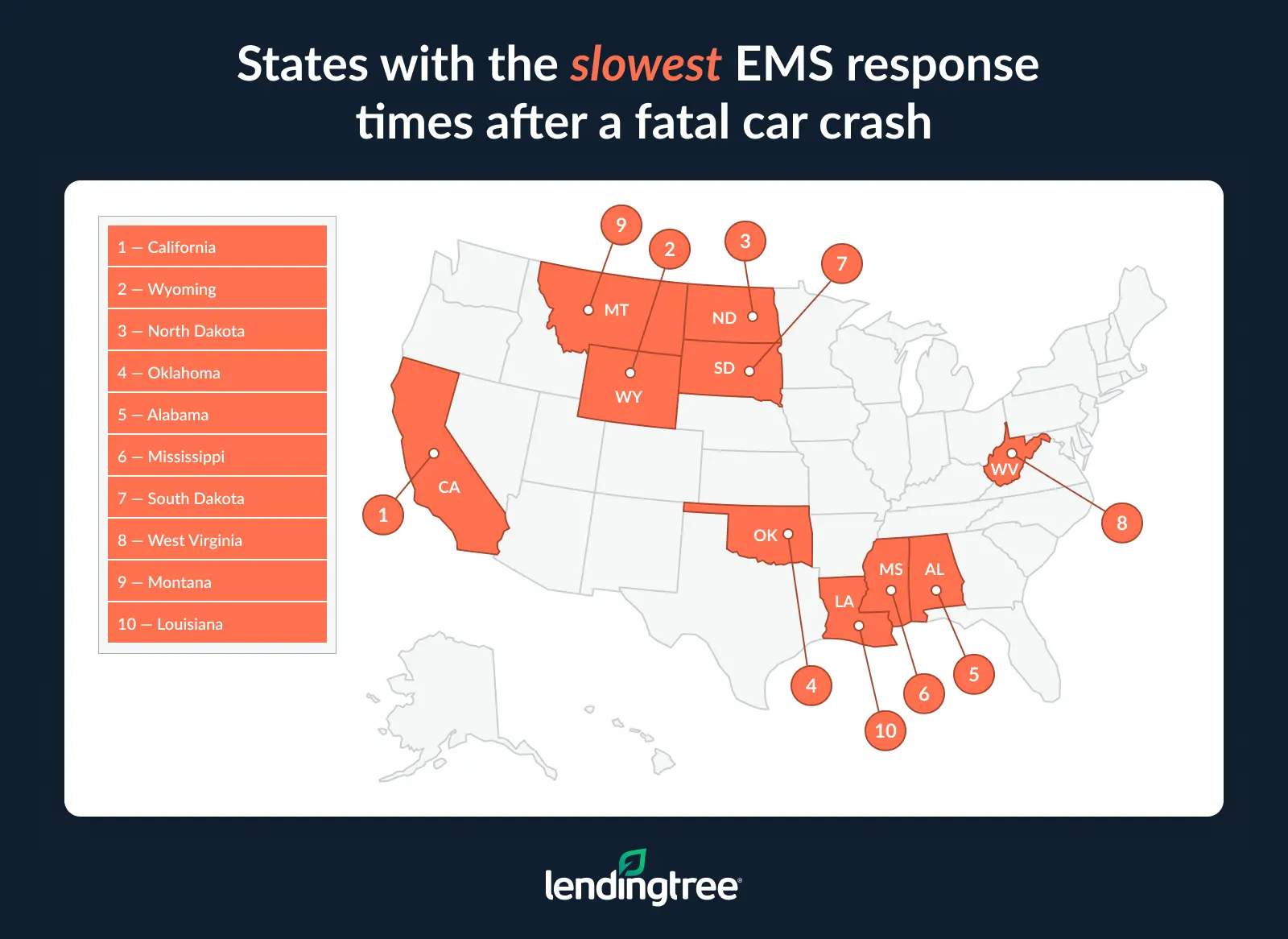
- California has the longest EMS response time after a fatal car crash. It takes an average of 19.6 minutes for EMS to arrive after a fatal crash in California — nearly double the national average. Wyoming (17.8) and North Dakota (15.7) rank next.
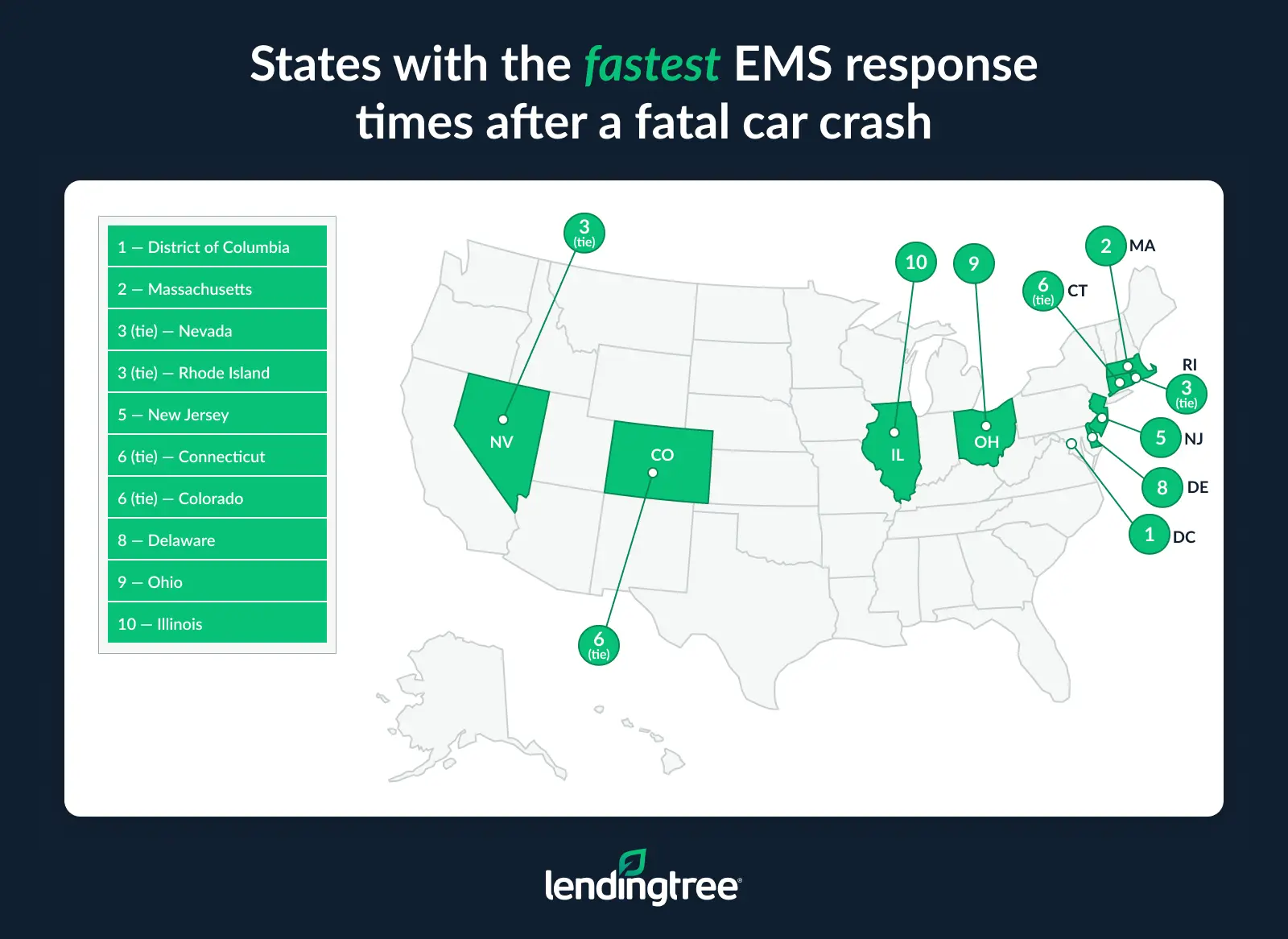
- The District of Columbia has the fastest response time. At an average of 4.7 minutes, D.C. is ahead of Massachusetts (6.4) and Nevada and Rhode Island (both 6.5).
- Location and time of day play a role in EMS response times. The average response time after a fatal crash in rural areas is 13.3 minutes, significantly more than the 7.6 minutes in urban areas. Additionally, the slowest response time is between 4 and 4:59 a.m., at 11.4 minutes, and the fastest is between 9 and 9:59 p.m., at 9.1 minutes.
EMS response times for fatal crashes average 10.0 minutes
The average emergency medical services (EMS) response time nationwide after a fatal car crash is 10.0 minutes. That’s the amount of time that elapses between getting notified of an emergency and arriving at the scene.
According to LendingTree auto insurance expert Lindsay Bishop, a 10-minute EMS response time is on the slower side of what emergency response standards aim for.
“In many cases, the goal is for the first emergency unit to arrive within about four minutes, with enough responders on scene to fully handle the situation within roughly eight to 10 minutes,” she says. “Those first few minutes can make a real difference after a serious crash. Faster emergency care can limit complications like severe bleeding, shock or lack of oxygen, which can affect survival and the long-term impact of injuries.”
From an insurance perspective, Bishop says those early minutes can also influence the overall cost of a crash. Accidents with severe injuries are the most expensive types of auto claims because they often involve lengthy hospital stays, rehab and long-term disability. The economic cost of a fatal crash averages about $1.9 million, while the cost of disabling injuries is around $167,000 on average, according to the National Safety Council.
“If faster EMS care reduces the severity of injuries or prevents complications, it can help lower the long-term medical and liability costs associated with a crash,” Bishop says.
EMS response time in California is nearly double the national average
Among states with available data, California has the longest EMS response time after a fatal car crash. On average, it takes 19.6 minutes for EMS to arrive at the scene of a fatal crash in California — nearly double the national average of 10.0 minutes.
Wyoming ranks second, with an average response time of 17.8 minutes, followed by North Dakota at 15.7 minutes.
(Note: South Carolina, Virginia and New Mexico didn’t have any data available for analysis.)
According to Bishop, longer response times can have real consequences for crash victims. They may go longer without critical care, which is particularly important in those early minutes. After serious trauma, complications like severe bleeding or oxygen deprivation can quickly worsen injuries.
When we compared state EMS response times with traffic safety data, states where emergency care takes longer to arrive tend to have higher death rates from crashes. According to the U.S. Department of Transportation, about 40% of people who die in fatal car crashes were still alive when EMS first responders arrived but later died. “While response time is only one factor influencing crash outcomes, it can affect whether severe injuries ultimately become survivable,” Bishop says.
Additionally, this data suggests a connection between response times and insurance costs tied to crash injuries. “Insurance data shows that several states with longer EMS response times, including California and Colorado, also report higher-than-average bodily injury claim severity,” Bishop says. “Because more serious injuries typically require longer hospital stays, rehab and ongoing care, they can lead to higher medical expenses and larger liability payouts for insurers.”
Meanwhile, the District of Columbia has the fastest EMS response time after a fatal car crash. On average, EMS arrives in 4.7 minutes — less than half the 10.0-minute national average.
Massachusetts ranks next, with an average response time of 6.4 minutes, followed by Nevada and Rhode Island, which tie at 6.5 minutes.
Full rankings: States with the slowest EMS response times
| Rank | State | Avg. EMS response time (minutes) |
|---|---|---|
| 1 | California | 19.6 |
| 2 | Wyoming | 17.8 |
| 3 | North Dakota | 15.7 |
| 4 | Oklahoma | 15.5 |
| 5 | Alabama | 14.5 |
| 6 | Mississippi | 14.2 |
| 7 | South Dakota | 13.4 |
| 8 | West Virginia | 13.1 |
| 9 | Montana | 12.9 |
| 10 | Louisiana | 12.0 |
| 11 | Idaho | 11.7 |
| 12 | Tennessee | 11.3 |
| 13 | Iowa | 11.2 |
| 14 | Missouri | 11.1 |
| 15 | Arkansas | 10.9 |
| 16 | Maine | 10.8 |
| 17 | Vermont | 10.6 |
| 18 | Washington | 10.5 |
| 19 | Indiana | 10.4 |
| 20 | Arizona | 10.3 |
| 20 | Texas | 10.3 |
| 20 | Utah | 10.3 |
| 23 | Kentucky | 10.2 |
| 24 | Alaska | 10.1 |
| 25 | Oregon | 10.0 |
| 26 | Georgia | 9.6 |
| 26 | Maryland | 9.6 |
| 28 | Kansas | 9.5 |
| 28 | Minnesota | 9.5 |
| 28 | North Carolina | 9.5 |
| 28 | Wisconsin | 9.5 |
| 32 | Hawaii | 9.3 |
| 33 | New Hampshire | 9.2 |
| 34 | Pennsylvania | 9.0 |
| 35 | Florida | 8.7 |
| 36 | Nebraska | 8.6 |
| 37 | Michigan | 8.5 |
| 38 | New York | 8.4 |
| 39 | Illinois | 8.3 |
| 40 | Ohio | 8.2 |
| 41 | Delaware | 7.5 |
| 42 | Colorado | 7.4 |
| 42 | Connecticut | 7.4 |
| 44 | New Jersey | 7.3 |
| 45 | Rhode Island | 6.5 |
| 45 | Nevada | 6.5 |
| 47 | Massachusetts | 6.4 |
| 48 | District of Columbia | 4.7 |
Location and time of day matter
Where and when a crash happens can also influence how quickly EMS arrives. After a fatal crash, the average EMS response time in rural areas is 13.3 minutes, compared with 7.6 minutes in urban areas.
Bishop believes that longer response times in rural areas can create additional challenges for crash victims.
“In rural crashes, victims often wait longer for emergency care and must travel farther to reach a hospital,” she says. “For example, in Texas, EMS takes nearly 14 minutes to arrive on the scene of rural crashes and doesn’t arrive at the hospital until over an hour after the accident. But victims of urban accidents in Texas get help within about nine minutes of an accident and are at the hospital about 39 minutes after the crash.”
This gap also helps explain why rural crashes tend to be more costly for insurance companies. Victims of rural crashes are more likely to have complications due to delayed medical care.
Average EMS response time by time of day
| Time of day | Avg. EMS response time (minutes) |
|---|---|
| Midnight-12:59 a.m. | 9.4 |
| 1-1:59 a.m. | 10.1 |
| 2-2:59 a.m. | 9.9 |
| 3-3:59 a.m. | 11.3 |
| 4-4:59 a.m. | 11.4 |
| 5-5:59 a.m. | 11.0 |
| 6-6:59 a.m. | 10.5 |
| 7-7:59 a.m. | 10.4 |
| 8-8:59 a.m. | 10.2 |
| 9-9:59 a.m. | 10.1 |
| 10-10:59 a.m. | 10.2 |
| 11-11:59 a.m. | 10.3 |
| Noon-12:59 p.m. | 10.3 |
| 1-1:59 p.m. | 10.1 |
| 2-2:59 p.m. | 10.4 |
| 3-3:59 p.m. | 10.5 |
| 4-4:59 p.m. | 10.6 |
| 5-5:59 p.m. | 9.7 |
| 6-6:59 p.m. | 9.8 |
| 7-7:59 p.m. | 9.3 |
| 8-8:59 p.m. | 9.4 |
| 9-9:59 p.m. | 9.1 |
| 10-10:59 p.m. | 9.7 |
| 11-11:59 p.m. | 10.0 |
Time of day also affects response times. The slowest average EMS response time occurs between 4 and 4:59 a.m., at 11.4 minutes, while the fastest occurs between 9 and 9:59 p.m., at 9.1 minutes.
Bishop says early morning crashes may also be more dangerous because of driver fatigue and road conditions. Crashes caused by drowsy drivers occur most frequently between midnight and 6 a.m., or in the late afternoon. These are times when the body’s natural sleep cycle makes drivers less alert.
“There also tends to be less traffic in the early morning hours, which can sometimes lead to higher speeds on open roads,” she says. “When crashes happen at higher speeds, they’re more likely to result in severe injuries or death.”
From an insurance perspective, fatigue and higher travel speeds on less congested roads can contribute to more serious injuries, greater vehicle damage and higher medical and liability costs.
Staying safe on the road: Top expert tips
While drivers can’t control emergency response times, these findings underscore the importance of being financially prepared for the unexpected — and also taking steps to lower your crash risk. We offer the following advice:
- Always adjust your driving to the situation. “Crashes in rural areas or late at night often involve higher speeds and longer EMS response times,” Bishop says. “Slowing down, avoiding impaired or drowsy driving and staying alert on less busy roads can help reduce risk.”
- Make sure you have enough insurance coverage. “Higher liability limits, uninsured or underinsured motorist coverage and medical payments coverage or personal injury protection can help protect you if a crash leads to serious injuries,” she says.
- Use safety tools and plan ahead. “Vehicles with safety features like automatic emergency braking or crash notification can help prevent crashes or alert responders faster,” she says. “Wearing a seat belt, keeping your phone charged and sharing your route on long trips can also help you get assistance more quickly if something goes wrong.”
Methodology
LendingTree researchers used the National Highway Traffic Safety Administration (NHTSA) Fatality Analysis Reporting System (FARS) public federal database of fatal traffic crashes in 2022 and 2023 — the latest available — to estimate how quickly emergency medical services (EMS) reach fatal crash scenes after EMS is notified.
For every fatal crash record that included usable timestamps, researchers calculated the number of minutes between “EMS notified” and “EMS arrived at the scene.” Researchers then summarized those response times by state, location (rural or urban) and time of day.
For state data, South Carolina, Virginia and New Mexico didn’t have data available for analysis.