Most Americans Think They’re Good Drivers, but Some Have Risky Habits


Most of us think we’re good drivers — an anecdotal observation that’s backed up by a LendingTree survey of 2,015 U.S. consumers.
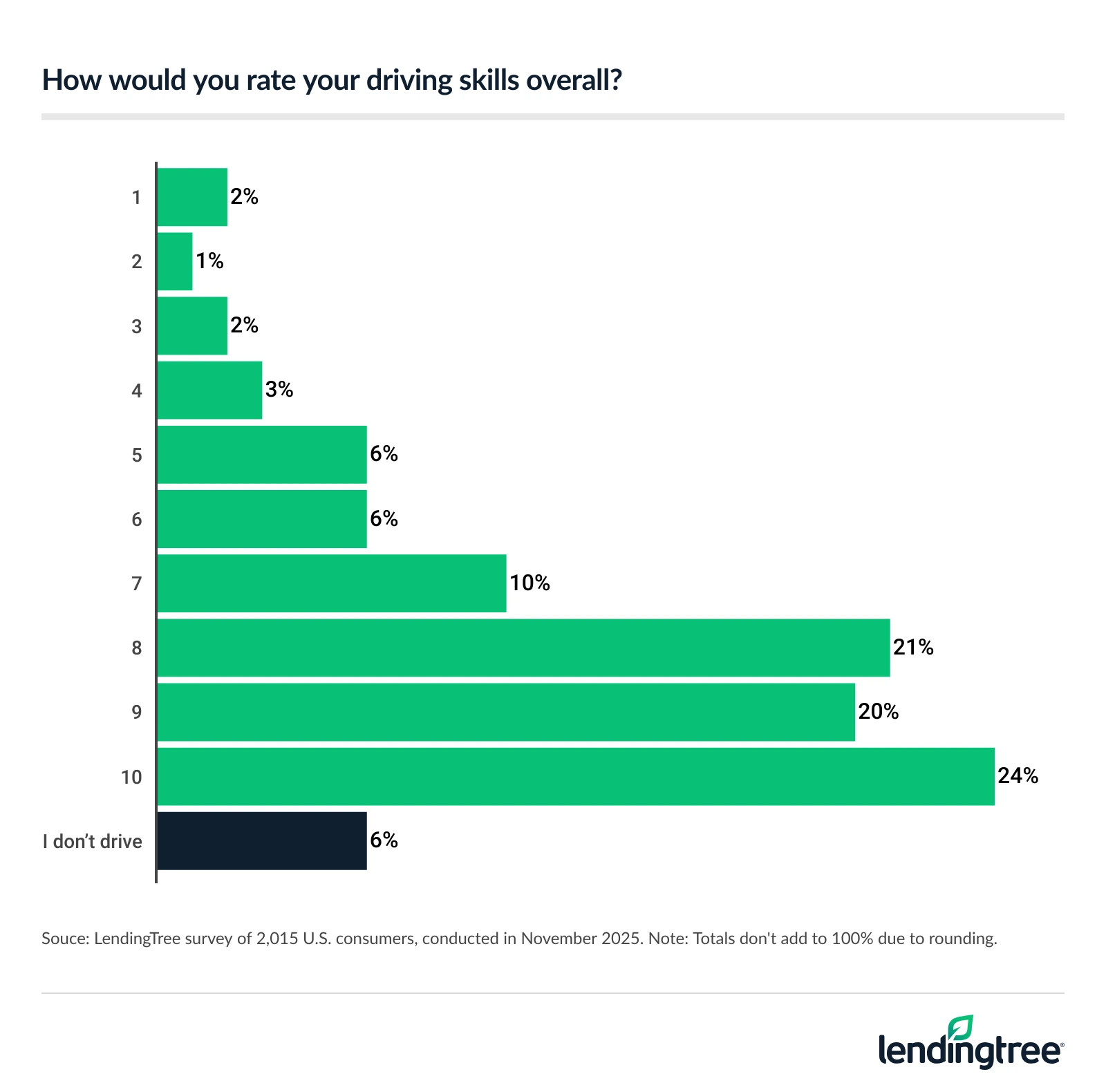
But while more than half of drivers (54%) describe their skills as above-average, and almost three-quarters of Americans (74%) rate their driving as 7 or higher out of 10, more than half of drivers (54%) admit to having caused an accident.
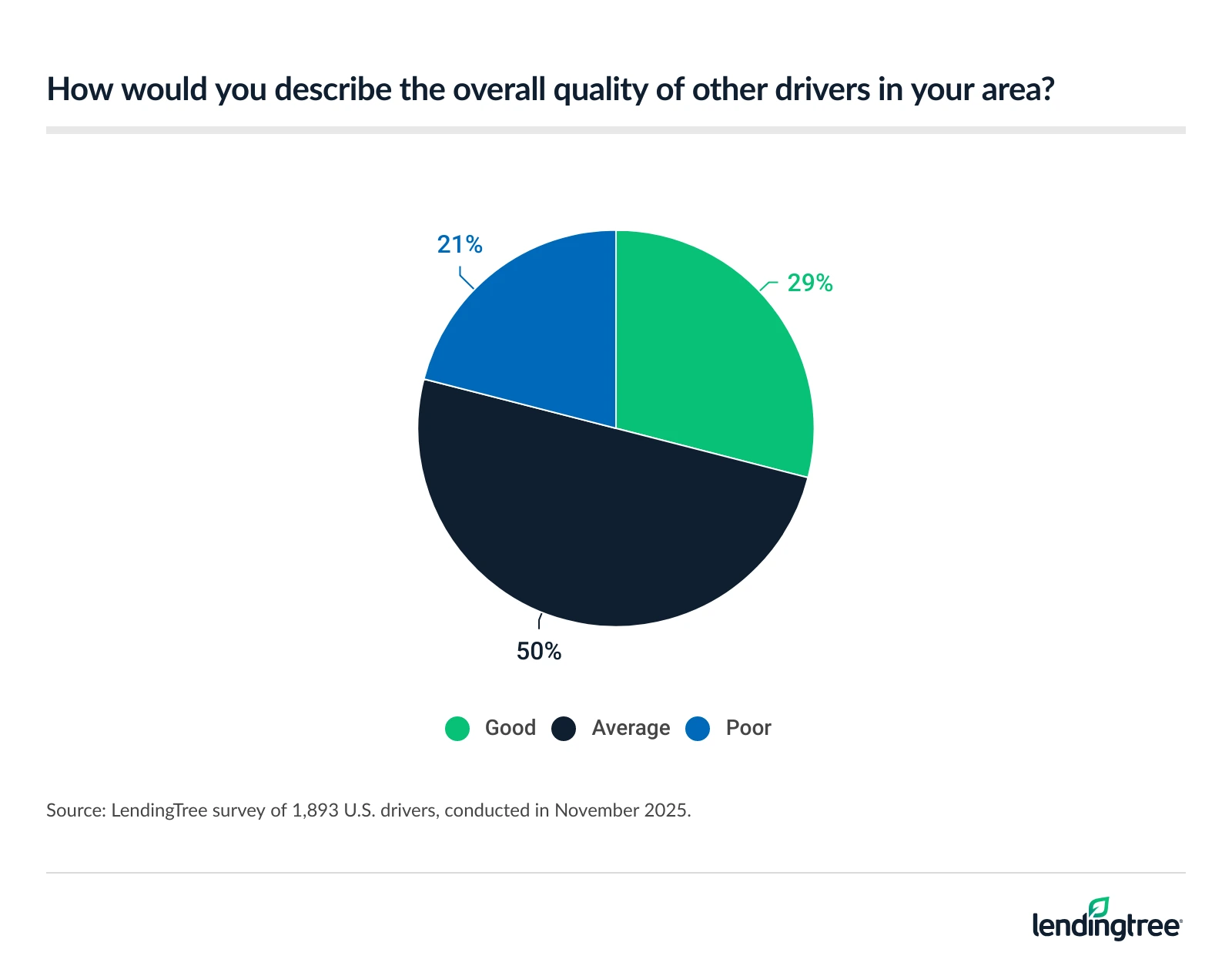
Meanwhile, drivers’ confidence behind the wheel doesn’t extend to others on the road, with 50% of drivers describing the skills of other drivers in their area as average, and 21% describing them as poor. Below, see our full findings.
Key findings
- Most Americans see themselves as good drivers. On a scale of 1 to 10, 74% rate their driving a 7 or higher. Of this group, having experience (76%), following traffic laws (68%) and avoiding accidents (59%) are cited as the top reasons for driving confidence. Additionally, 54% of drivers describe themselves as above-average compared to others on the road.
- On the road, confidence is high — just not in the other driver. 50% of drivers would describe other drivers in their area as average, while 21% would describe them as poor. Additionally, 34% of drivers believe that others on the road make unsafe or illegal maneuvers near them often, and 48% believe that driving in their area has gotten less safe over the past few years.
- Many drivers have risky habits. 29% of drivers admit to checking their phone at least sometimes while driving, with 48% of Gen Z drivers reporting this behavior. Other common risky actions while driving include eating or drinking (40%), searching for music or podcasts (28%), taking calls (26%) and adjusting the GPS (23%).
- More than half admit fault for an accident. 54% of drivers say they’ve been in an accident that they caused. Further, 45% of drivers say they exceed the speed limit by more than 10 mph on the highway at least sometimes, while 38% do in their local area.
Many Americans consider themselves good drivers
When asked to rank their driving skills on a scale of 1 to 10, the majority of Americans put themselves in the highest caliber. In the survey, a 10 response garnered the highest share of respondents (24%), and nearly three-quarters (74%) rated themselves a 7 or higher.
Along the same lines, more than half of drivers (54%) say their driving skills are above average, with another 41% calling their skills about average. Although it’s definitionally impossible, only 3% of respondents admit to having below-average driving skills, while another 2% are unsure. Interestingly, men are far more likely to rate themselves as above-average drivers (64%) than women (45%).
About 9 in 10 drivers (90%) describe their style as cautious, while the remaining 11% admit that their driving is aggressive. And 68% claim that they aren’t backseat drivers — though women are more likely to admit they are (40%) than men (24%). Of the demographics in this survey, Gen Zers ages 18 to 28 are the most likely to self-describe as backseat drivers, with 41% of them admitting to doing it.
Drivers aren’t confident in others on the road
Although U.S. drivers’ self-confidence is high, their confidence in their fellow drivers isn’t. Only 29% of drivers would describe the skills of other drivers in their area as good, while 50% say they’re about average. The remaining drivers — 21% — say the skills of the other drivers in their area are poor.
Further, most drivers believe that others around them regularly make unsafe or illegal maneuvers: 34% say this happens often, while 55% say it happens sometimes. Only 9% say it happens rarely, and a tiny 2% say it never occurs. (Note that these reports are at odds with the way the vast majority of drivers describe themselves as cautious rather than aggressive.)
Most drivers also deny any occurrence of road rage: When other drivers make mistakes, say 61% of respondents, they remain calm and focused. Another 37% say they get frustrated but don’t outwardly react. Only about 3% admit to honking, yelling or retaliating.
Many drivers (48%) also believe that driving has gotten less safe in their area over the past few years. About one-third (32%) believe the safety level has stayed static, while only 21% believe it’s gotten safer. That’s despite the fact that vehicle safety technology, like driver behavior monitoring, continues to evolve and improve, and that motor vehicle traffic-related deaths fell year-over-year in 2023 and 2024.
Drivers have risky habits
As confident as they may be that they’re skilled, safe drivers, many respondents admit to risky driving habits — including checking their phone. Overall, 29% of drivers say they check their phone at least sometimes while driving, with 8% admitting to checking it often.
Perhaps unsurprisingly, younger generations are substantially more likely to check their phone at least sometimes while driving: 48% of Gen Zers admit to doing so, as do 41% of millennials ages 29 to 44. (That’s compared with 23% of Gen Xers ages 45 to 60 and only 6% of baby boomers ages 61 to 79.)
Another demographic likely to check their phone while driving: the parents of children under 18. In fact, 45% of respondents in this group do so at least sometimes, and 14% admit to checking their phone often on the road — the highest of any studied group.
Men are also substantially more likely than women to check their phones regularly while driving — 34% say they do so at least sometimes, compared to women’s 24%. Meanwhile, 11% of men check their phones often while driving, more than double the rate of women (5%) who say the same.
Alongside phone checking, drivers also admit to a variety of other potentially distracting behaviors on the road, including eating and drinking (40%), searching for music or podcasts on their phone or car radio (28%), taking calls (26%) and adjusting the GPS (23%).
Another note of interest: Gen Z respondents are far more likely than any other age group to admit to reaching for something in the back seat while driving. While 18% of Gen Zers say they do this, only 12% of millennials, 7% of Gen Xers and 2% of boomers admit to doing the same.
Further, more than half of drivers (53%) say they’ve never completed a defensive driving course — and only 18% have done so in the past year. One of the biggest incentives for doing so, according to our respondents? Insurance discounts, with 28% of drivers who have taken a defensive driving course saying their primary reason for doing so was saving some money on their premiums. Other reasons high on the list include improving driving skills (27%) and getting a ticket dismissed or points reduced (15%).
Drivers also report relatively quiet roadways in terms of horn-honks. About half (48%) say they only rarely get honked at, and 26% say it never happens to them. Meanwhile, 21% say they sometimes get honked at, and 6% admit it happens often. Drivers are slightly more likely to admit that they honked at others, however, with 8% saying they do so often and 24% saying they do so sometimes. Still, 44% say they do so rarely, and 25% say they never do.
Some drivers have been told they’re bad at it
Although the drivers we surveyed are largely confident in their abilities, nearly 1 in 5 — 17% — have been directly told that they’re bad drivers. (The share of drivers who’ve been told so goes up to 30% among Gen Z respondents.)
The people brave enough to say this to respondents varied, with family members leading the way (50%). Partners were next-likeliest to let surveyed drivers know they weren’t great at driving (40%), followed by friends (38%) and acquaintances (11%).
However, drivers are likely to claim that they’ve become more careful in their driving over the past five years, with 65% of respondents saying as much. Another 29% say their driving hasn’t changed at all over the last half-decade, while only 6% admit they’ve become less careful.
54% of drivers have been in an accident they caused
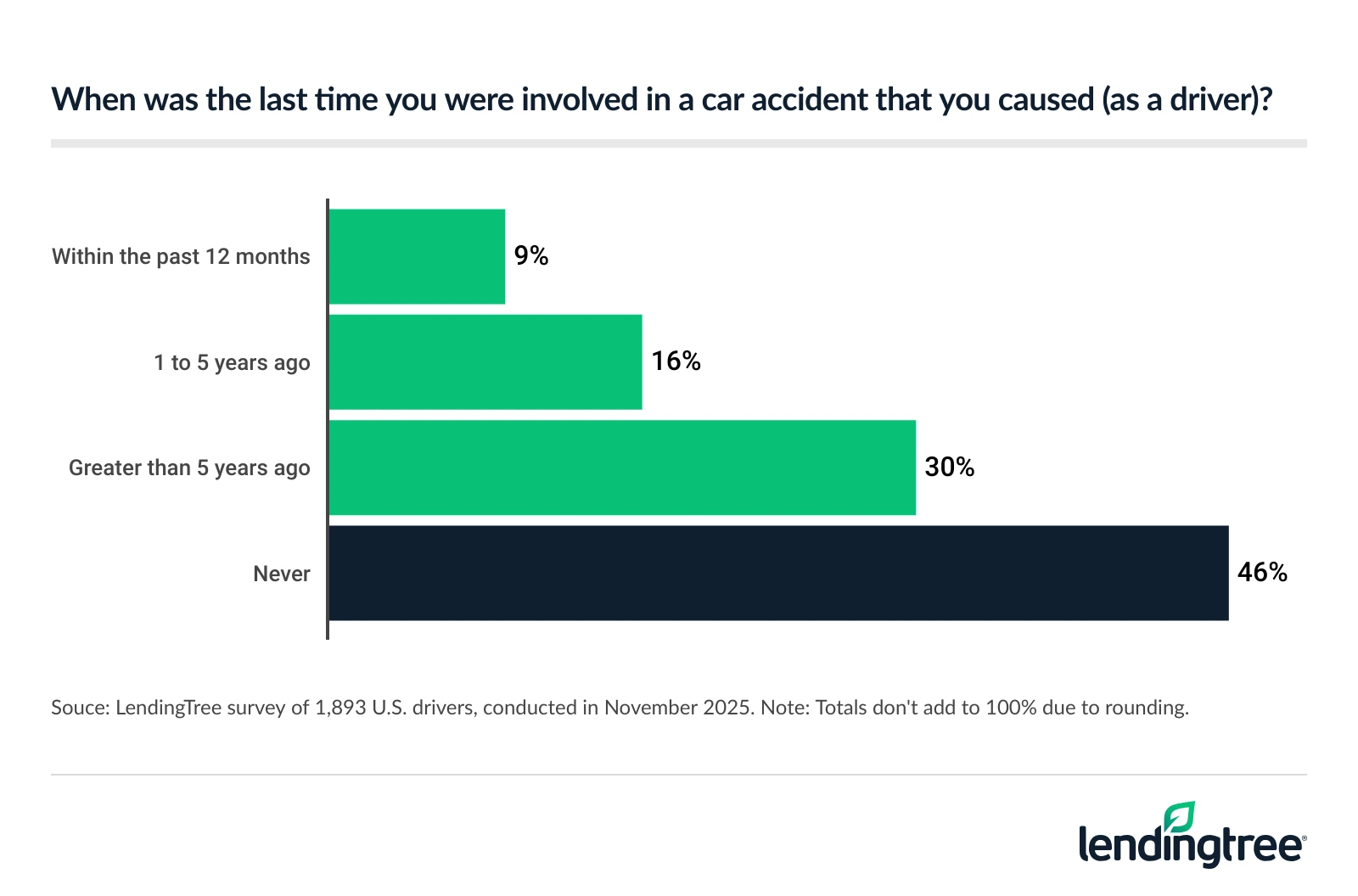
One bit of good news: 46% — or nearly half — of surveyed drivers say they’ve never been in a car accident they’ve caused. Another 30% say they have, but not in the past five years, while about 25% have caused a more recent accident.
Still, that means the majority of respondents, or 54%, have been at fault in a car accident.
On the whole, drivers say that if they were to be at fault in an accident, they’d be likely to admit so: 56% say they’d very likely admit their fault, while 32% say it’s somewhat likely they’d do so. (A bold 5% of respondents say they’d never admit fault.)
Drivers often hear that speed kills, yet most drivers we surveyed admit to speeding. Less than half (45%) say they go more than 10 mph above the speed limit on the highway at least sometimes, with men and younger generations more likely to speed often in comparison to women or older generations.
Speeding rates drop for local driving, however: Only 38% of drivers say they sometimes or often exceed the speed limit by more than 10 miles per hour on smaller local roads. Again, men and younger respondents are more likely than their counterparts to say they sometimes or often do so.
Being a good driver (and not just calling yourself one): Top tips
Thinking you’re a good driver is one thing, but walking (or driving) the talk is another. Here are our top tips for drivers looking to increase their skills and stay safe on the road:
- Stay sober. It might sound obvious, but almost a third of traffic crash fatalities in the U.S. (30%) involve drunken drivers, according to the National Highway Traffic Safety Administration (NHTSA). In 2023, more than 12,000 people died unnecessarily in such crashes, which are entirely preventable. If you’re going to a party or a bar, take an Uber or a cab, or elect a designated driver. Along with the potentially fatal results, if you’re caught driving under the influence, a DUI can cause your insurance rate to skyrocket. That means there’s a financial reason to avoid the scenario, along with a safety one.
- Put the phone down. It’s hard to ignore how prevalent mobile technology has become in our lives, and with features like GPS and streaming music, it seems natural to bring phones into our cars, too. But phones can also be incredibly distracting, and distracted driving is one of the primary causes of traffic-crash-related deaths. Along with injuring or killing yourself or others in motor vehicles, distracted driving also has devastating consequences for pedestrians and cyclists — according to the Federal Communications Commission (FCC), more than 600 were killed in car crashes that were the result of distracted driving in 2023 alone.
- Use insurance discounts as motivation. These days, driving better can save you money. “Many car insurance companies have safe driving programs, also called usage-based or telematics programs, that offer discounts if you have good driving habits,” explains Lindsay Bishop, LendingTree auto insurance expert and former auto insurance agent. “The companies outline the behaviors that they track, which gives a clear picture of what insurance companies believe makes a good driver. Most companies consider things like speeding, hard braking, cornering and driving late at night,” she explains. “Some also penalize you for using your phone while driving, even if it’s in hands-free mode” — yet another reason to leave it out of your driving experience entirely.
Methodology
LendingTree commissioned QuestionPro to conduct an online survey of 2,015 U.S. consumers ages 18 to 79 from Nov. 5 to 10, 2025. The survey was administered using a nonprobability-based sample, and quotas were used to ensure the sample base represented the overall population. Researchers reviewed all responses for quality control.
We defined generations as the following ages in 2025:
- Generation Z: 18 to 28
- Millennial: 29 to 44
- Generation X: 45 to 60
- Baby boomer: 61 to 79