Fewer Americans Buying Mother’s Day Gifts, but Those Who Do Spend More


Mother’s Day is around the corner, but rising prices may mean there’s less to unwrap this year. A LendingTree survey found that while Mother’s Day gift-giving remains the norm, more people plan to skip it this year. (Sorry, Mom.)
The holiday is also likely to hit wallets hard. Of those planning to give a gift this Mother’s Day, more than half say they might spend more than they can afford this year — largely due to inflation.
Read on for a closer look at the dollars and decisions shaping Mother’s Day gifting (or lack thereof) in 2026 — and how those trends have shifted in recent years.
- Fewer Americans are buying Mother’s Day gifts, but those who do plan to spend slightly more. 66% of Americans plan to give a gift this year, down from 71% last year. Among gift-givers, average spending is expected to hit $153, up from $148 in 2025.
- Inflation is driving higher Mother’s Day spending. More than a third (36%) of gift-givers say they’ll spend more this year. Inflation is the biggest factor influencing Mother’s Day budgets, cited by 40% of those who expect their spending to change, followed by changes in personal finances (21%).
- Many Americans may overspend to celebrate Mom. More than half (55%) of gift-givers say they may spend more than they can afford on Mother’s Day gifts, up from 50% last year. While 54% plan to pay with cash or debit, 25% say they’ll use a credit card, and nearly 1 in 10 (9%) will use buy now, pay later (BNPL) financing.
- Classic Mother’s Day gifts remain the most popular. Flowers or plants top the list, with 45% of gift-givers planning to give them. Cards or letters follow at 37%, while 33% plan to give physical gifts such as jewelry, clothing, beauty products or electronics. Another 32% say they’ll give gift cards or cash.
Fewer Americans are buying Mother’s Day gifts, but those who do plan to spend more
Fewer Americans plan to buy Mother’s Day gifts this year. Just 66% say they’ll purchase a present in 2026, down from 71% in 2025.
More women than men — 39% versus 30%, respectively — say they don’t plan to purchase a Mother’s Day gift this year. More baby boomers ages 62 to 80 (52%) than Gen Xers ages 46 to 61 (37%), millennials ages 30 to 45 (26%) and Gen Zers ages 18 to 29 (21%) say they won’t purchase one.
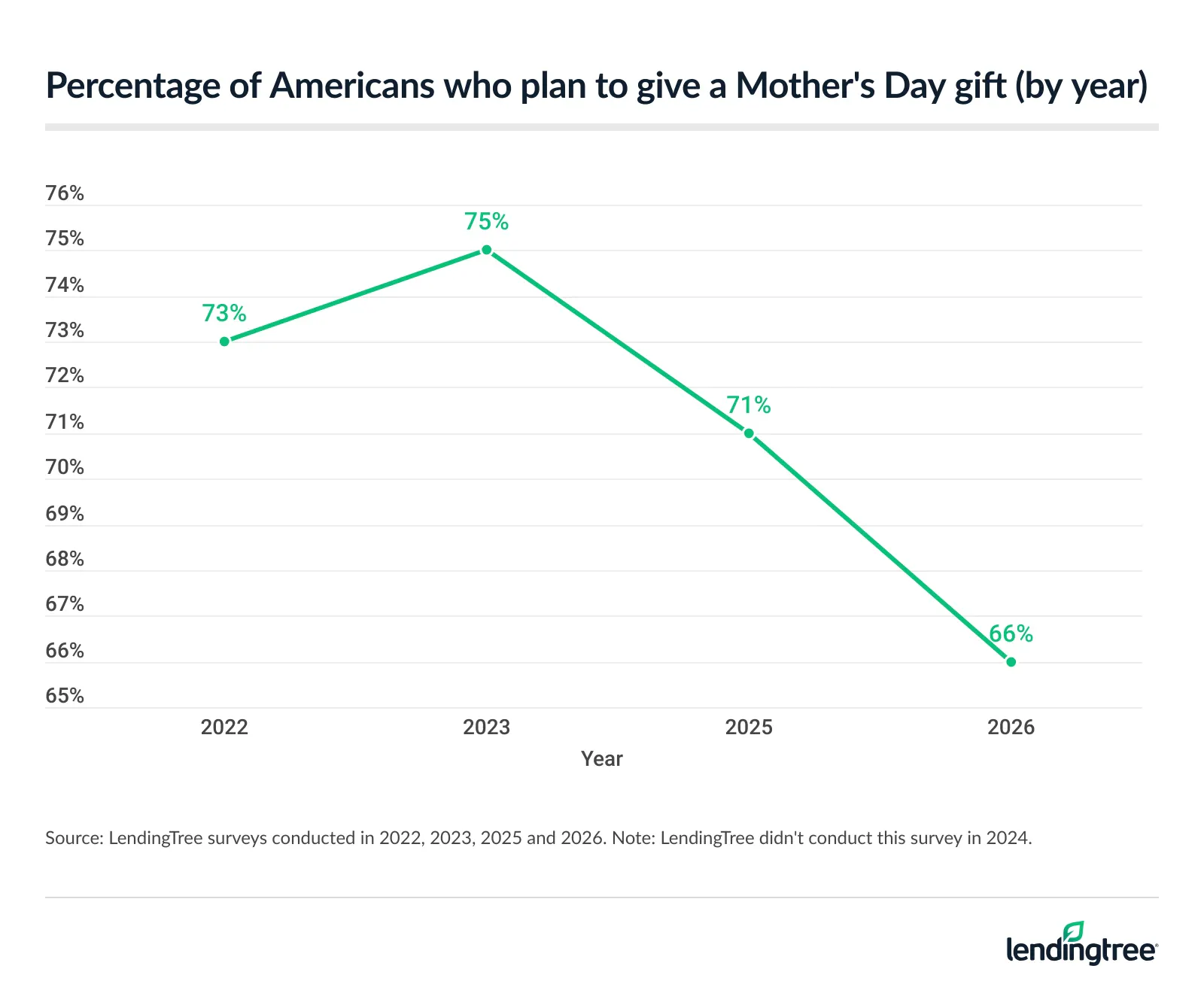
This year’s results include a minor methodological update to better capture respondent sentiment. In addition to “yes” and “no” responses, we introduced a “not sure yet” option. For year-over-year comparability, respondents who selected “not sure yet” are grouped with those who indicated they don’t plan to give a gift. This approach ensures continuity with prior years while acknowledging increased uncertainty in consumer intent.
Among those who are planning to give gifts, spending is expected to rise slightly. The average projected spend is $153, up from $148 in 2025, but still below 2023 ($172) and 2022 ($225).
Men plan to spend considerably more than women on Mother’s Day gifts — $190 versus $113, respectively. Gen Zers plan to spend more than any other generation — $186, versus $168 for millennials, $134 for Gen Xers and $114 for baby boomers.
With regard to parenting status, those with children younger than 18 plan to spend the most this year — $217, versus $114 for those with children 18 or older and $118 for those with no children. Higher-income households also plan to spend more: Those earning $100,000 or more expect to spend $230, while those earning less than $30,000 plan to spend $88.
These spending patterns reflect a “K-shaped” economy, according to Matt Schulz, LendingTree chief consumer finance analyst and author of “Ask Questions, Save Money, Make More: How to Take Control of Your Financial Life.”
“Some people are thriving and easily able to deal with the higher prices to spoil Mom on the big day, while others have simply been stretched past their limit and are going to sit this one out,” Schulz says. “It’s hard because no one wants to skimp on gifts for their mom, but unfortunately, tough times force sacrifices, and Mother’s Day spending is likely to be one of them for many Americans.”
Inflation is reshaping Mother’s Day budgets
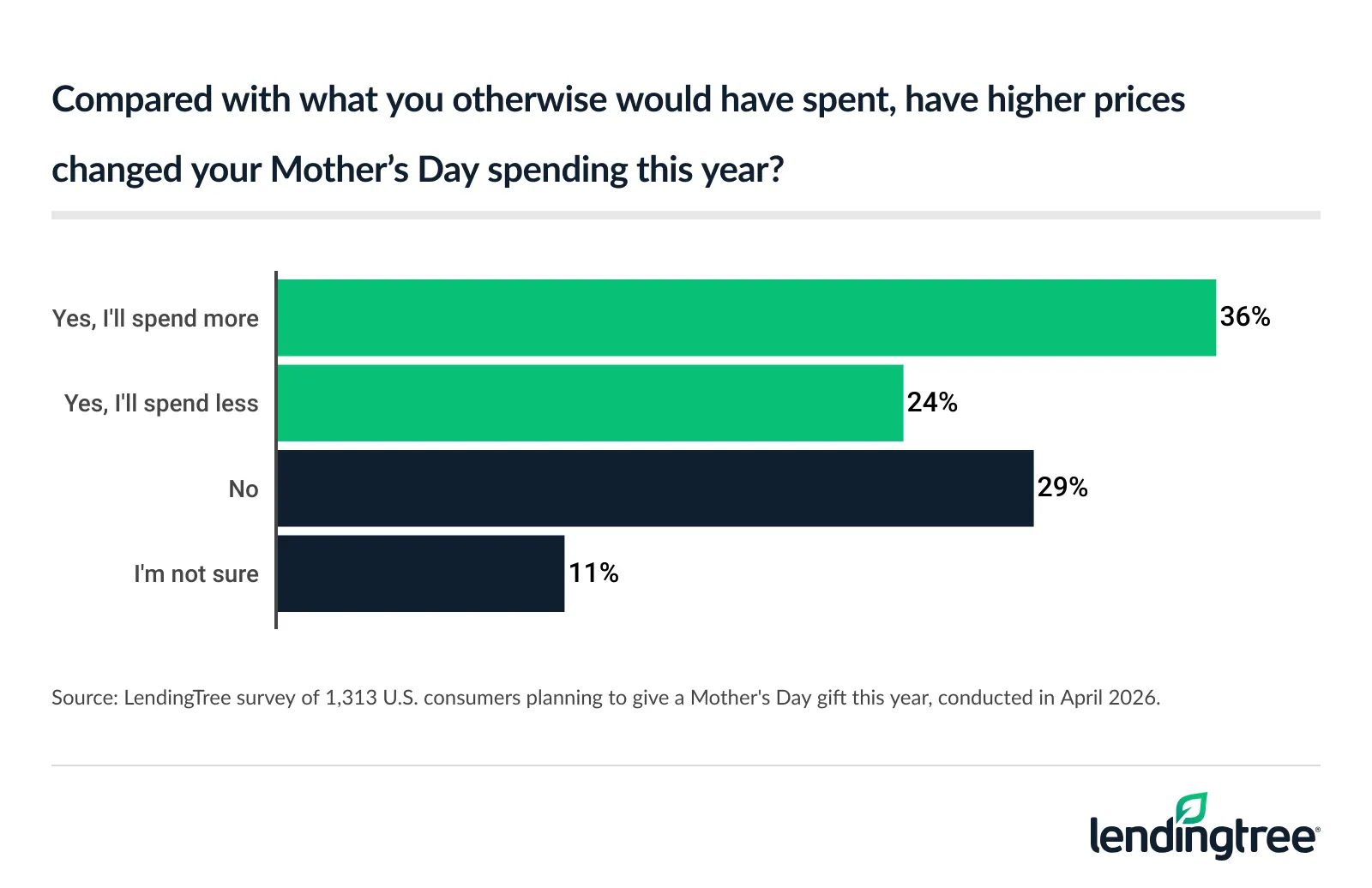
Higher prices are affecting Mother’s Day spending habits for many in different ways. When asked whether higher prices will change how much they’re planning to put toward Mother’s Day gifts, more than a third (36%) of gift-givers said they’ll spend more this year, while 24% said they’ll spend less. Just under a third (29%) said inflation won’t change their spending habits, while 11% were unsure.
Of all the demographics, those with children younger than 18 (51%) are the most likely to say they’re planning to spend more this year due to higher prices. That compares with 20% of those with children 18 or older and 31% of those with no children who say the same.
Compared with last Mother’s Day, spending expectations are mixed. Nearly 4 in 10 (39%) Americans say they plan to spend about the same amount this year, while 16% plan to spend somewhat more and 13% plan to spend much more than they did in 2025. Only 4% plan to spend much less than last year, while 6% plan to spend somewhat less. Nearly a quarter (23%) didn’t spend any money on Mother’s Day at all last year.
Inflation is the primary driver behind changes in spending. Among those who expect their spending to change, 40% cite inflation as the reason, while 21% point to changes in personal finances.
Schulz says he’s not surprised by inflation’s role in Mother’s Day spending, as rising costs are forcing many people to be more selective about where their money goes.
“It’s all about spending on what matters to you most and often forgoing the rest,” Schulz says. “Everyone has different priorities, of course, and people may value different holidays more or less than others. However, Mother’s Day isn’t a holiday that most people want to skip if they’re lucky enough to still have Mom around.”
Many gift-givers risk spending more than they can afford
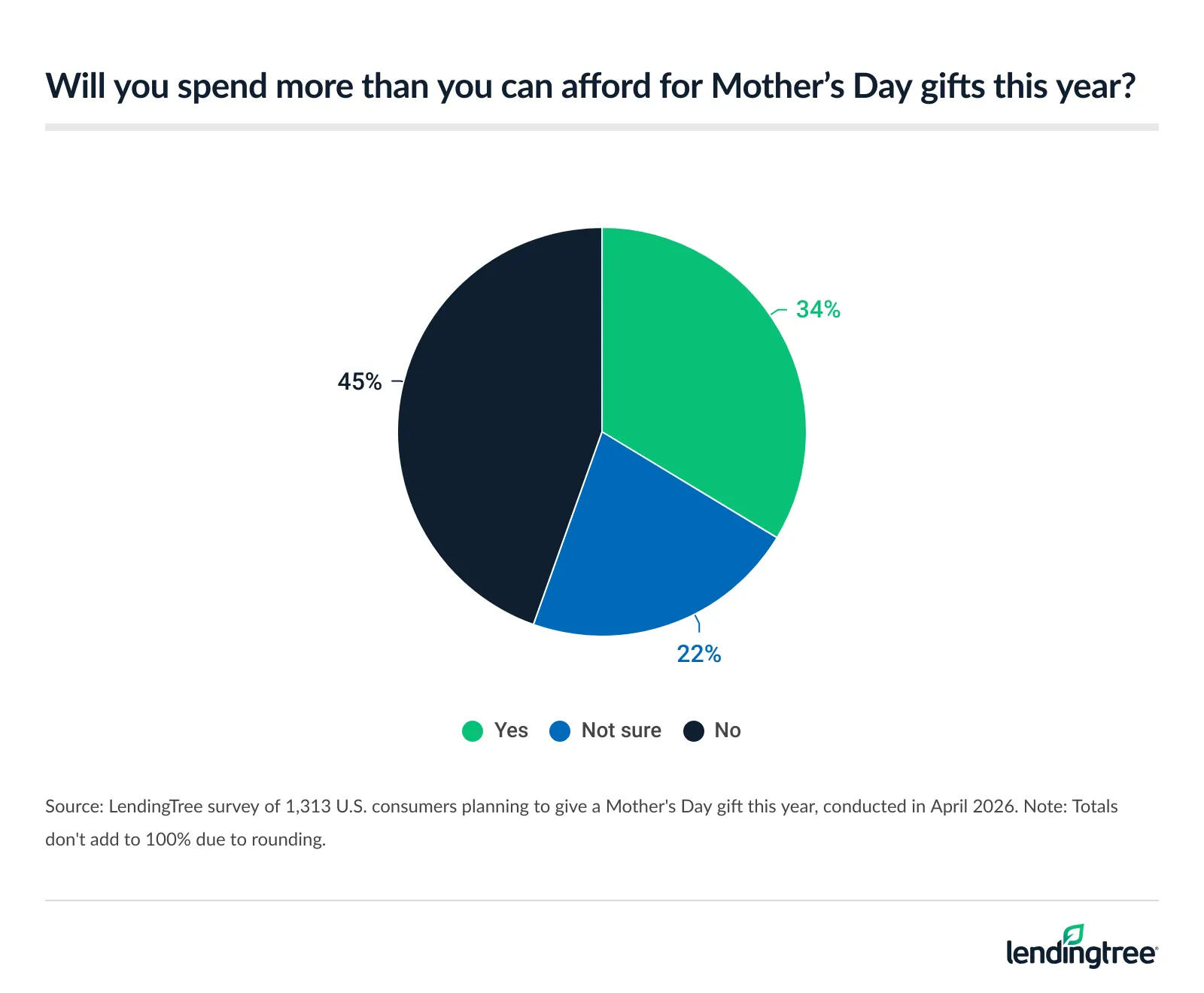
More than half (55%) of gift-givers say they may spend more than they can afford on Mother’s Day gifts, up from 50% last year.
Men (38%) are more likely to say they plan to spend more than they can afford on Mother’s Day gifts this year than women (28%). Gen Zers are also the most likely to overspend, at 47% compared with 38% of millennials, 32% of Gen Xers and 13% of baby boomers.
Half of respondents with children younger than 18 also plan to spend more than they can afford on Mom this year, while just 21% of those with children 18 or older and 26% of those with no children say the same.
Those earning the most ($100,000 or more) are slightly more likely to say they plan to spend beyond their means on Mother’s Day this year than those who make the least (less than $30,000) — 40% versus 37%, respectively.
As for how people are planning to pay for Mother’s Day gifts this year, 54% expect to use cash or debit, while 25% say they’ll use a credit card.
Nearly 1 in 10 (9%) will use buy now, pay later (BNPL) financing. Gen Zers are the most likely age group to use BNPL this Mother’s Day, with 12% planning to do so, followed by 11% of millennials. Only 7% of Gen Xers and 3% of baby boomers plan to use BNPL financing to pay for Mother’s Day gifts this year.
Schulz says the most important thing to keep in mind when considering Mother’s Day gifts is that loved ones likely don’t want you going into debt to celebrate them.
“Sure, everyone loves getting presents, but what parents most often want is your time,” Schulz says. “Maybe it’s an in-person visit or maybe just a phone call or Zoom, but that’ll be a far bigger deal than most any other gift you could give.”
Consumers spend more on Mother’s Day than Father’s Day
Mother’s Day in May is followed by Father’s Day in June, but spending is rarely equal between the two. About 4 in 10 (41%) Americans report spending more on the May holiday. Only 5% say they spend more on Father’s Day, while 24% don’t spend on either holiday.
For many, the gap is substantial. Among those who spend more on Mother’s Day, 55% say the difference is significant.
Those with children younger than 18 are the most likely to spend significantly more on Mother’s Day than Father’s Day — 67%, compared with 47% of people with no children and 45% of people with children 18 and older. Men are also slightly more likely than women to report spending significantly more on Mother’s Day — 57% versus 52%, respectively.
Classic gifts are the most common — for both gift-givers and mothers
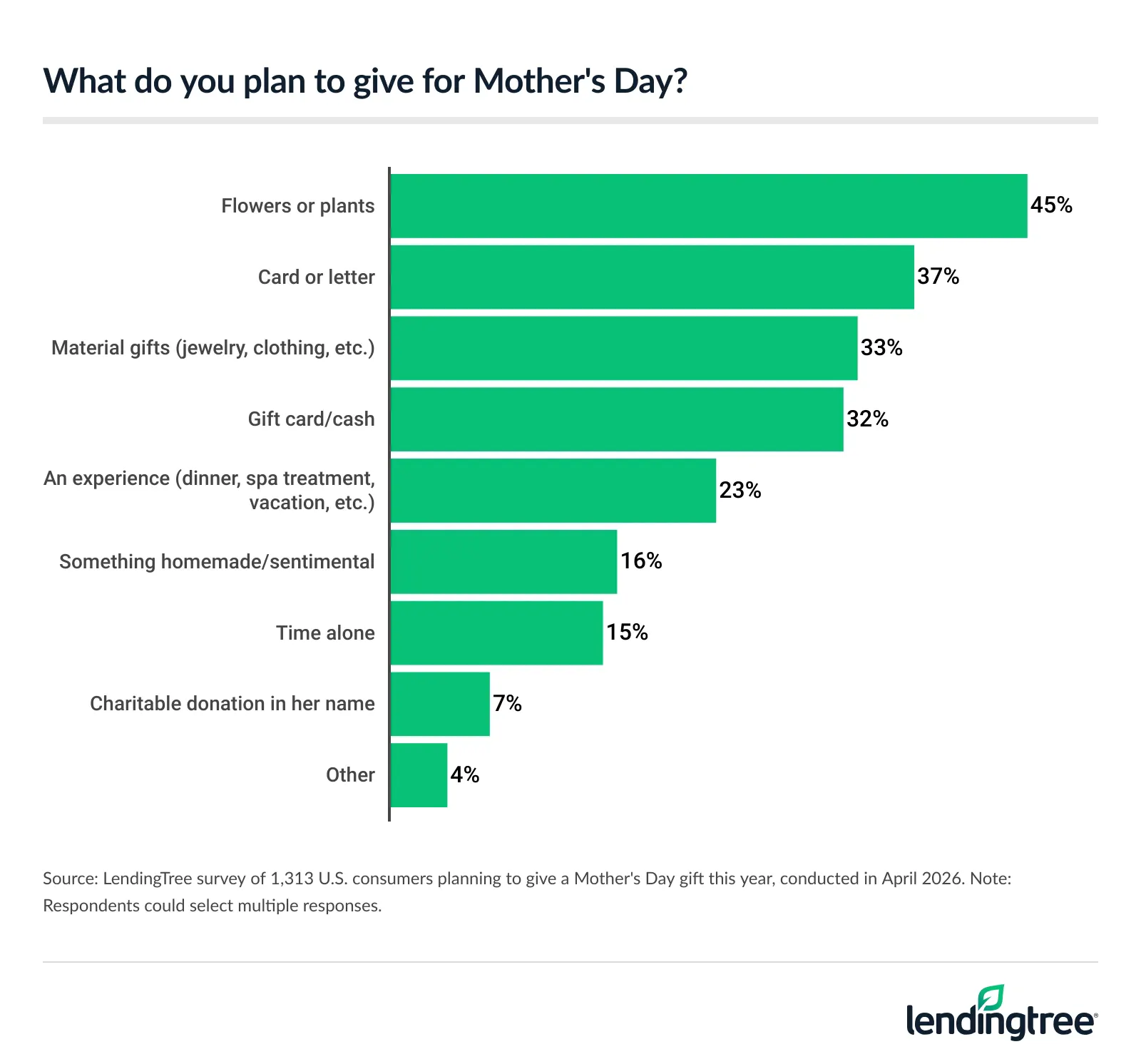
As for the type of gifts people are buying for Mother’s Day, flowers and plants are the most popular, with 45% of gift-givers planning to give some variety this year. They’re followed by cards or letters (37%), physical gifts such as jewelry, clothing, beauty products or electronics (33%) and gift cards or cash (32%).
Mothers’ expectations are relatively modest. Three in 10 (30%) mothers aren’t expecting a gift. Among mothers, flowers or plants (16%), physical gifts (11%) and a card or letter (9%) are among the top of wish lists.
Many Americans also believe Mother’s Day extends beyond traditional moms, as 62% of respondents say pet moms deserve to be celebrated as well.
Beyond gifts, time together remains a key part of the holiday. About 3 in 4 (76%) Americans plan to spend quality time with a loved one this Mother’s Day. More than a third (37%) plan to spend time with their mom, while 28% plan to spend the holiday with their spouse or partner and 23% plan to spend it with their daughter.
Affording a meaningful Mother’s Day: 5 expert tips
Celebrating Mom on a budget isn’t about cutting corners. It’s about spending smarter and being more intentional with your gift-giving. The following tips can help you celebrate the moms in your life while keeping your finances in check:
- Make a plan. If you’re going shopping, make a list and set a budget. “Bringing that list with you changes the vibe of the shopping trip,” Schulz says. “You’re not just browsing in search of inspiration, you’re on a mission to find what you’re looking for. That can help keep you focused and away from those budget-wrecking impulse buys.”
- Get creative. Think outside the box when considering what to give the mothers in your life. Thoughtful gifts don’t have to cost a lot — there’s a reason people say “it’s the thought that counts.” “Something you made or wrote yourself can be an amazing gift,” Schulz says. “You could also offer something practical, like helping Mom with tasks over a set period of time.”
- Give the gift of time. Most moms will tell you that spending time with you is more valuable than any material gift. Whether it’s brunch together, a phone call or a video chat, meaningful connection is priceless.
- Shop around. Last-minute shopping often leads to overspending. Start browsing early and watch for sales and promotions in the weeks leading up to Mother’s Day. Give yourself time to compare prices — a little planning can go a long way toward finding a thoughtful gift at an affordable price.
- Have a plan for debt. If you do have to go into debt to cover Mother’s Day gifts, set a clear limit and make a plan to pay off that debt as quickly as possible. After all, the last thing most moms want is for you to compromise your financial health for a gift.
Methodology
LendingTree commissioned QuestionPro to conduct an online survey of 2,000 U.S. consumers ages 18 to 80 on April 2-6, 2026. The survey was administered using a nonprobability-based sample, and quotas were used to ensure the sample base represented the overall population. Researchers reviewed all responses for quality control.
We defined generations as the following ages in 2026:
- Generation Z: 18 to 29
- Millennials: 30 to 45
- Generation X: 46 to 61
- Baby boomers: 62 to 80
Get debt consolidation loan offers from up to 5 lenders in minutes