Car Buyers Could Save $3,064, on Average, by Shopping Around for the Best Auto Loan Rate


Getting more than one auto loan offer is good practice and could save you thousands of dollars.
This LendingTree analysis finds that the gap between the lowest and highest APRs offered is wide enough to meaningfully change the total cost of an auto loan. Borrowers who choose the lowest APR offered could save an average of $3,064 over the average offered loan. For some credit tiers, the savings are even higher.
- Auto loan shoppers could save an average of $3,064 by choosing the offer with the lowest APR rather than the highest. The average lowest APR was 11.91%, 3.14 percentage points below the average highest APR of 15.05%.
- The average monthly payment was $541 with the average lowest APR and $586 with the average highest APR. That $45 monthly difference amounts to $3,064 over the average offered term of 68.1 months.
- Potential savings increased by $715, or 30.4%, from July 2025 to July 2026. The difference between the average lowest and highest APRs widened by 0.69 percentage points, even as both declined — the average lowest APR by 1.56 percentage points and the average highest APR by 0.87 percentage points.
- Near-prime borrowers could save the most by shopping around. Their average lowest and highest APRs differed by 4.57 percentage points, translating to estimated savings of $4,259 over their average offered term.
- Credit score differences can also substantially affect borrowing costs. On the same $26,706 loan, a subprime borrower with a credit score below 620 who received the average lowest APR offered to their credit band would pay an estimated $40,979 — $9,035 more than a super-prime borrower receiving their credit band’s average lowest APR.
Comparing offers could cut thousands off the total loan cost
The most important step an auto loan shopper can take is to avoid settling for the first rate they’re offered. On average, borrowers who received multiple offers saw a 3.14 percentage point spread between their lowest (11.91%) and highest (15.05%) APR.
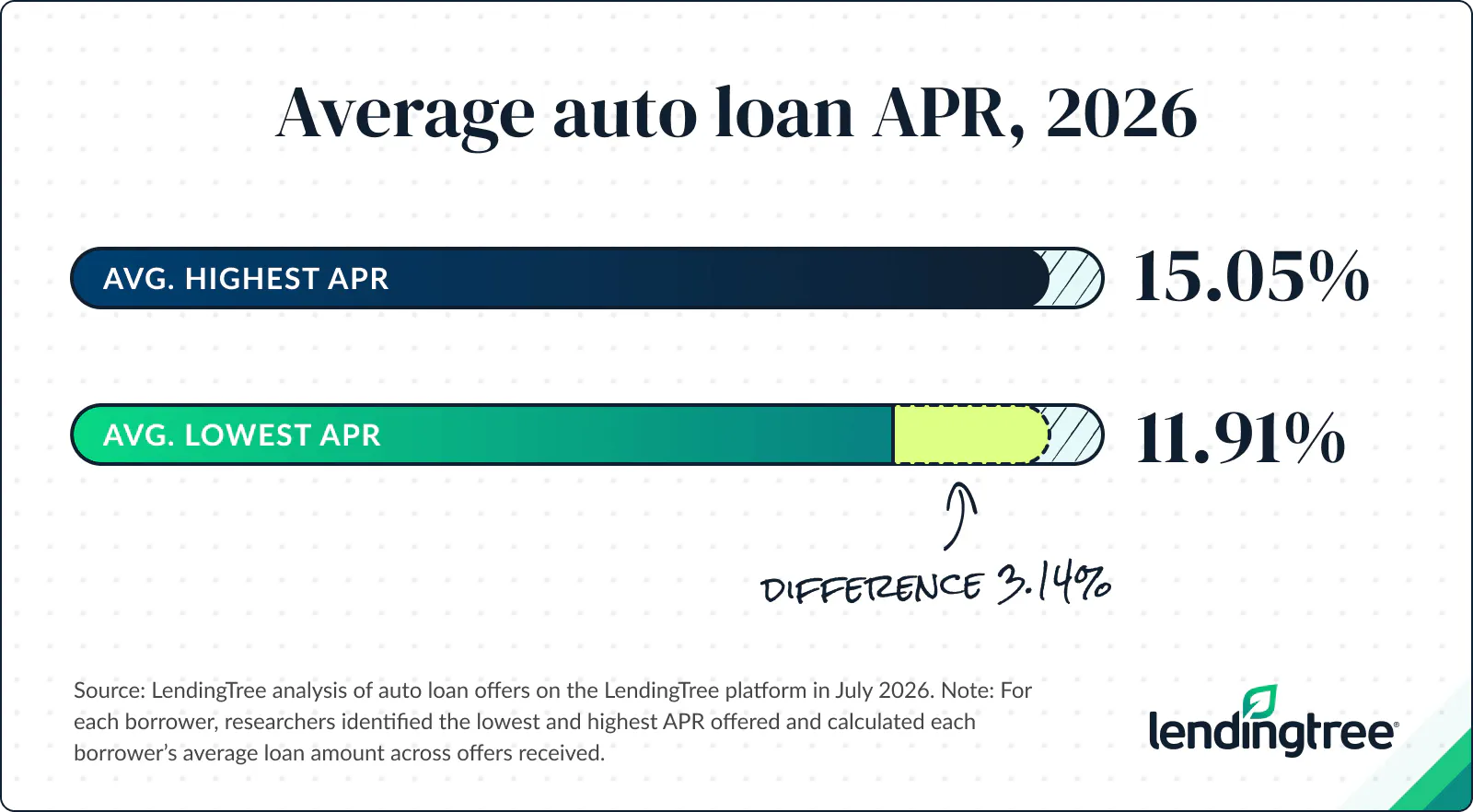
On an average loan amount of $26,706, that APR gap alone leads to a $3,064 difference in total payments over the average offered term.
Matt Schulz, LendingTree chief consumer finance analyst and author of “Ask Questions, Save Money, Make More: How to Take Control of Your Financial Life,” says the data underscores the value of shopping around.
“It’s absolutely, positively worth your time to compare multiple auto loan offers before you apply,” he says. “The possibility of saving more than $3,000 just by shopping around is a big deal, and the best news is that it’s never been easier to do, thanks to sites like LendingTree.”
Average auto loan offers, 2026
| Metric | Value |
|---|---|
| Avg. minimum offer (APR) | 11.91% |
| Avg. maximum offer (APR) | 15.05% |
| Avg. amount offered | $26,706 |
| Avg. term length offered (months) | 68.1 |
Note: The APRs reflect the mix of borrowers and vehicles on LendingTree’s marketplace, including differences in borrowers’ credit profiles and whether they’re financing new or used vehicles, both of which can have a significant impact on available rates.
$45 a month adds up quickly over a multiyear loan
Choosing the lowest-rate offer results in a monthly payment of $541, versus $586 with the highest-rate offer — a $45 monthly difference that may not seem dramatic in isolation.
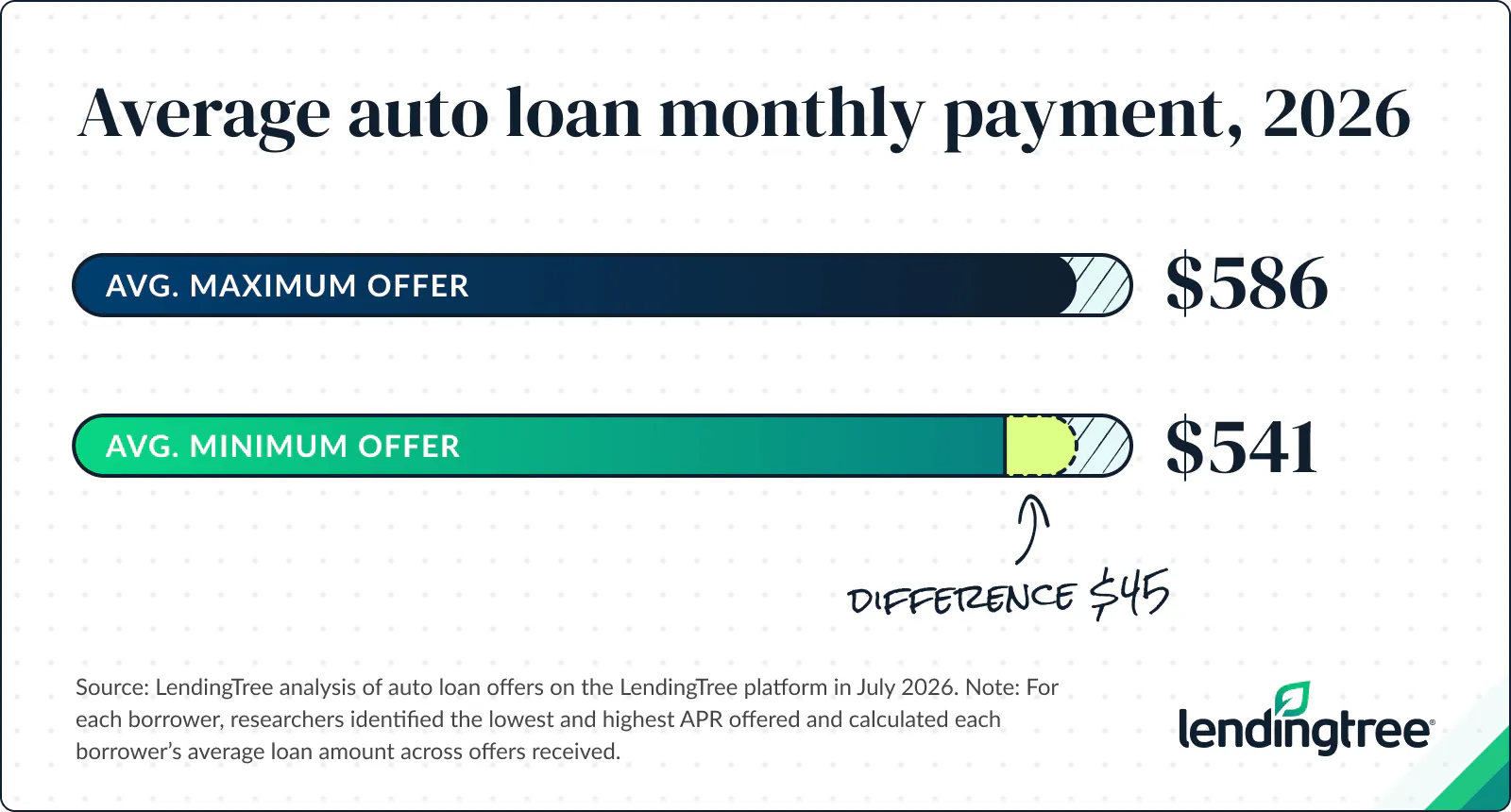
However, car loans aren’t short-term commitments: Over the average offered term of 68.1 months, that monthly difference adds up to the full $3,064 in savings cited above.
Average auto loan monthly payment, 2026
| Metric | Value |
|---|---|
| Avg. monthly payment on avg. minimum offer | $541 |
| Avg. monthly payment on avg. maximum offer | $586 |
| Monthly difference | $45 |
| Difference over avg. term length offered | $3,064 |
The cost of not shopping around is growing
Shopping around could pay off more than it did a year ago. Potential savings jumped $715, or 30.4%, between July 2025 (when we last conducted this study) and July 2026.
That increase came even as rates fell: The average lowest APR fell 1.56 percentage points year over year, and the average highest APR dropped 0.87 percentage points. Because the low end fell faster than the high end, the spread between the two widened by 0.69 percentage points, pushing potential savings higher despite lower overall rates.
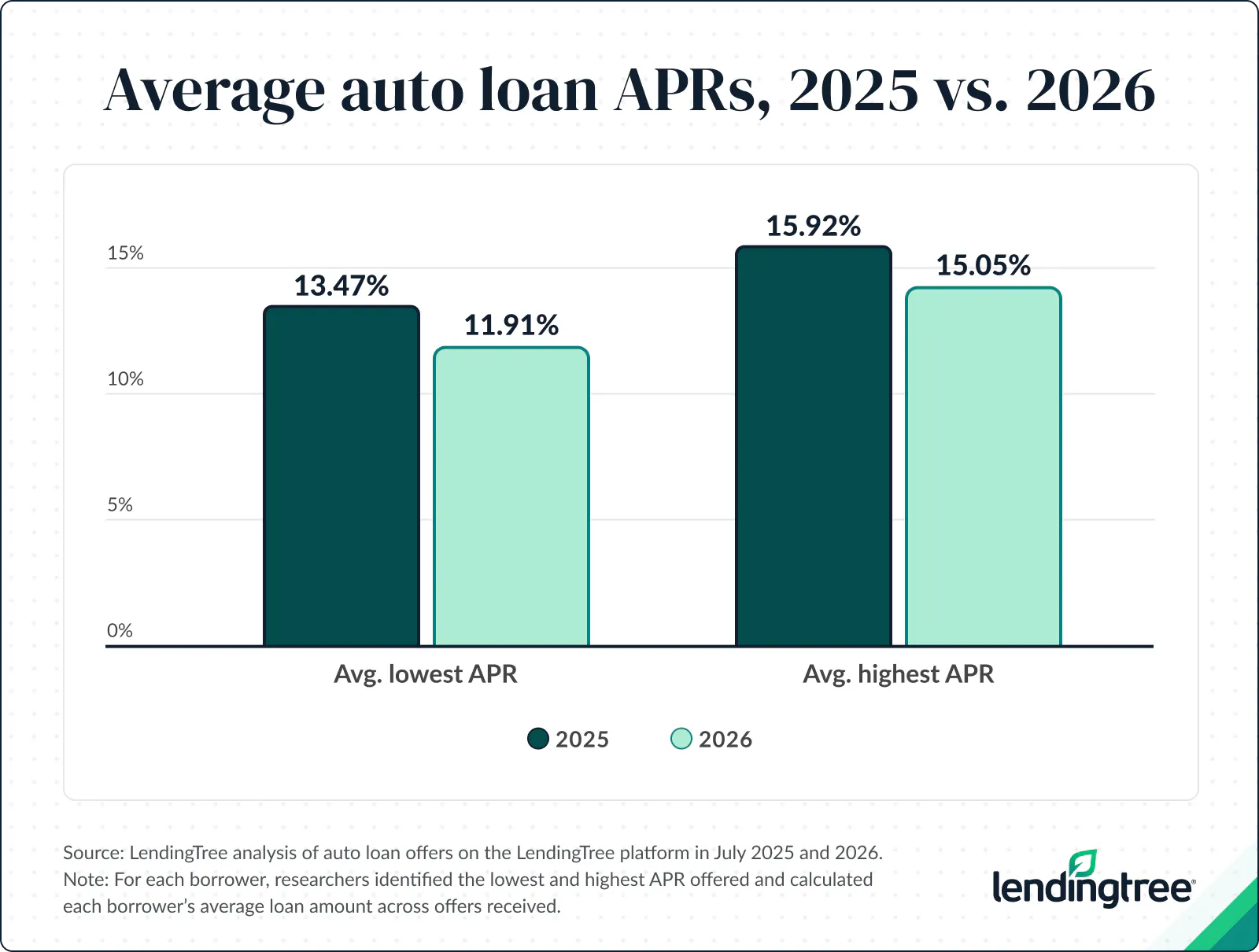
Average loan amounts also ticked up slightly, from $26,311 in July 2025 to $26,706 in July 2026, amplifying the effect of the wider APR spread.
Schulz says the findings indicate lenders are eager to do business with people with good credit. “We’ve seen lenders tighten their standards in recent years as they try to navigate an uncertain economy, but people with good credit are almost always going to be in demand,” he says.
Average auto loan offers, 2025 vs. 2026
| Metric | 2025 | 2026 | Change |
|---|---|---|---|
| Avg. minimum offer (APR) | 13.47% | 11.91% | -1.56 points |
| Avg. maximum offer (APR) | 15.92% | 15.05% | -0.87 points |
| Difference between avg. minimum and maximum offers | 2.45 points | 3.14 points | 0.69 points |
| Avg. amount offered | $26,311 | $26,706 | $395 |
| Difference over avg. term length offered | $2,349 | $3,064 | $715 |
Near-prime borrowers have the most to gain from rate shopping
Not every credit tier benefits equally from comparing offers. Near-prime borrowers with credit scores of 620 to 659 had the widest APR spread of any credit band, at 4.57 percentage points between the average lowest (12.12%) and highest (16.69%) offers.
That translates to estimated savings of $4,259 over their average offered term of 67.6 months.
Average auto loan offers by credit score, 2026
| Metric | Subprime (below 620) | Near-prime (620 to 659) | Prime (660 to 719) | Super-prime (720 or higher) |
|---|---|---|---|---|
| Avg. minimum offer (APR) | 16.37% | 12.12% | 8.77% | 6.23% |
| Avg. maximum offer (APR) | 19.74% | 16.69% | 11.93% | 8.27% |
| Difference between avg. minimum and maximum offers | 3.37 points | 4.57 points | 3.16 points | 2.04 points |
| Avg. amount offered | $23,347 | $26,158 | $27,589 | $32,104 |
| Avg. term length offered (months) | 67.4 | 67.6 | 67.5 | 69.9 |
| Avg. monthly payment, minimum offer | $532 | $536 | $519 | $549 |
| Avg. monthly payment, maximum offer | $576 | $599 | $563 | $580 |
| Monthly difference | $44 | $63 | $44 | $31 |
| Difference over avg. term length offered | $2,966 | $4,259 | $2,970 | $2,167 |
Subprime borrowers with scores below 620 had the next largest spread, at 3.37 percentage points between the average lowest APR (16.37%) and average highest APR (19.74%). However, the estimated savings over the life of the loan were $2,966 — slightly lower than for prime borrowers with scores of 660 to 719.
Prime borrowers could save $2,970, with a 3.16 percentage point spread between the average lowest (8.77%) and average highest (11.93%) APR offers. Despite their narrower APR spread, prime borrowers could save slightly more because their average amount offered was higher: $27,589, compared with $23,347 for subprime borrowers.
Credit score still drives the biggest swings in borrowing costs
Beyond how many offers a borrower compares, credit score remains a major factor in what a car loan costs. Using the same $26,706 loan across credit tiers, a subprime borrower who received the average lowest APR offered for their credit band would pay an estimated $40,979 over the life of the loan.
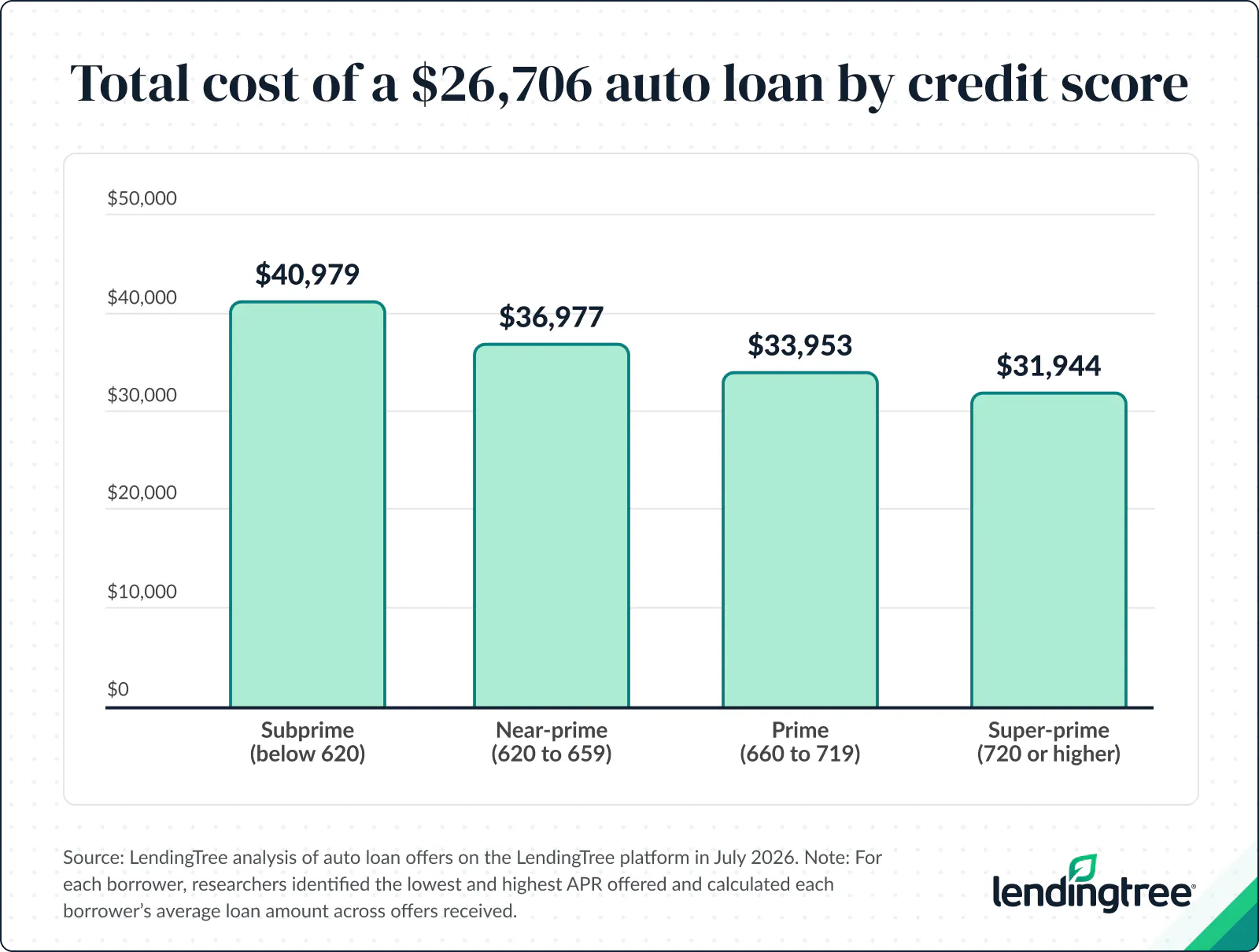
That’s $9,035 more than a super-prime borrower receiving their credit band’s average lowest APR, who would pay $31,944 in total.
Meanwhile, near-prime borrowers would pay $5,033 more than the super-prime borrower, for a total of $36,977. Prime borrowers would pay $2,009 more, for a total of $33,953.
With that in mind, Schulz says improving your credit should be a priority before you shop for an auto loan.
“There’s little in life that is more expensive than having crummy credit,” he says. “It can cost you tens of thousands of dollars over your lifetime in the form of higher APRs and fees on mortgages, credit cards, personal loans and auto loans. That’s why it’s so important to focus on improving your credit before you apply for an auto loan. Because a vehicle is one of the most expensive things we ever buy, it doesn’t take much of an APR reduction to bring substantial savings.”
Total cost of a $26,706 auto loan by credit score
| Metric | Subprime (below 620) | Near-prime (620 to 659) | Prime (660 to 719) | Super-prime (720 or higher) |
|---|---|---|---|---|
| Avg. monthly payment, minimum offer | $608 | $547 | $503 | $457 |
| Avg. monthly payment, maximum offer | $659 | $612 | $545 | $483 |
| Monthly difference | $51 | $65 | $42 | $26 |
| Difference over term of loan | $3,437 | $4,394 | $2,835 | $1,817 |
| Total cost using minimum offer | $40,979 | $36,977 | $33,953 | $31,944 |
| Difference from super-prime offer | $9,035 | $5,033 | $2,009 | N/A |
Top tips to prepare before you negotiate
Getting a good auto loan deal starts well before you arrive at the dealership. Knowing your credit, comparing financing offers and understanding the true cost of a loan can give you more leverage — and help you recognize when it’s better to walk away. Consider these tips:
- Do your homework first. “Check your credit, set a realistic budget and get preapproved by multiple lenders before visiting the dealership,” Schulz says. “Those offers give you a benchmark and put you in a stronger position to let the dealer compete for your business.”
- Compare the total cost. “Don’t focus solely on the monthly payment,” he says. “Compare the APR, loan term, amount financed and total cost. A longer loan might lower your monthly payment, but it can also mean paying significantly more interest over time.”
- Know when to walk away. “There will always be another car and another lender,” he says. “If the numbers don’t work for you, be prepared to leave — you may even find that the dealer’s ‘final’ offer wasn’t so final after all.”
Methodology
LendingTree researchers analyzed auto loan offers on the LendingTree platform in July 2026. For comparison, researchers analyzed offers from July 2025 using the same approach.
For each borrower, researchers identified the lowest and highest APR offered and calculated the average loan amount across the offers received. These borrower-level results were then averaged overall and within four credit bands: subprime (below 620), near-prime (620 to 659), prime (660 to 719) and super-prime (720 or higher).
Monthly payments were estimated using the applicable loan amount, APR and term. Savings were calculated as the difference between estimated payments using the highest and lowest APRs, multiplied by the applicable loan term. Credit band cost comparisons applied each band’s average APRs and term to the same national average loan amount of $26,706. Values were rounded for display.
Get auto loan offers from up to 5 lenders in minutes