Can You Be Denied a Refinance? 6 Common Reasons Why


You can be denied a mortgage refinance — and it’s more common than you might think. About 7% of refinance applications were recently rejected, though the rate reached nearly 46% in fall 2025.
Understanding why refinances get denied — and what you can do about it — can help you improve your chances of approval on your next attempt.
Mortgage denial reasons tend to fall into several categories, according to data collected under the Home Mortgage Disclosure Act. Here are some common reasons a refinance may be denied and what you can do to ultimately gain approval.
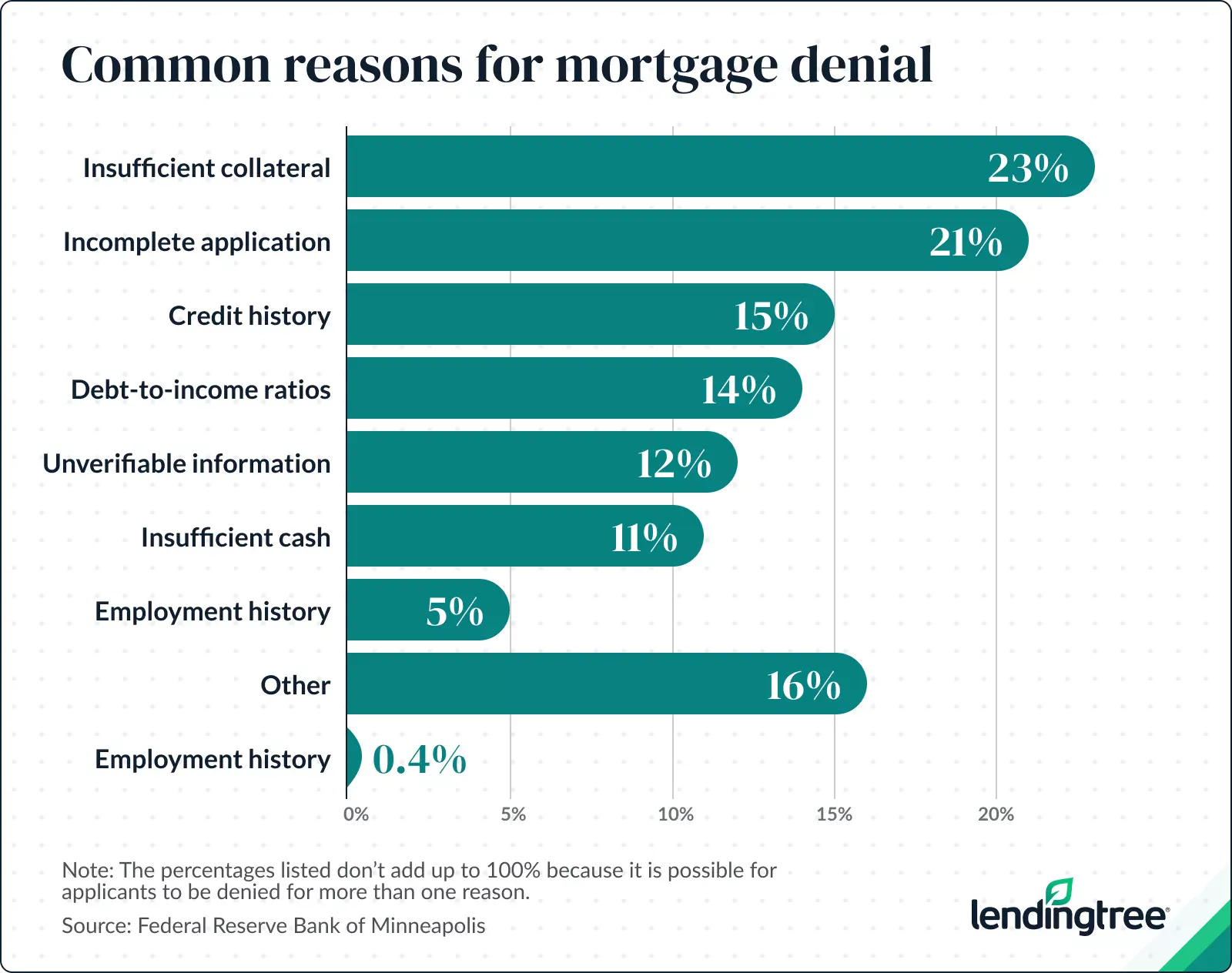
- A lender can deny your mortgage refinance application if your finances, credit or home value don’t meet their requirements.
- Common reasons for refinance denial include a high debt-to-income ratio, poor credit, low home equity, missing documents or insufficient cash to close.
- A refinance denial isn’t always final. You may be able to fix the issue, apply with another lender or consider an alternative to refinancing.
Reason 1: You have too much debt
A common reason a refinance loan application can be denied is having too much debt relative to your income. Lenders use your debt-to-income (DTI) ratio to compare your monthly debt payments with your gross monthly income. A higher DTI ratio can make it harder to qualify because a significant portion of your income is already committed to debt payments.
Some mortgage lenders calculate two DTI ratios: the front-end ratio and the back-end ratio. The front-end ratio, also called the “housing expense ratio,” compares your expected monthly housing costs with your gross monthly income. The back-end DTI ratio compares all your debt payments, including the expected mortgage payment, with your gross monthly income.
There isn’t one maximum DTI ratio that applies to every refinance. The limit can vary based on the lender, loan type and how the loan is underwritten. For example, some conventional (non-government) loans may allow a maximum back-end DTI ratio of 50% when approved through an automated underwriting system, while some refinance programs allow a higher ratio.
Manually underwritten conventional loans generally have a lower limit — 36% in some cases, although some borrowers may qualify with a DTI ratio as high as 45% if they meet additional requirements.
A higher DTI ratio doesn’t necessarily mean your refinance will be denied. Depending on the loan program, factors such as your credit score, cash reserves and other aspects of your financial profile may help you qualify. For more information, read our guide to minimum mortgage requirements.
Use LendingTree’s debt-to-income calculator to estimate your DTI ratio.
Reason 2: You have bad credit
Your credit score helps lenders gauge how likely you are to repay a loan. For a conventional loan, you’ll typically need a minimum credit score of 620, although requirements vary by lender and loan program. The median credit score of borrowers taking out a new mortgage was 762 in early 2026, so qualifying may be harder with a lower score.
Meeting a lender’s minimum credit score doesn’t necessarily mean you’ll qualify for the best mortgage rate. A lower score may result in a higher interest rate and monthly payment, which could contribute to a denial if your income isn’t sufficient to support the higher payment.
You may also be denied if you recently went through bankruptcy, even if your credit score meets the lender’s requirements. Depending on the loan program and type of bankruptcy, you may have to observe a waiting period before refinancing.
Not sure what your credit score is? Use the LendingTree app to track your score for free and get tips on how to improve it.
Reason 3: Your home’s value dropped
When you apply for a refinance, your lender will assess your home’s value to determine whether it supports the new loan amount.
This can be an issue if your home’s value has dropped significantly since you bought it. If you’re underwater on your mortgage — meaning you owe more than your home is worth — you may have difficulty refinancing.
Lenders typically have maximum loan-to-value (LTV) ratios for refinance loans. LTV compares the amount of your mortgage with your home’s appraised value. The maximum LTV ratio varies by loan type and refinance program, with some programs allowing higher LTVs than others.
Use LendingTree’s home value estimator to see what your home may be worth today.
Reason 4: Your application was incomplete
A refinance application can be denied if you don’t provide all the information or documentation your lender needs to evaluate your loan. If your application is incomplete, your lender may notify you of what’s missing and give you an opportunity to provide it — or deny the application.
Pay close attention to the documents and information your lender requests. This could include pay stubs, W-2 forms, tax returns, bank statements or other records used to verify your income and assets. Lenders may ask for additional documentation from borrowers who are self-employed, recently changed jobs or have other unique financial circumstances.
Reason 5: Your lender can’t verify your information
Lenders will verify key information in your refinance application before approving your loan. For example, they may confirm your income, employment history, assets or the source of funds used to close. If your lender can’t verify the information you’ve provided, your refinance application may be delayed or denied.
To avoid problems, try not to make major financial or employment changes that could create additional underwriting questions before closing.
Yes, a loan can be denied between approval and closing if your financial situation changes or the lender uncovers information that affects your eligibility.
Even if your lender says you’re “clear to close,” keep your finances as steady as possible until the loan is finalized. Avoid applying for new credit, changing jobs, moving large sums of money between accounts or making major purchases unless you’ve communicated with your lender first.
Reason 6: You don’t have enough cash
When you refinance a home, you may need cash to pay closing costs and fees for the new loan. In some cases, your lender may allow you to roll these costs into your loan or give you a lender credit in exchange for charging a higher interest rate. This is often called a no-closing-cost refinance, but it isn’t always available. As a result, “insufficient cash” is one reason lenders deny refinance applications.
Once your refinance has closed, your loan generally can’t be denied in the same way it can before closing. However, fraud or serious misrepresentation could create legal problems.
If you change your mind after closing, you may have the right to cancel your refinance within three business days. This is known as the right of rescission and typically applies to refinances and second mortgages, but not purchase loans.
My refinance was denied, now what?
If your lender denied your mortgage refinance application, it’s not the end of the world. Refinance rejection rates fluctuate over time, but one lender’s denial doesn’t mean every lender will reject your application.
Start by finding out why your refinance was denied. If your application is rejected, the lender is required to provide an “adverse action” notice explaining the reasons for the denial or telling you how to request them. However, you may not be entitled to a notice if you were denied during prequalification rather than at the preapproval or approval stage.
Once you know the reason, you may need to correct inaccurate credit report information, improve your credit score, pay down debt or increase your income. You can also shop around since lenders have different approval requirements. However, if the denial was due to a major issue — such as a very high DTI ratio, low credit score or lack of equity — you may have better odds if you strengthen your application before reapplying.
How to get approved after you’ve had a denial
Check your credit report for errors
If your refinance was denied due to your credit history, your lender must tell you the credit score it reviewed and the agency that provided it.
You can get a free copy of your credit report from the major credit reporting agencies. Review it closely and dispute anything inaccurate. Common credit report errors include:
- Credit cards or loans that aren’t yours
- Incorrect balances reported on credit lines
- Late payments that were actually made on time
- Multiple accounts reported for a single debt
These errors could lower your credit scores enough to make you ineligible for a refinance.
Take steps to improve your credit
If your credit score is keeping you from refinancing, work on raising it before you apply again. Since payment history makes up 35% of your FICO Score, one of the best steps is making your mortgage payments and paying other bills on time.
You should also bring past-due accounts current, keep credit card balances low and avoid applying for new credit unless you need it.
Join the LendingTree app for personalized guidance on boosting your credit.
Pay down your debt
Paying down debt can lower your DTI ratio and may improve your credit score. If possible, try to pay off some balances completely, such as a personal loan, auto loan or student loan.
In the meantime, avoid taking on new debt. Additional monthly obligations can increase your DTI ratio and make it harder to refinance.
Don’t forget to look into debt consolidation loan options if your current debt has a high interest rate.
Try a specialized refinance program
If you keep getting denied, ask your lender whether a specialized refinance program could help. Depending on your situation, you may be able to use a nonqualified mortgage (non-QM) lender, a bank statement loan program for self-employed borrowers or a government-backed streamline refinance.
Streamline refinance programs may require less documentation than a standard refinance and are generally for borrowers who already have a government-backed loan. For example, borrowers with an existing FHA, VA or USDA mortgage may be eligible for a streamlined refinance under their loan program.
Frequently asked questions
There’s no universal waiting period after a refinance denial. You may be able to apply again right away with the same lender or a different lender. However, if you were denied because of your credit, DTI ratio, income, home value or recent bankruptcy, it may make sense to wait until you’ve addressed the issue.
If you can’t refinance, your next step depends on your goal. If you need cash, compare a home equity loan, HELOC or personal loan. If you’re struggling with your mortgage payment, contact your loan servicer to ask about forbearance or a loan modification.
Applying with multiple refinance lenders can affect your credit, but the impact may be limited if you shop around within a short period. Multiple mortgage credit checks within a 45-day window are recorded as a single inquiry on your credit report.
Get Free Refinance Offers Now