Raising a ‘Fair’ Credit Score to ‘Very Good’ Could Save Borrowers Nearly $43,000


Your credit score is one of the biggest factors in determining how much you’ll pay to borrow money — and improving it could lead to significant savings.
According to a LendingTree study, borrowers who move their credit score from the fair range to very good could save $42,950 in total interest over the life of their debt. Even smaller improvements could still meaningfully reduce monthly bills.
Here’s a closer look.
- Improving your credit score from fair to very good could save nearly $43,000. Borrowers with four common debt types — credit cards, personal loans, auto loans and mortgages — could save $42,950 in total interest over the life of their debt by raising their credit score from fair (580 to 669) to very good (740 to 799).
- Even borrowers with good credit could save more than $20,000. Improving a credit score from good (670 to 739) to very good (740 to 799) could reduce total interest costs by $20,530 across the same four debt types.
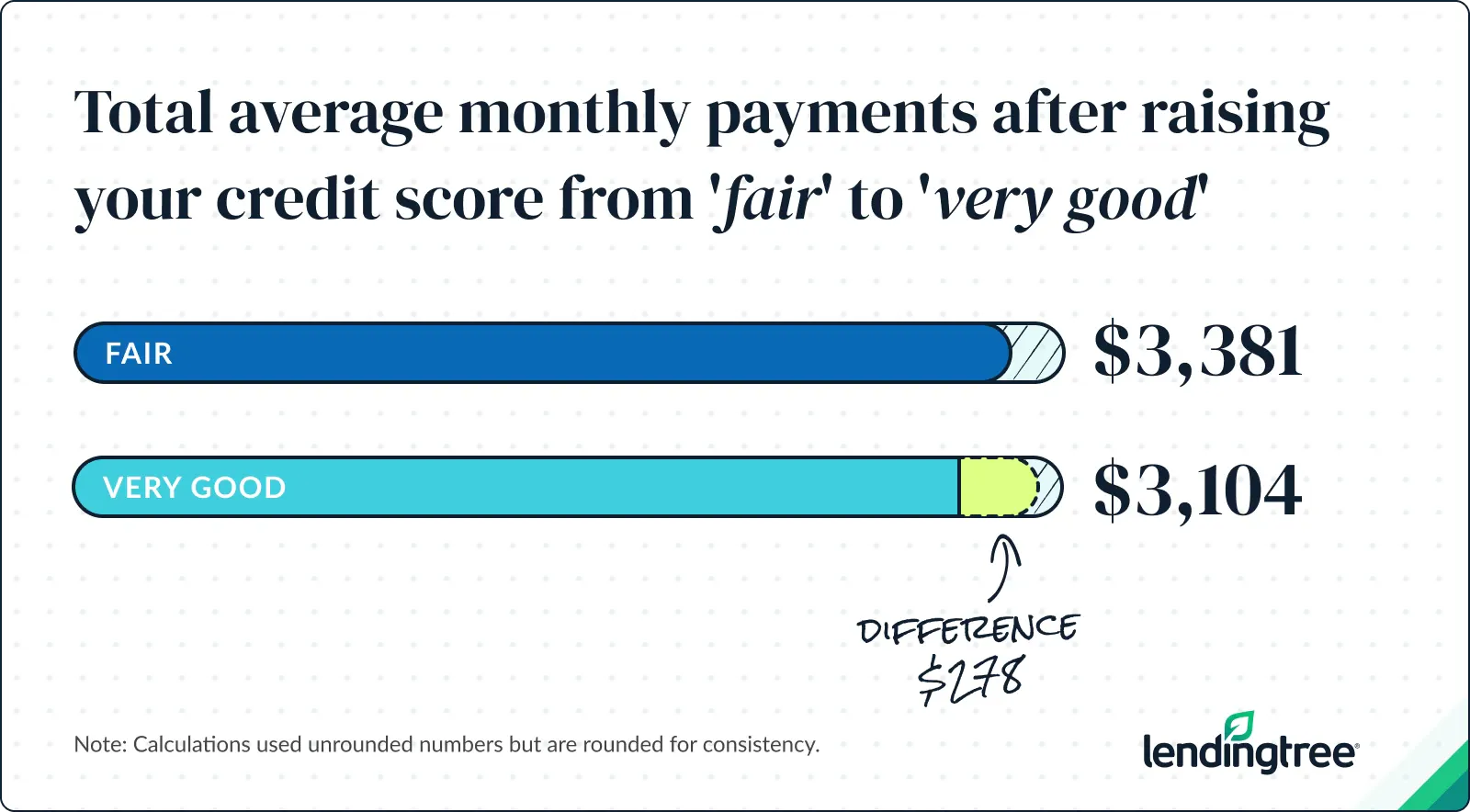
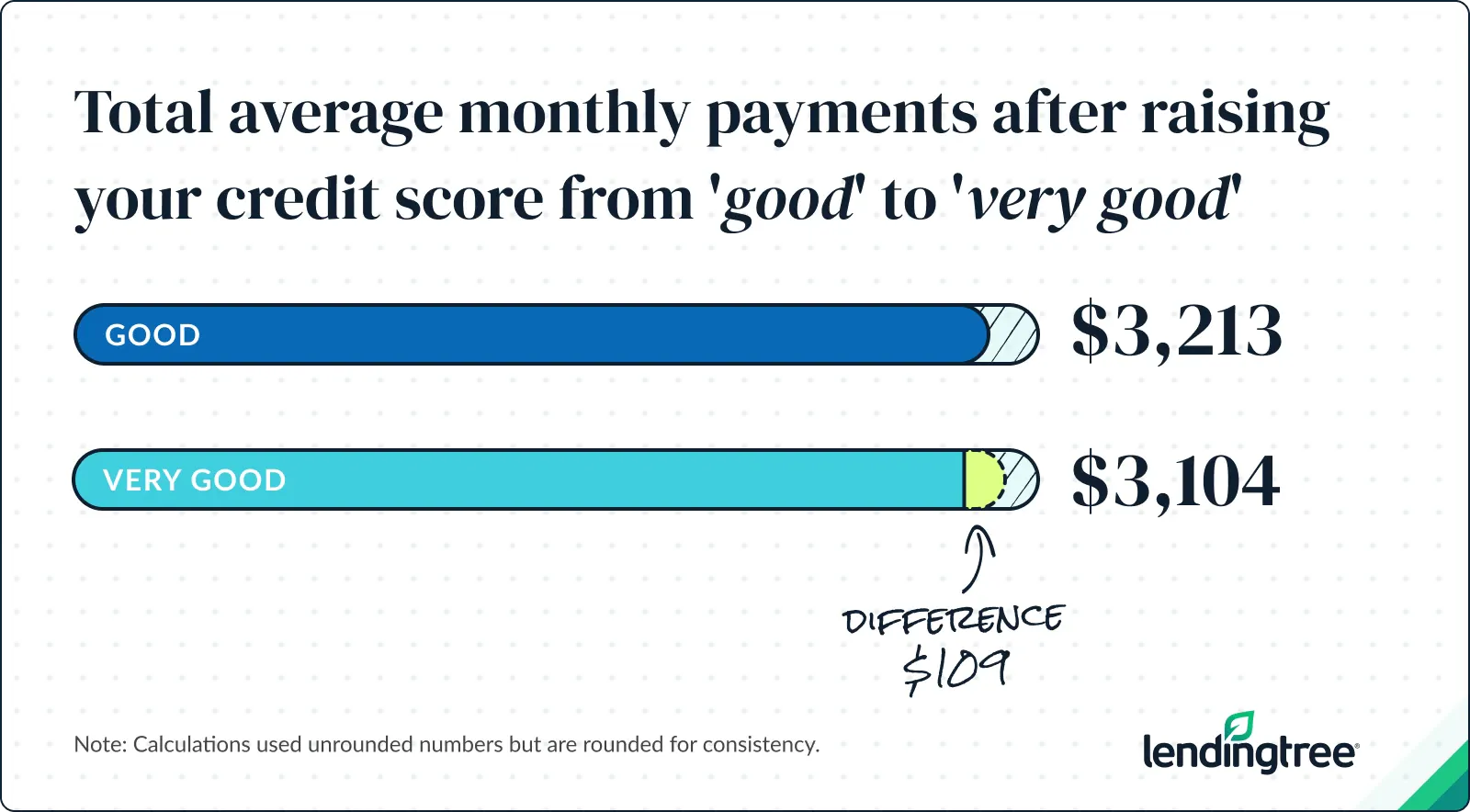
- A higher credit score could significantly lower monthly payments. Average monthly payments fall from $3,381 for borrowers with fair credit and $3,213 for those with good credit to $3,104 for borrowers with very good credit. That’s a savings of $278 a month (8.2%) when moving from fair to very good, or $109 a month (3.4%) when moving from good to very good.
- Mortgages offer the largest dollar savings. While mortgage rates vary less by credit score than other loan types, improving from fair to very good credit could save $28,894 in interest over the life of a 30-year, $350,000 fixed-rate mortgage. Borrowers improving from good to very good could still save $15,630.
- Auto loans offer the largest percentage reduction in interest costs. Improving from fair to very good credit could reduce total interest paid by 58.9% on a five-year, $25,000 auto loan — the biggest percentage drop among the debt types analyzed. Personal loans follow at 34.4%, ahead of credit cards (27.4%) and mortgages (6.4%).
Moving from fair to very good credit could save nearly $43,000
Borrowers juggling credit card, personal loan, auto loan and mortgage debt could cut their total interest payments by $42,950 over the life of their debt by raising their credit score from fair (580 to 669) to very good (740 to 799).
Matt Schulz, LendingTree chief consumer finance analyst and author of “Ask Questions, Save Money, Make More: How to Take Control of Your Financial Life,” says this underscores the high cost of having less-than-strong credit.
“There’s very little in life more expensive than having crummy credit,” he says. “When you have imperfect credit, you face higher interest rates as well as bigger and more frequent fees — and that’s assuming you’re even able to qualify for the loan at all. Having very good credit is a big deal. However, moving from fair to very good credit doesn’t typically happen overnight. It takes time, effort and — sometimes — help, but it’ll likely be worth it.”
Even a jump from good to very good could save more than $20,000
Borrowers don’t need to start at the bottom to benefit. Even those who already have good credit (670 to 739) could shave $20,530 off their interest costs by climbing into the very good (740 to 799) range.
That gap shouldn’t come as a surprise, Schulz says. “There can be a significant difference between the rates offered to people with good credit versus those with very good credit,” he says. “Also, people with very good credit might be more likely to get larger loans. Combine a lower interest rate with a bigger loan and the savings add up in a big hurry.”
Higher credit scores could mean smaller monthly bills
Beyond lifetime interest, credit score improvements could also translate into lower monthly payments. Borrowers with fair credit pay an average of $3,381 a month across the four debt types, compared with $3,213 for those with good credit and $3,104 for borrowers with very good credit.
That works out to monthly savings of $278 (8.2%) when moving from fair to very good and $109 (3.4%) when moving from good to very good.
Average monthly payments by credit score range
| Credit score range | Total avg. monthly payments | Monthly savings ($) | Monthly savings (%) |
|---|---|---|---|
| Fair (580 to 669) | $3,381 | $278 | 8.2% |
| Good (670 to 739) | $3,213 | $109 | 3.4% |
| Very good (740 to 799) | $3,104 | N/A | N/A |
Schulz cautions that lower payments aren’t automatically a win.
“Lower monthly payments can be a huge help because they free up cash to put toward other goals,” he says. “One of the biggest challenges people with poor credit face is that they’re charged high interest rates, which push monthly payments higher. However, lower monthly payments aren’t always the best solution. If you lower your payments by extending the loan for several more years, the additional interest you pay over the life of the loan can turn a good deal into a losing proposition.”
Mortgages deliver the biggest dollar savings
Because mortgages are typically the largest debt most people will ever have, even small rate differences can translate into significant dollar savings. Over a 30-year, $350,000 fixed-rate mortgage, improving from fair to very good credit could save a borrower $28,894 in interest over the life of the loan.
Borrowers improving from good to very good could still save $15,630.
The average mortgage APR falls 0.35 percentage points from 6.59% for fair-credit borrowers to 6.24% for those with very good credit. Mortgage rates tend to vary less by credit score than rates for other loan types, but the sheer size of a home loan means even a fraction of a percentage point can add up fast.
“Even though the interest rates are typically far less than you’d find for a credit card, the price of the home is so high and the payoff period so long that it still adds up to a massive amount of interest paid,” Schulz says. “However, that big price tag also means that every fraction of a percentage point you knock off of your interest rate can add up to major savings, making it absolutely crucial that you take the time to comparison shop before you apply.”
Money saved by raising your credit score from fair (580 to 669) to very good (740 to 799)
| Debt type | Loan amount | Term | APR (fair) | APR (very good) | Monthly payment (fair) | Monthly payment (very good) | Monthly savings | Total interest savings |
|---|---|---|---|---|---|---|---|---|
| Credit card | $7,000 | Variable | 27.41% | 20.18% | $80 | $68 | $11 | $4,055 |
| Personal loan | $10,000 | 3 years | 28.85% | 19.65% | $418 | $370 | $48 | $1,742 |
| Auto loan | $25,000 | 5 years | 19.14% | 8.49% | $650 | $513 | $138 | $8,259 |
| Mortgage | $350,000 | 30 years | 6.59% | 6.24% | $2,233 | $2,153 | $80 | $28,894 |
Money saved by raising your credit score from good (670 to 739) to very good (740 to 799)
| Debt type | Loan amount | Term | APR (good) | APR (very good) | Monthly payment (good) | Monthly payment (very good) | Monthly savings | Total interest savings |
|---|---|---|---|---|---|---|---|---|
| Credit card | $7,000 | Variable | 23.79% | 20.18% | $74 | $68 | $6 | $2,019 |
| Personal loan | $10,000 | 3 years | 25.35% | 19.65% | $399 | $370 | $30 | $1,065 |
| Auto loan | $25,000 | 5 years | 10.96% | 8.49% | $543 | $513 | $30 | $1,816 |
| Mortgage | $350,000 | 30 years | 6.43% | 6.24% | $2,196 | $2,153 | $43 | $15,630 |
Auto loans see the largest percentage drop in interest costs
While mortgages offer the most total dollars saved, auto loans see the steepest percentage decline in interest costs. Improving from fair to very good credit could cut total interest paid on a five-year, $25,000 auto loan by 58.9% — the biggest percentage drop among the debt types analyzed.
Personal loans follow at 34.4%, with credit cards (27.4%) and mortgages (6.4%) next.
Potential interest reduction when reaching very good credit (by debt type)
| Debt type | Fair to very good | Good to very good |
|---|---|---|
| Credit card | 27.4% | 15.8% |
| Personal loan | 34.4% | 24.3% |
| Auto loan | 58.9% | 23.9% |
| Mortgage | 6.4% | 3.5% |
| Total | 8.8% | 4.4% |
That gap highlights the importance of credit scores in auto financing, Schulz says.
“A good credit score is a big deal when shopping for a new vehicle because it could mean you’re eligible for 0% financing,” he says. “Those deals typically only go to so-called well-qualified buyers, as the TV ads say, but the savings can be massive if you can get one.“
The rate gap reflects that: Fair-credit borrowers face an average auto loan APR of 19.14%, compared with 8.49% for those with very good credit — a difference of nearly 11 percentage points, the widest spread of any debt type in the study.
Expert tips on building better credit over time
Improving your credit score doesn’t happen overnight, but small, consistent habits can make a big difference. Consider these tips:
- Pay every bill on time, every time. “Nothing matters to your credit more than this,” Schulz says. “Late payments can do real damage to your credit, so consider setting up autopay for at least the minimum amount due. It isn’t flashy advice, but consistency is one of the most powerful tools for building strong credit.”
- Keep your credit card balances as low as possible. “High balances can weigh on your credit score, even if you make every payment on time,” he says. “Paying down debt is easier said than done, of course, so be patient and give yourself some grace, but keep working toward that goal.”
- Review your credit reports, and be selective when applying for new credit. “You’d be surprised how often credit reports are inaccurate,” he says. “Look for errors that may drag down your score, and dispute any you find. Also, applying for too much credit too often can raise red flags, so only apply when it makes sense. Building credit is a marathon, but the potential savings make it well worth the effort.”
Methodology
LendingTree researchers analyzed personal loan, auto loan and mortgage offers on the LendingTree platform from the second quarter of 2026 to calculate average offered APRs. Offers were aggregated by credit score range, with the analysis focusing on borrowers with fair (580 to 669), good (670 to 739) and very good (740 to 799) credit.
For comparability, the analysis included only 36-month personal loan offers with requested amounts between $9,000 and $11,000, new and used auto loan offers with terms between 60 and 75 months and requested amounts between $20,000 and $30,000, and 30-year, fixed-rate purchase mortgage offers with requested amounts between $275,000 and $425,000.
Credit card APRs were based on a July 2026 analysis of about 220 credit cards from more than 50 issuers. The minimum APR was used to represent very good credit, the average APR to represent good credit and the maximum APR to represent fair credit.
For the potential savings calculation, researchers assumed repayment terms of 30 years for mortgages, 60 months for auto loans and 36 months for personal loans. Credit card payments were calculated as 1% of the balance plus interest, with a minimum monthly payment of $25.
Get personal loan offers from up to 5 lenders in minutes