How Does A Construction Loan Work?


A construction loan can help you design and build your dream home. However, new home construction loans function differently from traditional mortgages, and they come with some unique qualifying requirements. If you’re thinking of using this type of financing, here’s what you need to know before signing on the dotted line.
- Construction loans pay out funds in stages as your home is built, and you’re only charged interest on the money you take out until construction finishes.
- You’ll need at least a 620 credit score, 5% to 20% down payment and detailed construction plans with a licensed builder to qualify.
- Construction-to-permanent loans save you money by automatically converting to a regular mortgage, so you only pay closing costs once.
What is a construction loan?
A construction loan is a short-term mortgage that covers the cost of building a residential property from the ground up. This type of financing can cover a wide range of costs associated with the homebuilding process, including:
- Land
- Labor
- Materials
- Permits
- Inspections
In cases where the construction costs go over budget, it’s typically up to the property owner to cover the difference, usually by altering the project scope, finding additional financing or paying out of pocket.
Do you need a construction loan?
| If you’re… | You’ll probably need a… |
|---|---|
| Buying an existing home | Traditional mortgage |
| Buying a completed new home | Traditional mortgage |
| Buying a home still under construction from a builder | Traditional mortgage |
| Building a custom home | Construction loan |
Overview: Construction loans vs. traditional mortgages
Construction loans usually have shorter terms, lower payments during construction, higher credit and documentation requirements and higher interest than traditional mortgages.
| Construction loan | Traditional mortgage | |
|---|---|---|
| Best for | Building custom homes from scratch | Purchasing existing or completed homes |
| Loan duration | 12 to18 months (construction phase), then converts or refinances | 15 to 30 years |
| Payout type | Staged draws (Four to six payouts as construction progresses) | One lump sum at closing |
| Payment type | Interest-only during construction | Typically principal and interest from day one |
| Closing costs |
|
|
| Property collateral | Unfinished home and the land it sits on | Completed home and the land it sits on |
| Typical timeline to closing | 30 to 60 days | 30 to 45 days |
Looking for more detail on loan requirements? Jump down to the full details now.
Is building a home worth it when compared to buying an existing home?
In the past, newly built homes have been significantly more expensive than existing homes — but that gap has been getting smaller and, occasionally, the trend even reverses itself.
As of Q1 2026, new homes cost only slightly more on average than existing homes.
Median sales price: Existing homes
$408,500
Median sales price: New homes
$408,967
In many areas, it’s substantially cheaper to buy a new home than an existing one. In others, you may continue to see a gap more in line with the “old normal,” where new homes cost significantly more than existing homes.
Rising mortgage rates and low housing inventory play a large role in the high cost of existing homes and have pushed some borrowers into the new construction market.
Source: LendingTree New vs. Existing Homes study
How construction loans work
Provide detailed documentation to the lender: Before construction begins, you or your housebuilder will need to provide the lender with documentation, like a realistic timeline, a complete construction plan and a budget for the build. You’ll also need to regularly update the lender on your progress.
Funds disbursed in stages: The funds are disbursed in stages for a home construction loan. At each stage of construction, the lender will likely request that a licensed inspector come look at the work that’s been done. As long as everything looks good, the lender will then disburse more funds (known as a “draw”) to the builder so construction can continue.
Paying back the loan: Repayment on a construction loan generally lasts 12 to 18 months, during which time you’ll complete your construction project. You’ll typically only be responsible for making interest-only payments during the construction period. In addition, you’ll only pay interest on the amount that you’ve borrowed to date.
After the construction: After the construction phase is complete, it’s time to convert your construction loan into a permanent mortgage. There are two types of construction loans, and they handle this differently:
- Construction-only loans must be paid off, typically done by refinancing the construction loan into a more traditional mortgage product.
- Construction-to-permanent loans will automatically convert into permanent mortgages, so you’ll only have to pay one set of closing costs. (More on each of these loan types below.)
Let’s say you’re building a $500,000 house with $100,000 down
| Construction phase | Monthly payment amount | Percentage of loan amount drawn | Payment type |
|---|---|---|---|
| Draw #1 | $325 | 15% | Interest only on drawn amount |
| Draw #2 | $867 | 40% | Interest only on drawn amount |
| Draw #3 | $1,300 | 60% | Interest only on drawn amount |
| Draw #4 | $1,733 | 80% | Interest only on drawn amount |
| Final draw | $2,167 | 100% | Interest only on drawn amount |
| Permanent loan | $2,528 | 100% | Principal and interest on full amount |
4 types of construction loans: Which is right for you?
Construction-only loan
A construction-only loan just covers the cost of building the home. Once the home is constructed, the whole loan amount will typically become due. Borrowers usually cover the balance by paying cash or taking out a new mortgage. However, these loans may be costlier and more time-consuming, because you’ll have to go through the mortgage process twice and pay two sets of closing costs.
Construction-to-permanent loan
A construction-to-permanent loan transitions from a construction-only loan to a traditional mortgage once the home is built. The loan allows the buyer to complete one round of applications and paperwork and pay one set of closing costs.
Renovation or rehabilitation loan
A renovation loan is a type of construction loan that finances the costs of large improvements to an existing home — like adding rooms, a garage or an in-ground swimming pool. Similarly, a rehabilitation loan also finances major changes to a home, but these changes are focused on making a dilapidated home fit to live in.
Owner-builder construction loan
If you’re a general contractor or professional builder and you want to build your own home, an owner-builder construction loan could finance your project. With this loan type, the homeowner is responsible for acting as the builder and providing the lender with the necessary information to keep the project moving forward.
How to get a construction loan
Here are the basic steps to get a construction loan:
- Confirm your eligibility: If you’re interested in an FHA construction loan or a VA construction loan, check out the eligibility requirements to make sure you qualify.
- Get preapproved: Before you find a builder and design your home, get a mortgage preapproval so you know how much financing you can qualify for.
- Find your land and your builder: Make sure your builder meets any requirements set by your lender. Pay close attention to licensing and insurance.
- Complete paperwork: Finalize the plans with the builder and submit all paperwork to the lender. The lender will likely order an appraisal and inspection.
- Close on the loan: The mortgage closing process ends with your signature on the dotted line. After everything is signed and the funds are released, your builder can begin.
What to expect: A typical construction loan timeline
While your exact timeline will differ based on your project’s needs, a typical construction loan timeline might look like this. Click through the sections below to see more detail about each phase of construction.
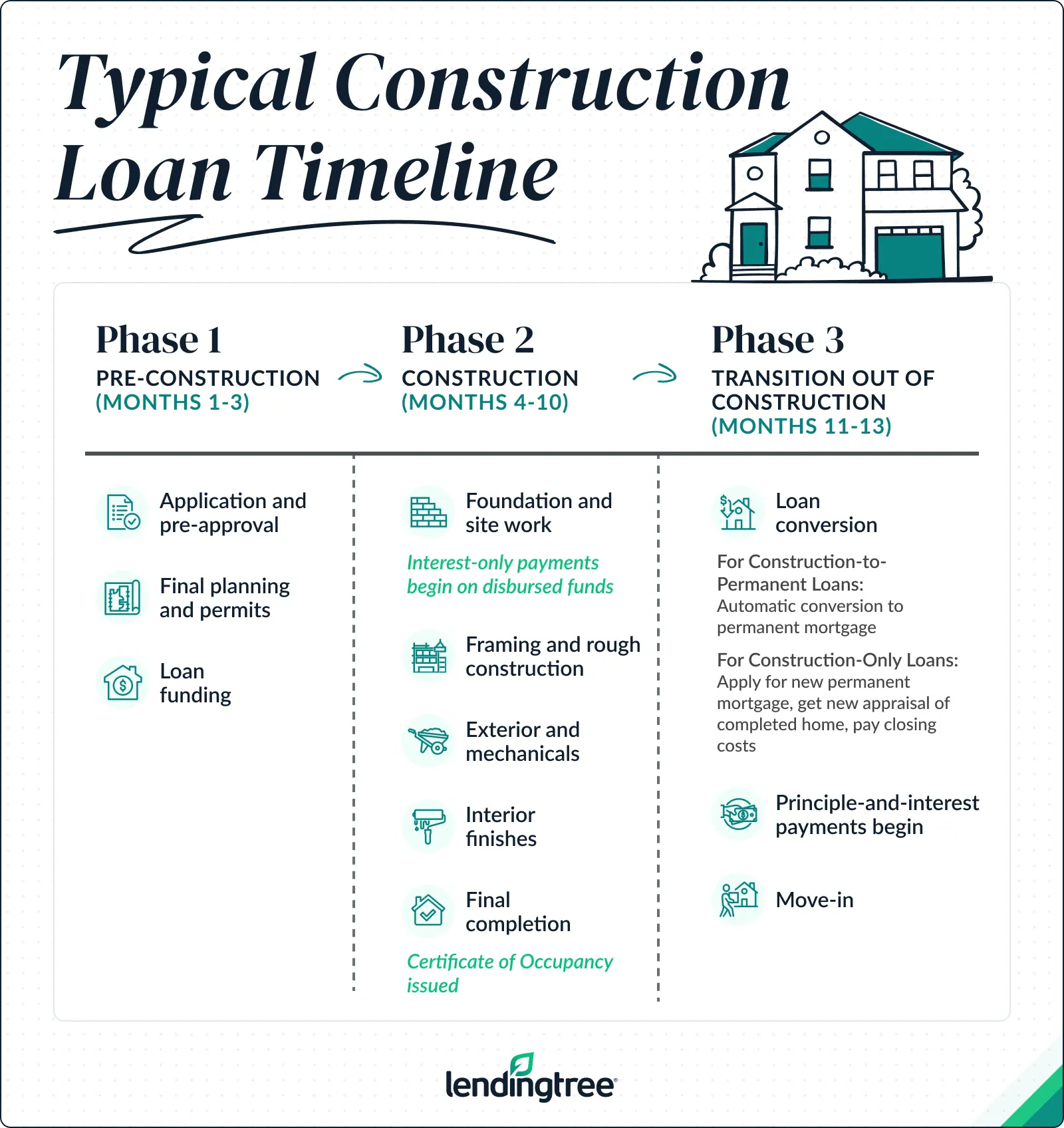
Phase 1: Pre-construction (months 1 to 3)
Key Activities:
Submit construction loan application
Provide financial documentation (income, assets, credit)
Receive preapproval
Submit construction plans and blueprints
Provide detailed project budget
Submit builder contracts
Milestone: Loan preapproval issued
Key Activities:
Finalize architectural plans
Apply for building permits
Obtain homeowners insurance quote
Schedule appraisal of future value
Review and sign final construction contract
Milestone: Building permits obtained
Key Activities:
Final underwriting review
Review and sign closing documents
Pay closing costs
Transfer down payment funds
Obtain title insurance
Milestone: Construction loan funded
Note: Interest-only payments begin on disbursed funds
Phase 2: Construction (months 4 to10)
Lender schedules inspection
Inspector verifies completed work
Builder requests draw #1
Funds released to builder (usually within seven to 10 days)
Milestone: Foundation complete and inspected
Duration: 30 to 60 days
Your payment: Interest only on disbursed amount ($325 per month in our example)
Draw #2: Framing and rough construction and roofing
Builder requests draw #2
Lender inspection of framing and mechanical, plumbing and electrical (MPE) rough-ins
Approval and fund disbursement
Municipal framing inspection may be required
Milestone: The home has been “dried-in” (made weather-tight) and MPE systems have been inspected.
Duration: 30 to 45 days
Your payment: Interest only on total disbursed ($867 per month in our example)
Draw #3: Exterior completion
Builder requests draw #3
Lender inspection of completed exterior
Funds released
Milestone: Exterior complete
Duration: 30 to 60 days
Your payment: Interest only on total disbursed ($1,300 per month in our example)
Draw #4: Interior finishes
Builder requests draw #4
Lender inspection of interior finishes
Verification of quality and completion
Fund disbursement
Milestone: Interior substantially complete
Duration: 30 to 60 days
Your payment: Interest only on total disbursed ($1,733 per month in our example)
Final draw: Project completion
Builder requests final draw
Comprehensive final inspection by lender
Final inspection and certificate of occupancy
All lien waivers collected from subcontractors
Final funds disbursed
Milestone: Certificate of Occupancy issued
Duration: Seven to14 days
Your payment: Interest only on full loan amount ($2,167 per month in our example)
Phase 3: Transition out of construction (months 11 to 13)
For construction-to-permanent (single close) loans:
Automatic conversion to a permanent mortgage
Mortgage rate locked at initial closing
Principal and interest payments begin
No additional closing costs
No new loan application required
For construction-only (double-close) loans:
Apply for a new permanent mortgage
Submit updated financial documentation
New appraisal of completed home
New underwriting process
Second closing, which means a second round of closing costs (2% to 5% of loan amount)
Pay off construction loan with new mortgage
Milestone: Permanent financing in place
New Payment: Principal and interest ($2,528 per month in our example)
Final step: Move-in
Key activities:
Final walkthrough with builder
Receive all warranties and manuals
Receive garage door openers, keys and access codes
Schedule utility transfers
Milestone: Move in!
Ongoing:
Make monthly mortgage payments
Builder warranty period begins (typically one year)
Maintain homeowner’s insurance
Begin building equity
Construction loan rates tend to be about 1% higher than you’d pay to purchase an existing home. That said, purchasers of new construction may be able to secure more favorable interest rates via discounts and promotions, which builders have begun to offer more frequently.
The best way to get your lowest mortgage rate is to comparison shop with multiple lenders. Borrowers can save $62,572, on average, just by shopping around, according to LendingTree data.
Construction loan requirements
Due to the tight timeframe, construction loans often come with more — and more strict — requirements than traditional mortgage loans. Unless you get a home construction loan through a government agency, like the Federal Housing Administration (FHA) or the U.S. Department of Veterans Affairs (VA), you’ll typically need to meet conventional mortgage requirements:
- 620 minimum credit score: You’ll generally need at least a 620 credit score to qualify for a construction loan.
- 36% to 50% maximum debt-to-income ratio: Your debt-to-income (DTI) ratio measures the percentage of your total income that goes toward paying your existing debts. It tells the lender how easily you’ll be able to manage paying another loan. Conventional lenders typically look for a DTI ratio below 45%, but may allow up to 50%.
- 5% to 20% down payment: Construction loans may require a bigger down payment than most traditional mortgages. In some cases, you may be required to put down up to 20%.
- Builder contract: In addition to all the requirements for a traditional mortgage loan, you’ll also need to show a contract from a licensed builder or contractor.
- Construction documents: Your lender will need to approve your construction plans, schedule and project budget.
- Home appraisal: Once your home is fully built, it will serve as collateral for your mortgage loan. Lenders will generally require a home appraisal that estimates the completed home’s value so they can be sure they’re making a sensible investment.
- Mortgage reserves: Lenders often require you to have somewhere between one and 12 months of loan payments in liquid savings. This helps ensure that you can still make your loan payments, even if something unexpected happens.
Pros and cons of construction loans
Pros
- Customization: You’ll have a lot of flexibility to design your dream home.
- Structured process: The construction loan process comes with staged draws and inspections. This can help keep things on track in a way that might not happen with a home equity line of credit (HELOC) or other loan product.
- Low payments: During construction, you’ll usually make interest-only payments. These are typically lower than the monthly payment on a traditional mortgage.
- Potential for single closing: If you choose a single-close construction loan, you can fund the purchase of land, build a home and live in the home all with a single loan.
Cons
- Higher risk: Construction delays and the possibility of going over budget mean that it can be hard to know exactly how much you’ll end up spending.
- Less predictable monthly payments: During construction, you’ll only pay interest on the money you’ve drawn, but that amount will change each month as your project progresses.
- Additional costs: Some construction loans require you to go through a second closing, which means you’ll pay closing costs twice.
- Higher cost: Building a new home is often more expensive than buying an existing home, though this can vary by state.
Alternatives to a construction loan
| Loan type | Description | Best if… |
|---|---|---|
| HELOC | A revolving credit line secured by the equity in your existing home. You can draw funds as needed during construction and only pay interest on what you borrow. | You already own property with substantial equity and your renovation or construction project is on the smaller side. |
| Home equity loan | A lump-sum loan secured by your home’s equity with a fixed interest rate. | You know exactly how much your construction project will cost and prefer predictable monthly payments. |
| Cash-out refinance | Refinance your existing mortgage for more than you owe and receive the difference in cash. | You have significant equity and want to consolidate your construction financing and current home loan into one loan. |
| Renovation (fixer-upper) loan | A single mortgage that combines the home purchase price and renovation costs into one loan. The funds will be released as work is completed. | You want to buy a fixer-upper but avoid managing multiple loans. |
| Land loan | A loan specifically for purchasing raw land or a lot where you plan to build. Usually requires a larger down payment (15 to 35%) and has higher interest rates than home mortgages. | You want to secure and pay for the lot first, then arrange construction financing separately later. Good if you found the perfect location but aren’t ready to build immediately. |
| Home improvement (personal) loan | An unsecured loan based on your creditworthiness with no collateral required. Fixed monthly payments over a set term (typically two to five years). | You want to complete a small project (under around $50,000) and don’t want to use your home as collateral. |
| Buy an existing home instead | Purchase a move-in-ready home rather than building from scratch. Uses a standard mortgage with established processes and timelines. | You want to avoid construction risks, delays and cost overruns. Ideal if you need to move in relatively quickly. |
View mortgage loan offers from up to 5 lenders in minutes
Recommended Articles