Common Reasons To Get a Personal Loan and When Borrowing Makes Sense


If you need cash, a personal loan can be a useful tool in the right situation — like consolidating debt or covering an unexpected car repair or emergency expense. But taking out a personal loan isn’t always the best solution.
Borrowing has the potential to help or harm your financial situation, depending on how and why you use the money. Before you take out a personal loan, determine whether it makes sense for your needs or if there is a more suitable option available.
- You can use a loan to pay for almost anything, but some purposes are riskier than others.
- Most people borrow money to consolidate debt. Bills, home improvement projects and major expenses are other popular reasons to get a loan.
- Personal loans make the most sense when consolidating debt, covering necessary expenses or improving your overall situation.
Smart uses vs. risky uses of personal loans
Not every reason for borrowing is a good one. Even if a personal loan seems like it will solve your financial problems, it can sometimes be a risky option. For example, using a loan for debt consolidation could help you better manage your debt, while using a personal loan to cover a vacation or everyday expenses could lock you in a cycle of debt.
| Usually worth borrowing | Usually best to avoid borrowing |
|---|---|
| Debt consolidation | Every day bills/expenses |
| Home improvements | Vacation |
| Credit card refinancing | Tuition |
| Major, necessary purchases | Starting a business |
Top reasons for personal loans
You can get a personal loan for any purpose — almost. So what are personal loans used for? Here are the most common reasons to get a loan, according to the most recent LendingTree data as of publication:
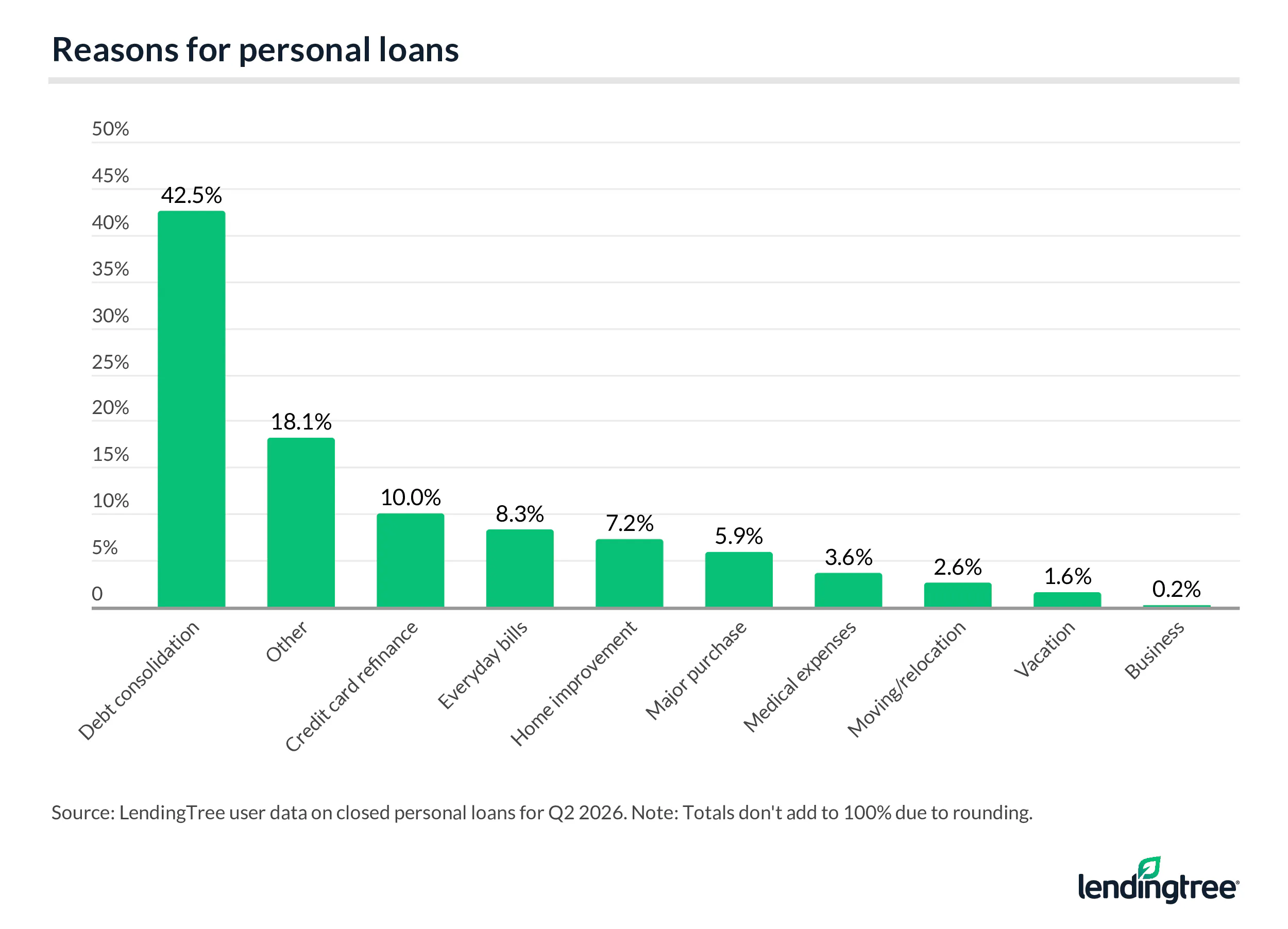
Most borrowers take out loans to consolidate debt, but loans can also cover a variety of other expenses like bills and home improvement projects. Here’s what you need to know about the most popular loan purposes.
Debt consolidation
The most popular reason for taking out a personal loan is debt consolidation, or using a loan to pay off several smaller debts. In fact, 41.3% of LendingTree users who took out a personal loan report having done so to consolidate debt.
Using a personal loan in this way can make good financial sense (or cents) — that’s because you could potentially save $1,750 by consolidating $10,000 worth of credit card debt.
See how much money you can save with a consolidation loan by using our debt consolidation calculator.
Credit card refinancing
Credit card refinancing was the reason why 11.8% of borrowers took out a personal loan. This is just another form of debt consolidation, in which you use a loan to pay off several credit card debts. You could save money and boost your credit score by more than 80 points by using a loan to refinance your credit card debt.
Learn more about using a loan to pay off your credit cards.
Bill pay
Rising costs are putting pressure on households — at the start of 2026, 60% of Americans said their financial situation was the same or worse compared with the beginning of 2025, with 26% citing rising prices and inflation as their main challenges last year.
As a result, it’s not surprising that 8.4% of borrowers took out a personal loan to pay off everyday bills, according to our Q1 2026 study.
Learn more about how to keep your head above water by prioritizing which bills to pay first.
Home improvement
Another common form of debt people take on is a home improvement loan — 7% of borrowers reported having done this. Some of the most popular home improvement projects are small upgrades like interior painting, landscaping and upgrading a bathroom, but you can also take out a large fixer-upper loan.
Major purchases
According to our study, 6% of borrowers took out a personal loan to cover a major purchase. But not all large purchases are created equal. Taking out an emergency loan to replace an essential appliance, like a broken fridge, is a better use of your money than borrowing to buy the latest iPhone when yours is still working.
Learn more about using a buy now, pay later app to spread out payments interest-free.
When to consider loans
You qualify for low interest rates
Unless you can manage to borrow money interest-free with a family loan or a 0% APR credit card, it costs money to borrow money. That said, the best personal loans come with rates as low as 5.96%, which can make your monthly payments affordable.
Market rates are low
When the Fed cuts rates, personal loan interest rates tend to follow suit. A percentage point or two can mean the difference between hundreds of dollars in interest payments, so try to time taking out a loan when rates are low, if you can.
Calculate the total cost of borrowing with a personal loan calculator.
You’ve just improved your credit
If you’ve just boosted your credit score, it could be a good time to consider getting a loan. It’s no secret that borrowers with excellent credit qualify for lower interest rates, meaning they can save money on the cost of borrowing.
In fact, raising your score from “fair” to “very good” could save you about $1,800 on a personal loan.
Don’t know your score? Check your credit score for free with LendingTree app. Doing so won’t impact your score.
When to avoid personal loans
High monthly payments
If the monthly payments are too big for your budget, hold off on taking out a loan if at all possible. If you can’t afford your monthly payments, you’re more likely to skip payments and default on your loan. Your credit will take a hit, and lenders can send your account to collections.
Avoid high interest rates from payday lenders at all costs. These loans trap borrowers in a cycle of debt, meaning they often need to take out a new loan to pay off the old one.
Nonessential purchases
Whenever possible, avoid taking on debt for things you don’t absolutely need. It’s tempting to keep up with the Joneses by buying a new capsule wardrobe or updated gadget, but you could face buyer’s remorse in addition to those monthly payments.
Small, ongoing expenses
Consider paying small, regular expenses like a utility bill or streaming subscription with a credit card rather than a personal loan, especially if you can afford to pay them off before your monthly statement is due.
If you pay your bill in full every month and avoid carrying a balance, you’re essentially getting an interest-free loan every month — and building your credit at the same time.
As a bonus, you could also earn points or cash back on your everyday spending with a rewards credit card. You could then put that cash back toward your financial goals, such as building your savings, paying down debt or covering another small expense.
Tuition and business expenses
Many personal loan companies don’t allow you to use the loan money for your business or education costs. Consider small business loans and student loans to cover the cost of your business expenses or college tuition.
If you determine a personal loan doesn’t make sense, consider alternatives, including:
- Tapping into your savings
- Applying for a 0% APR credit card
- Borrowing from a friend or family member
- Using a buy now, pay later service
Finally, consider delaying the purchase if it’s not urgent.
Questions to ask before taking out a personal loan
You should get a personal loan only after you’ve considered the following:
- Do I actually need to borrow money? Ask yourself if the debt is absolutely necessary. You’ll likely be paying off the debt over several years, so make sure that the reason behind your loan is worth it to you.
- Can I comfortably afford the monthly payments? Before you sign on the dotted line, you want to consider your financial situation. It may be helpful to create a budget to pay off the debt. If you can afford the monthly payments, move on to the next step. If not, consider ways to make extra cash. You can even ask for a raise — 82% of full-time workers we surveyed in 2024 got a pay raise after asking.
- Is there a cheaper alternative? Personal loans aren’t the only way to borrow money. Consider loan alternatives like a credit card or borrowing from a friend or family member before you commit to borrowing from a personal loan lender.
-
Have I compared offers from multiple lenders? The rates you qualify for can vary dramatically between lenders, so be sure to compare offers from several lenders before you commit to a loan. LendingTree users save an average of $1,787
by shopping for a personal loan on our platform, according to May 2026 data. LendingTree makes the process easy — you’ll get offers from up to five of our trusted lending partners by filling out a single form.Based on LendingTree’s analysis of personal loan offers from May 2026. Across all credit profiles, choosing the lowest-APR offer instead of the highest-APR offer could save borrowers an average of $1,787 over a 36-month loan. Estimates are based on the average loan amount among borrowers who closed a personal loan during the study period.
- Will this loan improve my financial situation or make it worse? Your loan payments will impact you now and in the future. Ideally, they will fit into your budget and help you achieve your financial goals, not create additional obstacles and stress.
Frequently asked questions
Personal loans, otherwise known as installment loans, are a type of debt. You borrow a lump sum of money from a lender that you then pay back in monthly installments. Personal loans can be secured with collateral or unsecured, meaning they’re backed by your promise to pay the lender back.
Personal loans aren’t necessarily bad. How the loan affects your finances determines if it’s good or bad for your particular situation.
Taking out a loan with monthly payments you can afford in order to cover a necessary expense could be a smart financial move. But it’s rarely a good idea to borrow money for something you don’t need, especially if you can’t afford the monthly payments.
One of the strongest reasons to get a personal loan is debt consolidation, since you’re not putting more strain on your finances by taking on additional debt. Plus, you could save money on interest with debt consolidation, putting you in a better financial position in the long run.
Yes, you need a reason for a personal loan. Lenders typically ask how you plan to use your loan during the loan application process.
Yes, the reason for your personal loan matters because it could determine the loan rates and the amount you can borrow. Some lenders allow you to borrow more (and at lower rates) for certain loan purposes.
Get personal loan offers from up to 5 lenders in minutes