Cheapest Car Insurance for Bad Credit 2026
Geico and Travelers have the cheapest car insurance for bad credit among large companies. Some regional companies like MMG and Westfield have even cheaper rates.


Advertising Disclosures
Loading Disclosures…
Best cheap bad credit car insurance


Cheapest bad credit credit car insurance
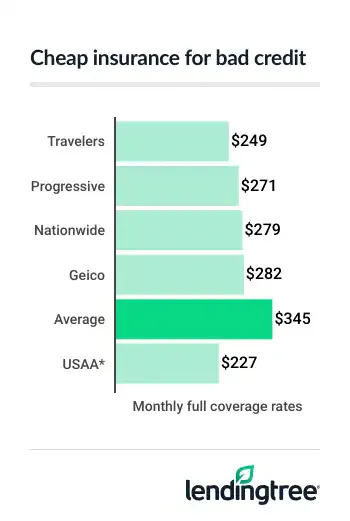
Travelers has the cheapest bad credit car insurance for most drivers. It charges drivers with bad credit an average of $249 a month for full coverage. USAA is cheaper, but it’s only available to the military community.
Cheap car insurance for bad credit
| Company | Monthly rate | LendingTree score | |
|---|---|---|---|
 | Travelers | $249 |  |
 | Progressive | $271 |  |
 | Nationwide | $279 |  |
 | Geico | $282 |  |
 | Allstate | $402 | |
 | Farmers | $473 | |
 | State Farm | $593 | |
 | USAA* | $227 | |
Drivers with bad credit pay an average of $345 a month for car insurance. This is 95% higher than the average for good credit, but some companies raise their rates by less. This makes it good to compare car insurance quotes from a few companies to find a cheap rate.
Cheap regional car insurance companies for bad credit
Regional companies are sometimes cheaper for bad credit car insurance than large ones like Travelers. For example, NJM only charges drivers with bad credit $229 a month, or 8% less than Travelers.
NJM also has a higher J.D. Power satisfaction
Regional company rates for bad credit
| Company | Monthly rate | LendingTree score |
|---|---|---|
| NJM | $229 | |
| Erie | $288 | |
| Mercury | $323 | |
| NYCM | $345 | |
| Farm Bureau | $346 | |
Cheapest bad credit car insurance companies by state
The cheapest bad credit car insurance near you depends on where you live. Travelers has the cheapest bad credit rates in 13 states, but Progressive is the cheapest in 10. In a few states, smaller companies like Farm Bureau and UAIC have the cheapest bad credit car insurance.
Your credit doesn’t affect your car insurance in California, Hawaii, Massachusetts and Michigan. These states don’t let auto insurance companies factor credit into your rates.
Cheap bad credit car insurance near you
| State* | Company | Monthly rate |
|---|---|---|
| Alabama | Country Financial | $160 |
| Alaska | Progressive | $188 |
| Arizona | Travelers | $223 |
| Arkansas | Farm Bureau | $298 |
| Colorado | Geico | $267 |
| Connecticut | Travelers | $221 |
| Delaware | Progressive | $271 |
| Florida | UAIC | $250 |
| Georgia | Farm Bureau | $119 |
| Idaho | State Farm | $121 |
| Illinois | Travelers | $140 |
| Indiana | Travelers | $157 |
| Iowa | Progressive | $144 |
| Kansas | Travelers | $203 |
| Kentucky | Travelers | $250 |
| Louisiana | Allstate | $212 |
| Maine | Travelers | $105 |
| Maryland | Geico | $207 |
| Minnesota | Travelers | $294 |
| Mississippi | Travelers | $212 |
| Missouri | Travelers | $187 |
| Montana | Nationwide | $251 |
| Nebraska | Farmers Mutual of Nebraska | $149 |
| Nevada | Travelers | $261 |
| New Hampshire | Safety | $144 |
| New Jersey | NJM | $229 |
| New Mexico | Geico | $254 |
| New York | Nationwide | $182 |
| North Carolina | Progressive | $70 |
| North Dakota | Progressive | $211 |
| Ohio | Geico | $150 |
| Oklahoma | Progressive | $158 |
| Oregon | Progressive | $169 |
| Pennsylvania | Nationwide | $231 |
| Rhode Island | Progressive | $272 |
| South Carolina | Nationwide | $229 |
| South Dakota | Farmers Mutual of Nebraska | $135 |
| Tennessee | Travelers | $184 |
| Texas | Progressive | $298 |
| Utah | Progressive | $223 |
| Vermont | Co-Op | $135 |
| Virginia | Travelers | $152 |
| Washington | Mutual of Enumclaw | $185 |
| Washington, D.C. | Geico | $423 |
| West Virginia | Westfield | $166 |
| Wisconsin | State Farm | $139 |
| Wyoming | American National | $93 |
Best car insurance companies for bad credit
Travelers and Progressive are the best large companies for bad credit car insurance. Travelers is cheaper, but Progressive has a better satisfaction score from J.D. Power. NJM is the best regional car insurance company for drivers with bad credit.
| Company | Annual rate | J.D. Power score* | LendingTree score |
|---|---|---|---|
| Progressive | $271 | 621 | |
| Travelers | $249 | 613 | |
| NJM | $229 | 721 | |
Best overall for bad credit: Progressive

Progressive’s good satisfaction score means customers generally like its rates, coverage options and customer service. It’s only slightly more expensive than Travelers, which makes it good to get quotes from both companies.
Progressive and Travelers offer similar discounts and coverage options. These include discounts for bunding
PROS
- Good customer satisfaction score
- Bad credit rates are 21% less than U.S. average
- Offers free accident forgiveness
CONS
- Slightly more expensive than Travelers
Best rates for most drivers: Travelers

Travelers’ bad credit car insurance rates are 28% less than the national average. You can get its quotes online or through an independent insurance agent. Many independent agents can also get you quotes from Progressive, which makes it easy to compare quotes.
Like Progressive, Travelers offers gap insurance, which isn’t always easy to find. Travelers offers many routine discounts for things like bundling policies and setting up auto pay. It also provides discounts for driving a hybrid vehicle or electric vehicle (EV). This isn’t offered from Progressive or many other companies.
PROS
- Cheapest large company for bad credit
- Offers gap insurance
- Discounts for hybrids and EVs
CONS
- Below-average satisfaction rating
Best regional company for bad credit: NJM

NJM has a better satisfaction rating than almost every other company in the Mid-Atlantic region. It also has lower rates for drivers with bad credit than most large companies. These are two good reasons to get quotes from NJM.
NJM also offers a few unique perks. Its full coverage
PROS
- Lower rates for bad credit than most large companies
- Excellent satisfaction rating
- Full coverage pays for a rental car after an accident
CONS
- Only available in five states
How does credit affect my car insurance rate?
Insurance companies believe your credit history shows how risky you may be to insure. In most states, insurance companies use your credit based insurance score (CBIS) to help set your rate.
Your CBIS is slightly different from the credit score lenders use for loans and credit cards. However, both scores are based on factors like your payment history and the amounts you owe.
Your insurance score determines your credit tier, or rating. Drivers with excellent credit pay 19% less for car insurance on average than drivers with good credit. Drivers with fair credit pay 21% more than those with good credit.
Insurance rates by credit tier
| Credit tier | Monthly rate | Rate vs. good credit |
|---|---|---|
| Excellent | $143 | -19% |
| Good | $177 | 0% |
| Average | $195 | +10% |
| Fair | $214 | +21% |
| Poor | $345 | +95% |
Avoiding late payments and paying down debts are good ways to help improve your credit based insurance score (CBIS). This, in turn, can eventually help you get cheaper car insurance.
Learn more with our guide to improving your credit score, and monitor your credit for free with the LendingTree app.
How to save money on bad credit car insurance
Shopping around and finding car insurance discounts can help you save money on car insurance with bad credit. So can raising your deductible.
Why shop around?
Car insurance companies look at more than just your credit to determine your rate. These other factors include your age, location, driving record and the type of car you drive.
Each company treats these factors differently. Some also place less emphasis on your credit score than others. Comparing quotes helps you find the company with the cheapest rates for your specific situation.
Which car insurance discounts are good for bad credit?
Bundling policies is a good way to save on car insurance, regardless of your credit rating. Payment discounts and usage-based insurance (UBI) programs can also help you save.
Most companies give you a generous discount for bundling your car insurance with a home or renters policy. You can often also save by setting up automatic payments or paying for your policy in full upfront.
Several companies also give you a discount for joining their usage-based insurance programs. Most of these require you to download a smartphone app that monitors how safely you drive. You get discounts for avoiding excessive speeds, distracted driving and other unsafe behaviors.
Why should I raise my deductibles?
Raising your deductibles
Consider asking for multiple deductible options with your quotes. This can help you find a deductible and rate that makes you comfortable.
Frequently asked questions
CURE and Dillo are among the car insurance companies that don’t check your credit. CURE is available in Michigan, New Jersey and Pennsylvania. Dillo is only available in Texas.
Most other insurance companies factor your credit into your quote, with some exceptions. The practice is banned in California, Hawaii, Massachusetts and Michigan.
Yes. In most states, your credit-based insurance score (CBIS) affects your car insurance rates. Your CBIS is slightly different from your normal credit score for things like loans and credit cards. However, both rely on factors like your payment history, the amounts you owe and your credit mix.
No. The credit checks that insurance companies run are known as soft inquiries. Soft inquiries don’t affect your credit score. Hard inquiries, like those for loan applications, do affect your credit score.
Methodology
LendingTree uses insurance rate data from Quadrant Information Services using publicly sourced insurance company filings. Most rates are based on an analysis of car insurance quotes for a typical driver in every U.S. state. Rates for credit tiers are based on quotes from Georgia, Illinois and Washington state.
All prices are shown for comparative purposes only. Your own rates may be different.
Unless noted otherwise, quotes are for a full-coverage policy for a 30-year-old man with a clean driving record who drives a 2018 Honda CR-V EX.
Coverage limits
Full-coverage policies include collision, comprehensive and liability coverage:
- Bodily injury liability: $50,000 per person, $100,000 per accident
- Property damage liability: $50,000
- Uninsured / underinsured motorist bodily injury: $50,000 per person and $100,000 per accident
- Personal injury protection: minimum limits, where required by law
- Collision: $500 deductible
- Comprehensive: $500 deductible
How we evaluated car insurance companies
Our team of insurance experts rated insurance companies based on several categories. These categories include average rates, discounts, coverage options, third-party customer service ratings and app/website experience. We weighted these categories based on what customers value in an insurance company.
For third-party customer service ratings, we included Complaint Index scores from the National Association of Insurance Commissioners (NAIC) and financial strength ratings from AM Best. NAIC Complaint Index scores are used to determine how satisfied customers are with their claims, while financial strength ratings from AM Best reflect the ability to pay out claims.
—
*USAA is only available to current and former members of the military as well as certain family members.