LendingTree’s Health Insurance Evaluation Methodology: How We Choose the Best Health Insurance Companies


Without health insurance, the cost of staying healthy and handling medical emergencies can be overwhelming. If you don’t have insurance through work, you can get it through the Health Insurance Marketplace, or exchange.
As part of our goal to support you in your financial journey, LendingTree analyzes marketplace health insurance plans to help you find the best options for you and your family.
Our evaluations focus on the factors that matter most, including costs, benefits and customer service ratings. This page explains the factors we use to make our picks for the best companies and plans in your area.
Our methodology categories
LendingTree evaluates marketplace plans across five categories that are essential to your healthcare journey.
Premium (25%)
Your premium is the monthly rate for your health insurance plan. Marketplace plans usually cover wellness visits and routine screenings at no extra cost. The rates shown in our articles are from the national healthcare exchange, state exchanges and other public sources.
Unless noted, our rates are for a 30-year-old nonsmoker with a Silver tier plan.
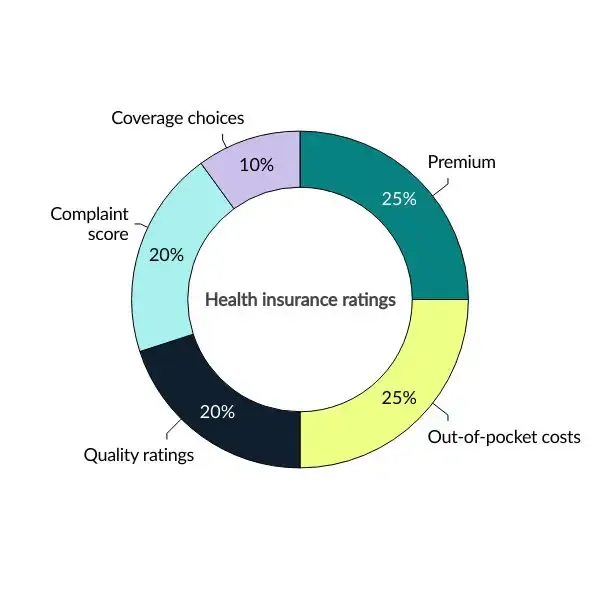
Out-of-pocket costs (25%)
A plan’s out-of-pocket spending requirements can have as much impact on your healthcare costs as your monthly rate does. If you need more care than just a wellness visit, you’ll have to pay, depending on your deductible and coinsurance, up to your policy’s maximum limit.
We analyze publicly filed plan data to review each company’s out-of-pocket spending requirements. Plans with lower deductibles, coinsurance and maximum limits are generally rated better.
Quality ratings (20%)
The Centers for Medicare and Medicaid Services (CMS) rates plans for quality on a five-point scale. Plans get higher scores by making it easy to understand both how your coverage works and how to get care. A third category uses customer surveys to measure member experience.
A plan’s overall quality rating is based on its average score in the three categories. Five stars is the highest score, and this is factored into our LendingTree rating.
Complaint score (20%)
The National Association of Insurance Commissioners (NAIC) tracks the complaints companies receive over things like claims and service. NAIC focuses on complaints that lead to a finding of fault.
A 1.0 rating is average. A 0.5 complaint score means the company receives half as many complaints as average, while 2.0 means twice as many. Companies with low complaint scores are generally more reliable, and this factors into our rating.
Coverage choices (10%)
A company with multiple plan options gives you more choices over how to get care and how to pay for it. Some companies offer plans that cover treatment from providers outside your network. Some let you choose between copayments for certain services or applying their cost to your deductible.
Companies with a wider array of plan types and payment options get higher ratings in this category.
Our methodology process
Companies that combine affordability, quality care and reliable customer service stand out as the best in our state and national health insurance comparisons.
We apply the same standards to every insurance company. While LendingTree may receive compensation from some companies if you request a quote, such compensation does not affect our editorial recommendations.
Please see our editorial standards for more information.