Big Companies Are Racing Ahead on AI — but Few Are Cutting Jobs


Nearly 1 in 5 U.S. businesses have used AI in the past two weeks, and a growing share plan to lean in even further. But a widening gap between large corporations and small businesses suggests the AI revolution isn’t arriving equally. For employees across the board, however, it seems their jobs may be safe for now, as companies report using AI more to supplement what their workers do, rather than to replace them.
Here’s a closer look.
- Nearly 1 in 5 (19.8%) U.S. businesses have used AI in the past two weeks, and 22.8% expect to use it in the next six months. Larger companies are adopting AI much faster, with businesses employing 250 or more workers reporting usage rates nearly twice as high as those with fewer than five employees (37.3% versus 19.0%).
- Delaware leads all states, with 33.5% of businesses using AI, compared with just 9.3% in Vermont. Across major metros, Seattle leads at 30.6%, while Riverside, Calif., has the lowest adoption rate at 12.4%.
- AI use is changing how work is done more than it is replacing employees. Among AI-using businesses, 95.7% report no employment changes as a result. Businesses are more than four times as likely to use AI to supplement employee tasks (43.7%) as to perform tasks previously done by employees (10.1%). They’re also about as likely (10.6%) to use AI for new tasks.
- Writing — not coding — dominates how employees use generative AI at work. Among businesses using generative AI, 85.4% report using it for emails, documents or communications, while many also use it for information searches (49.9%) and document analyses (44.6%). Software coding or debugging is much less common, at just 12.7%.
- The main barrier to AI adoption is a lack of relevance, not cost or regulation. Among businesses not planning to use AI, 61.6% say it doesn’t apply to their business. A lack of knowledge (22.0%) and privacy concerns (20.7%) follow, while cost (6.9%) and legal restrictions (2.8%) rank near the bottom.
Large companies lead the charge on AI adoption
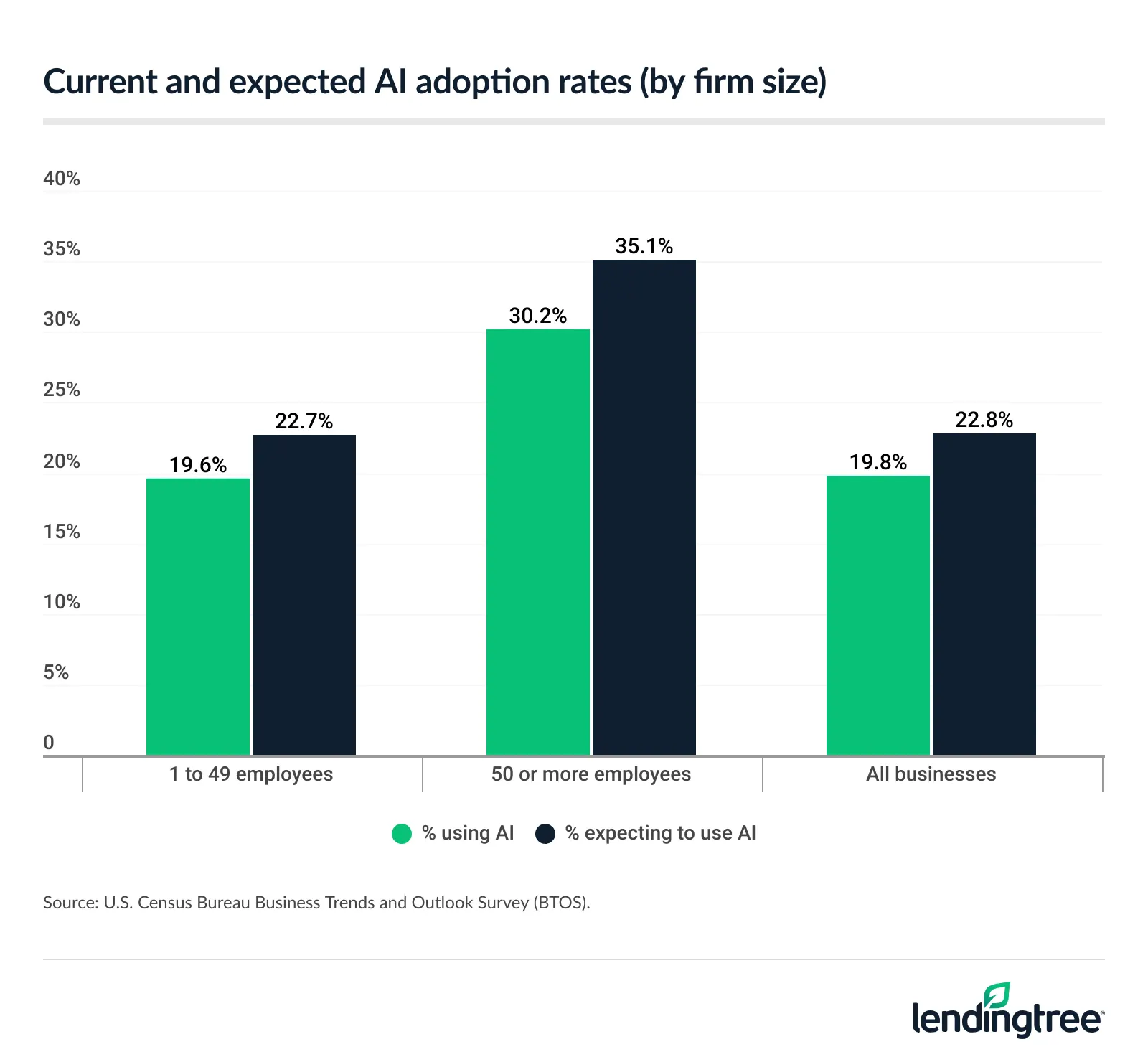
Across all U.S. businesses, 19.8% have used AI in the past two weeks, and a slightly larger 22.8% expect to use it in the next six months. But adoption isn’t evenly distributed. Larger companies are adopting AI at a much faster pace, with businesses employing 250 or more workers (37.3%) reporting usage rates that are significantly higher than those with fewer than five employees (19.0%).
Current and expected AI adoption rates by firm size
| Firm size | % using AI in the past 2 weeks | % planning to use AI in the next 6 months |
|---|---|---|
| 1 to 4 employees | 19.0% | 21.5% |
| 5 to 9 employees | 19.5% | 22.9% |
| 10 to 19 employees | 19.4% | 23.0% |
| 20 to 49 employees | 21.3% | 25.2% |
| 50 to 99 employees | 25.8% | 30.4% |
| 100 to 249 employees | 32.0% | 37.0% |
| 250 or more employees | 37.3% | 42.6% |
| All businesses | 19.8% | 22.8% |
Firms with 250 or more employees are also the most likely to expect to use AI over the next six months, at 42.6%. That is compared with just 21.5% of companies with fewer than five employees.
Matt Schulz, LendingTree chief consumer finance analyst and author of “Ask Questions, Save Money, Make More: How to Take Control of Your Financial Life,” says that gap in AI adoption reflects a familiar dynamic.
“Larger companies tend to have more money, more technical expertise and sometimes even more room to experiment, which makes it easier for them to adopt AI quickly,” he says. “Small businesses are often too busy running day-to-day operations to spend time evaluating new tools or training employees. The good news is that smaller businesses can still learn from enterprises by starting with one or two high-impact use cases, such as customer communication or administrative work, instead of trying to overhaul everything at once.”
Among businesses that are planning to use AI in the next six months, sales and marketing (62.8%) and strategy (57.4%) are the most common target functions. That’s followed by:
- Research and development (48.3%)
- Information technology (47.3%)
- Public relations and communication (43.8%)
- Customer service (40.0%)
- Management and administration (38.2%)
- Finance and accounting (36.5%)
- Provision of services, products or merchandise (32.4%)
- Legal and compliance (32.3%)
- Human resources (21.6%)
- Quality management and control (18.3%)
- Sourcing, supply chains and purchasing (14.6%)
- Production of goods (8.1%)
- Distribution (6.3%)
Delaware businesses lead in AI adoption
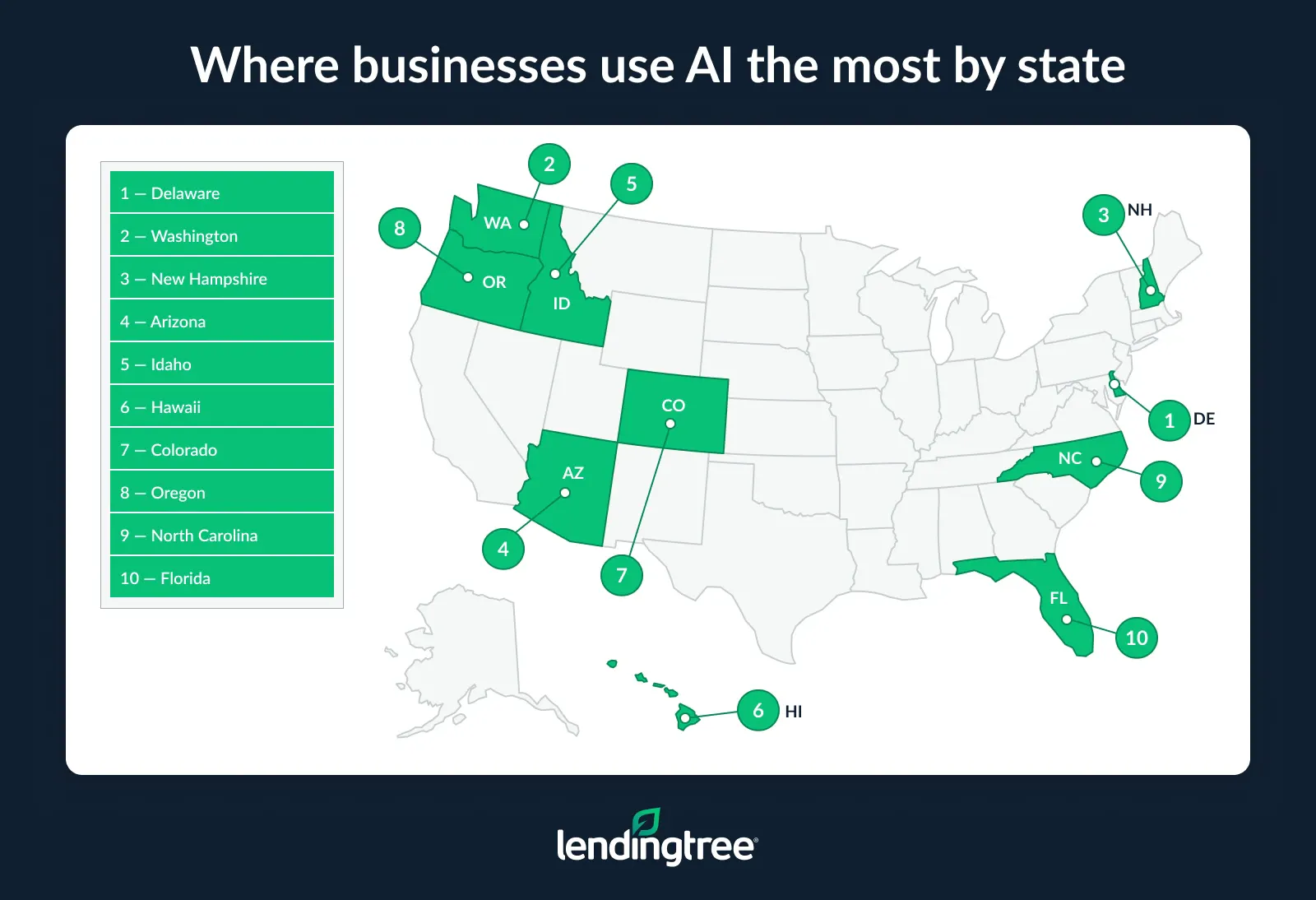
By state, Delaware has the highest share of businesses adopting AI, with 33.5% of businesses reporting using it in the past two weeks. It’s also the state with the highest rate of businesses planning to use AI in the next six months, at 43.4%.
Washington (28.6%) and New Hampshire (27.8%) follow in the rankings for current AI adoption among businesses. These states are also the next most likely to use AI in the future, at 32.0% and 30.0%, respectively.
Meanwhile, just 9.3% of businesses in Vermont have used AI in the past two weeks — the lowest rate of any state. Nebraska (11.3%) and New Mexico (11.9%) follow.
Drilling down to the largest major metros, Seattle leads, with 30.6% of businesses having used AI recently. Denver (29.3%) and Phoenix (28.4%) follow, while Riverside, Calif. (12.4%), Detroit (14.4%) and Baltimore (14.4%) have the lowest adoption rates.
By industry, the information sector — which includes jobs like publishing, motion picture and sound recording and broadcasting — leads, with nearly 2 in 5 (39.7%) businesses using AI in the past two weeks. Professional, scientific and technical services (like accounting, legal services and more) follows at 37.0%, with education (34.7%) rounding out the top three.
At the other end of the spectrum, mining and oil extraction sits at just 6.8%. This is also the only sector not expecting growth in AI usage over the next six months.
Industries using AI the most/least
| Industry | % using AI in the past 2 weeks | % planning to use AI in the 6 six months |
|---|---|---|
| Information | 39.7% | 41.8% |
| Professional, scientific and technical services | 37.0% | 40.4% |
| Educational services | 34.7% | 39.9% |
| Finance and insurance | 33.9% | 38.9% |
| Real estate | 24.4% | 26.4% |
| Healthcare and social assistance | 21.9% | 26.0% |
| Administrative and support and waste management and remediation services | 18.5% | 21.1% |
| Wholesale trade | 17.7% | 20.4% |
| Arts, entertainment and recreation | 17.3% | 19.9% |
| Utilities | 16.4% | 21.6% |
| Manufacturing | 16.4% | 19.5% |
| Retail trade | 14.3% | 16.8% |
| Construction | 12.3% | 15.0% |
| Other services (except public administration) | 9.5% | 11.5% |
| Accommodation and food services | 8.4% | 11.2% |
| Transportation and warehousing | 7.6% | 9.6% |
| Mining, quarrying, and oil and gas extraction | 6.8% | 6.8% |
Full rankings: Where businesses use AI the most/least by state
| Rank | State | % using AI in the past 2 weeks | % planning to use AI in the next 6 months |
|---|---|---|---|
| 1 | Delaware | 33.5% | 43.4% |
| 2 | Washington | 28.6% | 32.0% |
| 3 | New Hampshire | 27.8% | 30.0% |
| 4 | Arizona | 25.0% | 28.3% |
| 5 | Idaho | 24.9% | 26.9% |
| 6 | Hawaii | 24.4% | 24.9% |
| 7 | Colorado | 23.2% | 27.3% |
| 8 | Oregon | 22.7% | 22.5% |
| 9 | North Carolina | 22.3% | 24.6% |
| 10 | Florida | 22.1% | 24.9% |
| 11 | Massachusetts | 21.7% | 25.4% |
| 12 | Utah | 21.6% | 25.5% |
| 13 | Maryland | 21.3% | 26.5% |
| 14 | California | 20.6% | 23.6% |
| 14 | Texas | 20.6% | 24.1% |
| 16 | Minnesota | 20.2% | 23.0% |
| 17 | Missouri | 20.1% | 23.0% |
| 18 | Nevada | 19.9% | 20.7% |
| 19 | Indiana | 19.7% | 22.8% |
| 19 | Rhode Island | 19.7% | 23.6% |
| 21 | Illinois | 19.5% | 23.4% |
| 22 | Wyoming | 19.3% | 20.5% |
| 23 | Virginia | 19.2% | 22.1% |
| 24 | Ohio | 18.6% | 22.2% |
| 24 | South Dakota | 18.6% | 29.5% |
| 26 | Maine | 18.5% | 18.5% |
| 26 | New Jersey | 18.5% | 20.5% |
| 28 | Louisiana | 18.0% | 21.0% |
| 29 | Connecticut | 17.9% | 19.4% |
| 30 | Pennsylvania | 17.8% | 19.6% |
| 31 | Montana | 17.5% | 16.9% |
| 32 | Georgia | 17.4% | 21.5% |
| 33 | South Carolina | 17.3% | 24.7% |
| 34 | New York | 17.1% | 19.6% |
| 35 | Oklahoma | 16.9% | 20.4% |
| 36 | Wisconsin | 16.8% | 17.9% |
| 37 | Michigan | 16.7% | 19.0% |
| 38 | Arkansas | 16.3% | 20.7% |
| 38 | Iowa | 16.3% | 16.1% |
| 40 | Alabama | 16.1% | 20.4% |
| 41 | Alaska | 15.8% | 26.8% |
| 42 | Kentucky | 14.7% | 17.8% |
| 42 | Mississippi | 14.7% | 17.1% |
| 44 | Tennessee | 13.4% | 16.3% |
| 45 | Kansas | 12.8% | 15.3% |
| 46 | New Mexico | 11.9% | 13.8% |
| 47 | Nebraska | 11.3% | 14.6% |
| 48 | Vermont | 9.3% | 8.5% |
Full rankings: Where businesses use AI the most/least by metro
| Rank | Metro | % using AI in the past 2 weeks | % planning to use AI in the next 6 months |
|---|---|---|---|
| 1 | Seattle, WA | 30.6% | 34.5% |
| 2 | Denver, CO | 29.3% | 31.9% |
| 3 | Phoenix, AZ | 28.4% | 31.0% |
| 4 | Portland, OR | 26.2% | 25.1% |
| 4 | San Diego, CA | 26.2% | 29.6% |
| 6 | Washington, DC | 25.4% | 28.3% |
| 6 | Boston, MA | 25.4% | 28.7% |
| 8 | Miami, FL | 24.2% | 28.2% |
| 9 | Tampa, FL | 23.3% | 26.5% |
| 10 | Houston, TX | 23.0% | 26.5% |
| 11 | Charlotte, NC | 22.9% | 26.1% |
| 12 | Dallas, TX | 21.8% | 26.9% |
| 13 | Chicago, IL | 21.7% | 26.2% |
| 14 | Minneapolis, MN | 21.2% | 26.9% |
| 15 | Atlanta, GA | 21.0% | 25.8% |
| 16 | St. Louis, MO | 20.3% | 21.3% |
| 17 | Philadelphia, PA | 19.9% | 24.1% |
| 18 | Los Angeles, CA | 19.3% | 22.0% |
| 19 | San Francisco, CA | 17.2% | 23.3% |
| 19 | Orlando, FL | 17.2% | 20.1% |
| 21 | New York, NY | 17.0% | 19.6% |
| 22 | Baltimore, MD | 14.4% | 25.0% |
| 22 | Detroit, MI | 14.4% | 16.5% |
| 24 | Riverside, CA | 12.4% | 14.7% |
AI is changing jobs, not eliminating them
Despite widespread anxiety about AI displacing workers, the data indicates that isn’t necessarily the case. Among AI-using businesses, 95.7% report no employment changes as a result of AI use.

Schulz says those numbers track — at least for now. “Most are using AI to save time on repetitive work or to help employees work more efficiently rather than eliminate jobs outright,” he says. “Still, I understand why the fears about job losses persist. We’re in the early innings of this massive change, and no one quite knows what to expect. That sort of uncertainty is unnerving for people, especially when money is tight and prices are rising.”
When it comes to how businesses use AI, they’re more than four times as likely to use AI to supplement employee tasks (43.7%) than to perform tasks that were previously done by employees (10.1%). Businesses are about as likely to use AI for new tasks (10.6%).
Writing is the dominant use case for AI work
When businesses do use generative AI, they’re most likely reaching for it to write. Among businesses using AI, 85.4% report using it for emails, documents or communications, while many also use it for information searches (49.9%) and document analyses (44.6%).
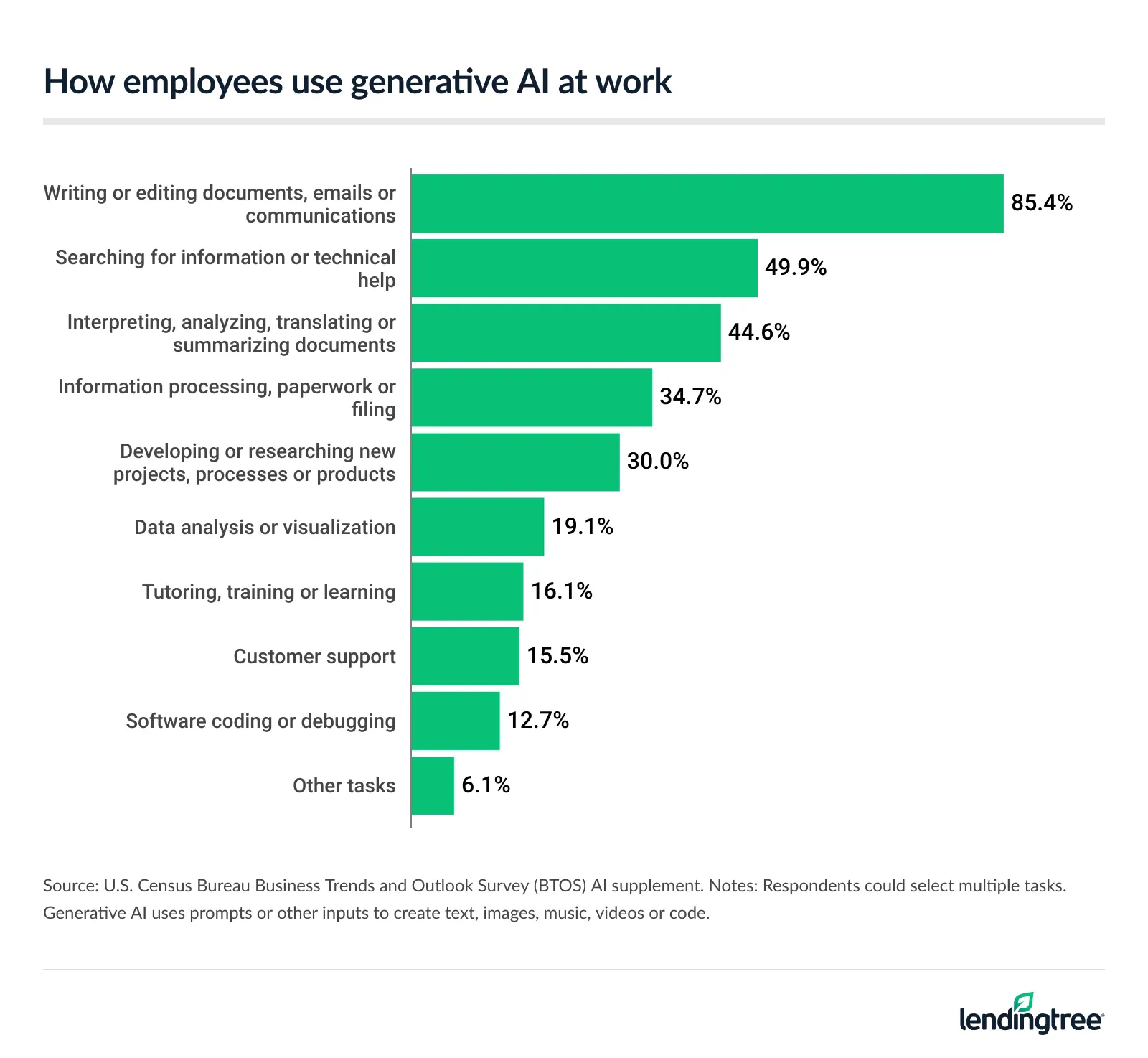
Meanwhile, just 12.7% report using it for software coding or debugging.
Schulz believes that writing tasks are a natural entry point for AI use because pretty much everyone does them. “Almost every business sends emails, creates documents or communicates with customers, and most people probably feel a little insecure about their writing ability, so they lean on AI tools for help,” he says. “Those sorts of tools can improve things in a hurry, and every business loves when a new tool can be used immediately, effectively and with minimal training.”
Businesses not adopting AI blame lack of relevance
Cost and regulation aren’t what’s keeping most businesses away from AI — instead, it’s simply a perceived lack of relevance. Among businesses that aren’t planning to use AI over the next six months, a whopping 3 in 5 (61.6%) say it doesn’t apply to their business.
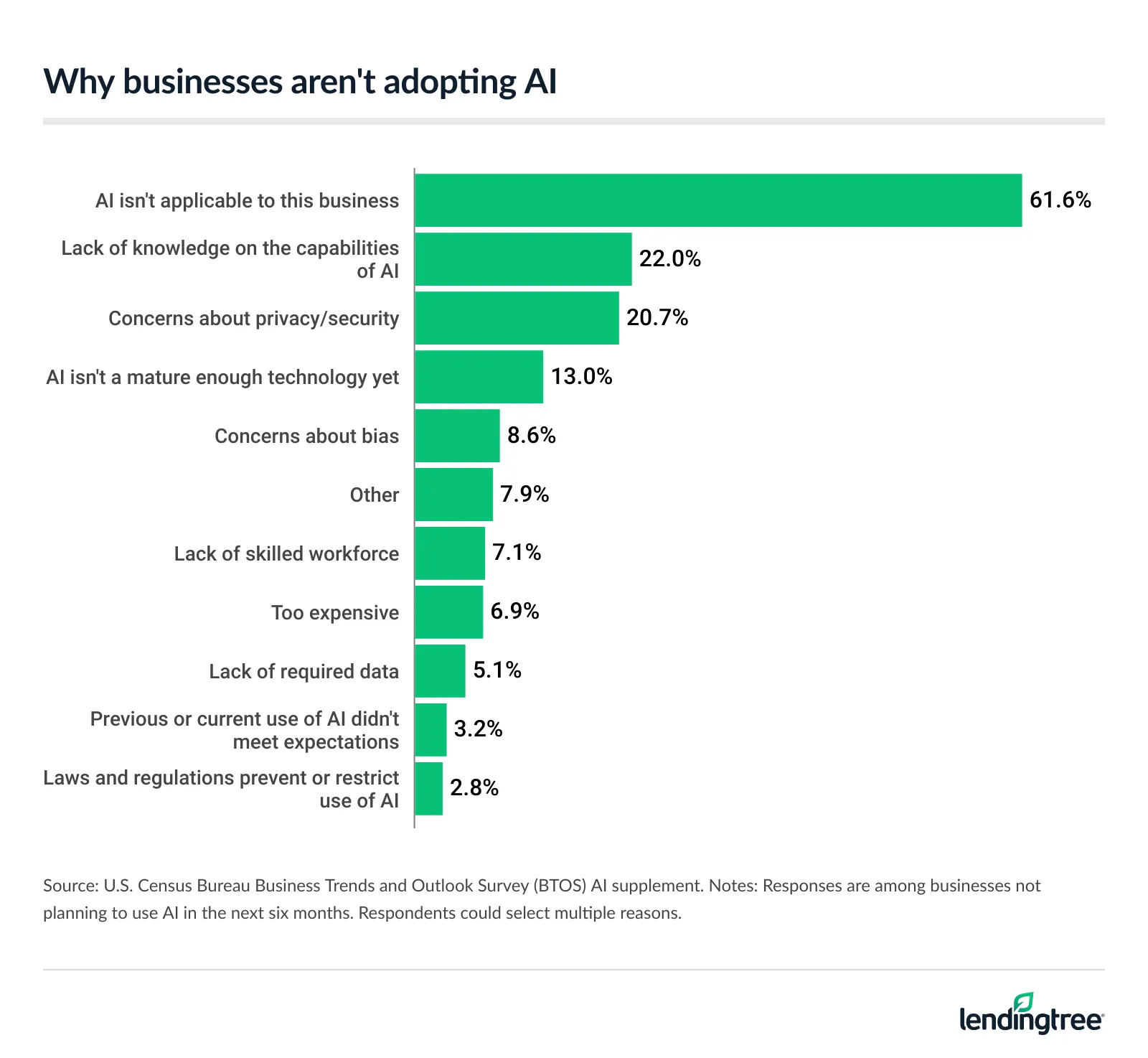
That’s followed by a lack of knowledge of the capabilities of AI (22.0%) and privacy concerns (20.7%). Meanwhile, legal restrictions (2.8%), previous use of AI not meeting expectations (3.2%) and a lack of required data (5.1%) rank at the bottom. Just 6.9% of businesses cite cost as a factor in their decision not to adopt AI.
Still, Schulz believes that AI adoption will only grow. “As time rolls on and understanding of AI tools grows, far more business owners will realize how it can help them,” he says. “At the same time, there are likely some industries where AI adoption may stay limited because the work depends heavily on physical labor or face-to-face interaction, for example. Still, I think in the long run, far more businesses will find they can benefit from AI tools, at least to some degree, than can’t.”
Top ways to start using AI in your business
AI can be a powerful tool for small businesses, but the most successful companies approach it with a clear purpose and realistic expectations. We offer the following advice:
- Identify one specific problem that wastes time or money, and test AI on that before expanding further. “Don’t spend on AI just to spend on it,” Schulz says. “Figure out ways that it can help your business, and then put it to work. To figure out where it can be valuable, involve employees early. That way, you can ensure that the tools solve real problems instead of becoming a top-down experiment nobody uses and some even resent.”
- Don’t expect perfection. “AI is amazing, but it can be wrong, and it can be a bit of a people-pleaser, at least at this point in its evolution,” he says. “Make sure that what it produces lives up to your company’s standards.”
- Make training and oversight part of the process from day one. AI works best when employees understand how to use it effectively and where human judgment still matters. Set clear guidelines for reviewing AI-generated work, protecting sensitive information and measuring results, so the technology supports your business instead of creating new risks.
- Be strategic about your investment. Before committing to expensive tools or subscriptions, evaluate what your business needs and whether small business loans, SBA loans or a business line of credit could help support long-term growth. AI can be most effective when paired with a clear plan, employee training and realistic expectations about the return on investment.
Methodology
LendingTree researchers used U.S. Census Bureau Business Trends and Outlook Survey (BTOS) data released May 7, 2026.
We analyzed two survey questions:
- Whether businesses have used artificial intelligence (AI) in any of their business functions in the past two weeks
- Whether they expect to use AI in any of their business functions in the next six months
This analysis uses the broader “business functions” definition introduced in November 2025. Results are analyzed across firm size, sector, state and large metros.
The analysis also incorporates data from the BTOS AI supplement, collected from Nov. 17, 2025, through Feb. 8, 2026. Supplemental questions examined:
- How businesses use AI and generative AI in day-to-day work tasks
- The effects of AI on employment and task replacement
- Why some businesses don’t plan to adopt AI
Some supplemental questions were asked only of businesses already using AI or businesses not planning to adopt AI.
Compare business loan offers