50% of Americans With Auto or Home Insurance Have Avoided Filing a Claim


Having insurance and using it are two different things.
This LendingTree survey finds that half of Americans with auto or home insurance have held off on filing or pursuing a claim they were otherwise entitled to — often because they’re worried about what it might cost them down the line.
Here’s a closer look at what’s keeping policyholders from picking up the phone, and what happens when they don’t.
- Half (50%) of Americans with auto or home insurance have avoided filing or pursuing a relevant claim, including 84% of Gen Zers. Key deterrents include potential premium increases (24%), costs below or slightly above the deductible (23%) and expenses or damage seeming too minor to report (22%). Additionally, 73% say they probably would have filed if they knew the claim wouldn’t affect premiums, discounts, renewals or future coverage eligibility.
- Many are willing to shoulder significant expenses rather than turn to insurance. Among those who’ve avoided a claim, 34% paid $1,000 or more out of pocket, including 15% who paid at least $2,500. Of those who avoided filing a claim, 37% say they regret it, while 40% say it was the right decision.
- Instead of filing a claim, many take matters into their own hands. Claim avoiders most commonly handle the issue themselves (29%). Some pay the full cost (23%), opt for a less expensive solution (20%) or skip the repair or replacement entirely (18%).
- For many, pursuing a claim falls short of expectations. Among those who pursued a nonroutine auto or home claim in the past five years, 46% say the insurer paid roughly what they expected, but 33% say it paid less than expected. Meanwhile, 26% had a claim denied, and 27% saw their premium increase.
- Avoiding a claim often creates additional problems. Only 16% of claim avoiders say there were no noticeable negative consequences. Common consequences included delaying other spending (23%), emotional stress (20%), financial stress (20%), the damage or problem becoming worse (18%) and going into or increasing debt (17%).
Premium increases and minor costs help keep half of policyholders from filing
Half (50%) of Americans with auto or home insurance say they’ve avoided filing or pursuing a claim they could have made.
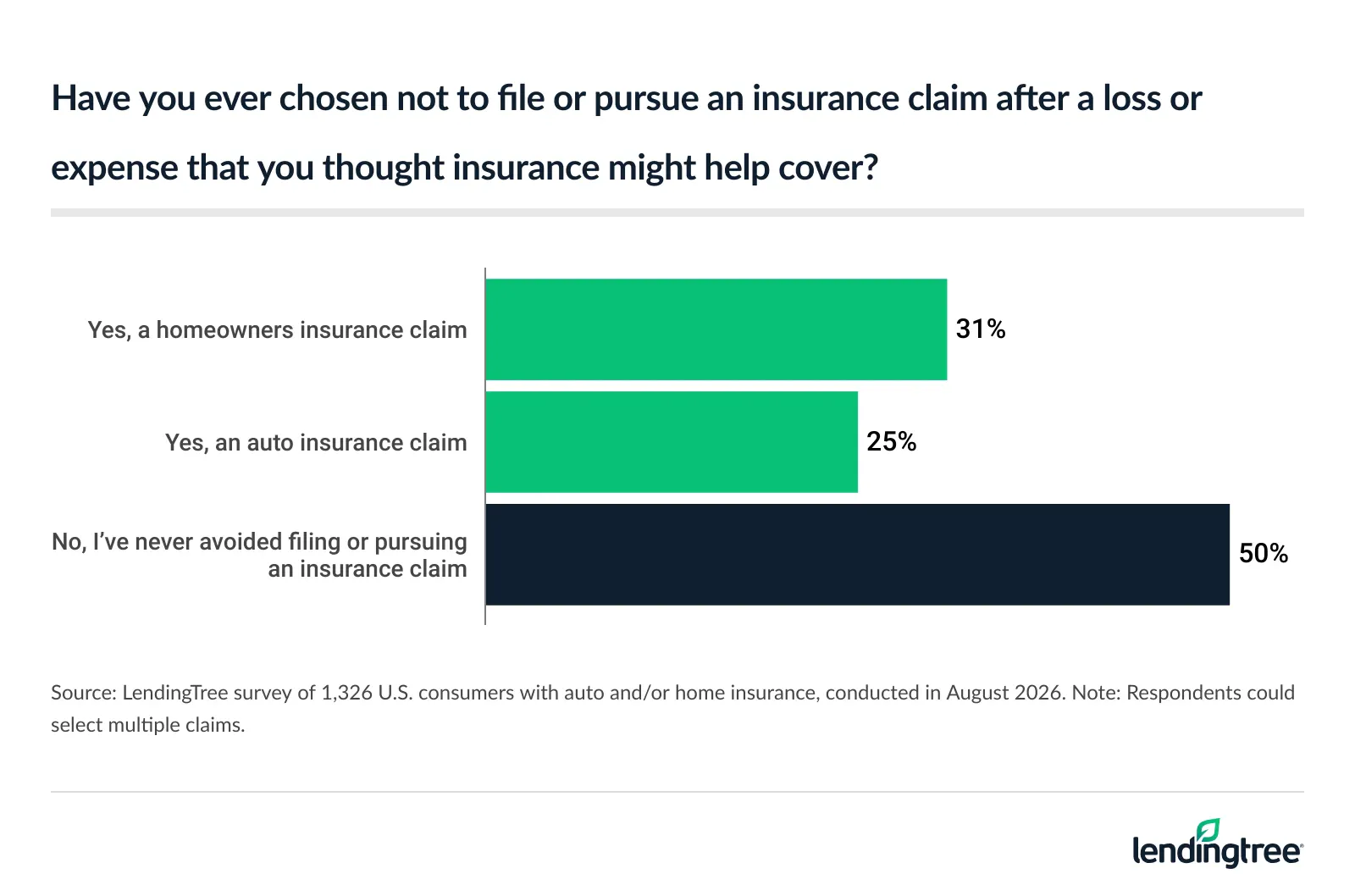
That percentage jumps to 84% among Gen Zers ages 18 to 29 — the highest by far. Meanwhile, 63% of millennials ages 30 to 45 say similarly. In contrast, Gen Xers ages 46 to 61 (40%) and baby boomers ages 62 to 80 (27%) are less likely to avoid a claim.
The biggest deterrents are the fear of a premium increase (24%), a cost that falls below or just above the deductible (23%) and damage that feels too minor to bother reporting (22%). Other concerns include:
- They worried their insurer would cancel or not renew their coverage (15%)
- They didn’t want the claim to appear on their insurance history (15%)
- They viewed the claims process as too time-consuming, stressful or inconvenient (15%)
- They believed the claim would be denied or only partially covered (14%)
- They wanted to resolve the issue privately (13%)
- They were advised not to file by an insurance agent, contractor, repair shop or other professional (13%)
- They had another person, company or organization agree to pay (13%)
- They worried about having too many claims on their record (12%)
- They didn’t want to share personal or location information with the insurer (10%)
- They didn’t know how to file a claim or what documentation was needed (10%)
- They were unsure whether the damage was covered (10%)
- Other (3%)
That hesitation lines up with how insured people think about claims in general. Asked which statement best matches their outlook, 36% say insurance is there to be used whenever they have a covered loss, while 23% say they typically only file for bigger losses. Another 20% actively try to avoid filing because they worry it’ll cost them more in the long run.
Much of that worry comes down to cost. Nearly three-quarters (73%) of avoiders say they probably would have filed if they’d known the claim wouldn’t affect their premiums, discounts, renewal terms or future eligibility for coverage — suggesting a lot of this avoidance comes down to uncertainty about the rules, not the size of the loss itself.
According to LendingTree insurance expert Rob Bhatt, there are a few key differences in auto and home insurance worth considering before deciding to file a claim.
“For car insurance, a claim over something that wasn’t your fault usually has a smaller impact on your rates than claims over accidents you cause,” he says. “For example, some companies won’t raise your rates over a small comprehensive claim for damage to a window or vandalism. A claim from an accident caused entirely by another driver usually doesn’t increase your car insurance rate either. However, most states have partial-fault laws. Your rates may go up if your insurance company had to pay for a portion of your repairs due to your partial fault.”
Home insurance claims are different. “Most property damage and liability claims will make your home insurance rates go up, and if you have too many claims within two or three years, your insurance company may drop you,” he says. “This makes it generally worth avoiding insurance for minor repairs you can afford to pay out of your own pocket.”
Of course, there are a few exceptions to this, according to Bhatt. “If you’ve been with your insurance company for several years and haven’t filed a claim in the past, one small claim may not be such a big deal,” he says. “Some companies offer claims forgiveness, which prevents your first claim from making your rate go up.”
Many would rather pay out of pocket than turn to their insurer
Skipping a claim isn’t necessarily cheap. Among those who’ve avoided filing, 34% ended up paying $1,000 or more out of their own pocket, including 15% who paid at least $2,500. Six-figure earners with insurance (53%) are the most likely to pay $1,000 or more out of pocket.
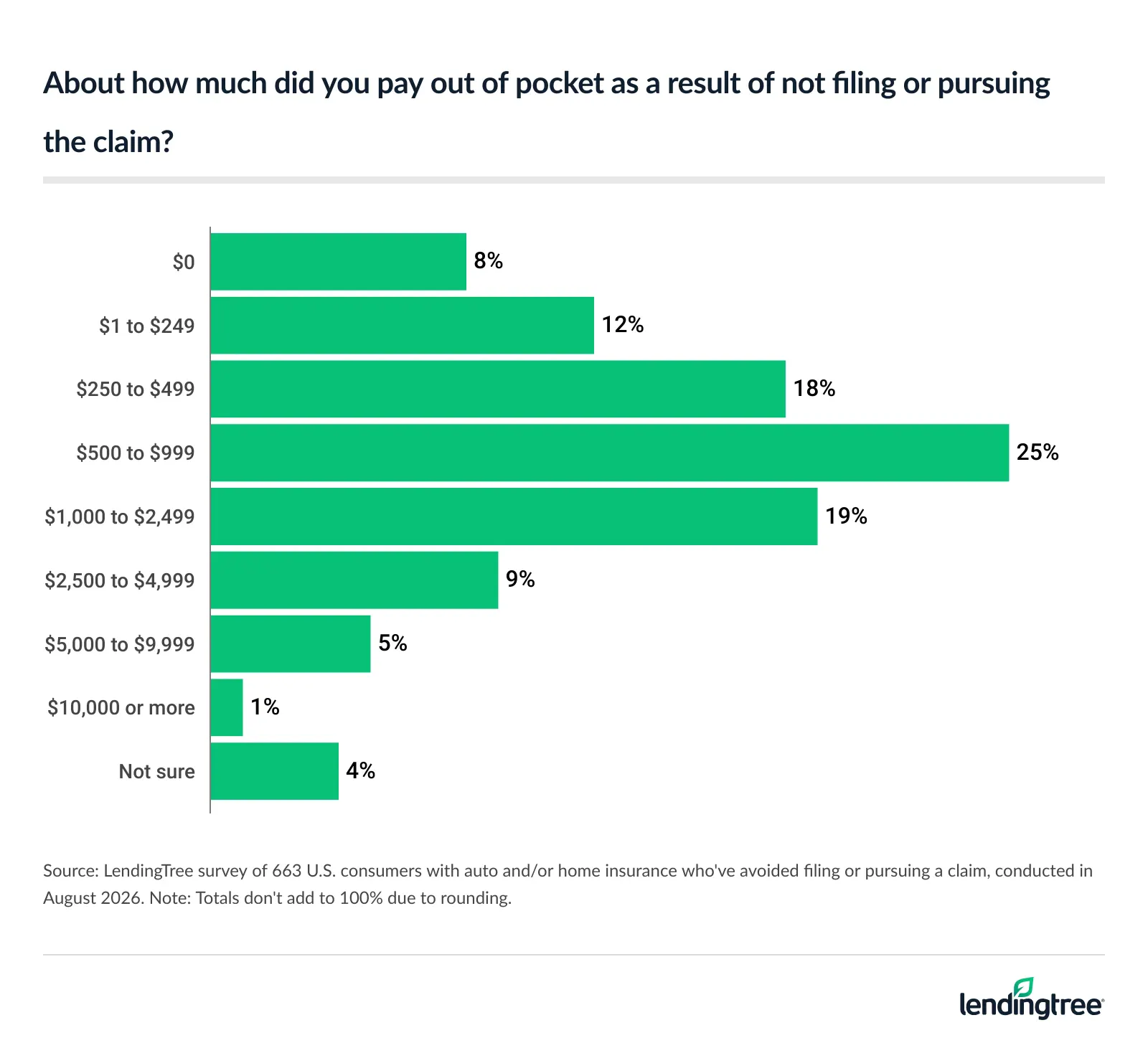
Even so, opinions are split on whether it was worth it, as 37% of claim avoiders say they regret the decision, while 40% say it was the right call. That split holds even though a majority (53%) of insured Americans believe that filing a legitimate claim would leave them better off financially overall — a sign that plenty of people are choosing short-term caution over what they themselves believe is the better financial outcome.
When it comes to car insurance, Bhatt notes that having an accident of any type show up on your vehicle history report, like Carfax, can reduce its resale value. “Paying for minor damage yourself helps keep a small fender bender that you’ve fixed from reducing your car’s resale value,” he says.
Ultimately, Bhatt says there are a few steps to take to determine your out-of-pocket costs before ruling out a claim entirely — though the hard cutoff depends on your financial situation.
“Start by getting a repair estimate to see how much you’re going to have to spend,” he says. “Then, compare it to your deductible, which is the amount you have to cover for repairs. If you have a $3,500 deductible and need $5,000 in repairs, insurance is only going to pay $1,500, which isn’t very much.”
When consumers skip a claim, they handle the problem themselves
Rather than call their insurer, most claim avoiders find another way to deal with the issue. The most common approach is handling the repair or problem themselves (29%), followed by paying the full cost out of pocket (23%), opting for a cheaper repair or replacement (20%) or skipping the repair altogether (18%).
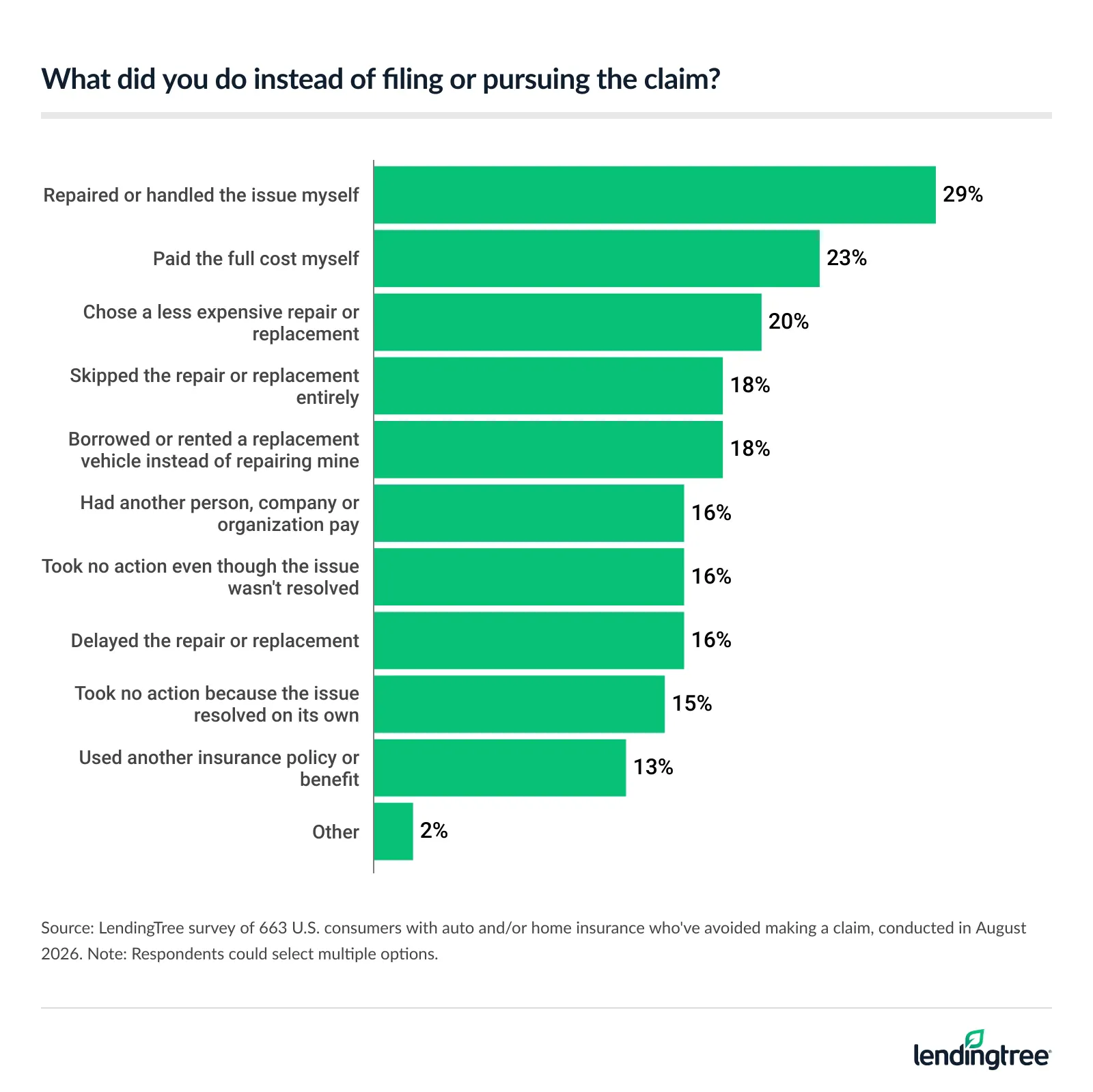
While Bhatt says it’s usually good to make the repairs yourself when you have the skills to do so, it’s not always the smartest move. Still, consumers certainly shouldn’t skip repairs.
“Doing it yourself helps you avoid a possible insurance rate hike from a claim and also potentially high costs of hiring someone for repairs,” he says. “However, complex projects involving the drivetrain of your vehicle or the plumbing, wiring or HVAC in your home are often better left to trained professionals. Delaying repairs is rarely good. Letting damage go unrepaired for too long often opens the door up to more serious problems like rust to your car or mold damage to your home. This can have long-term impacts on the resale value of your car or home.”
When claim avoiders have to cover a cost themselves, they lean hardest on money they already have. Savings (27%) are the most common source, followed closely by current income or checking account funds (25%). Credit cards play a big role, too: 21% paid with a card they cleared in full, while a nearly identical 20% put the cost on a card and carried a balance. Other common cost-covering methods include:
- Delaying other spending because of the cost (17%)
- Borrowing money from family or friends (17%)
- Using money from selling investments or other belongings (15%)
- Using a personal loan, payment plan or buy now, pay later service (15%)
- Using an emergency fund (13%)
- Other (3%)
These decisions skew heavily toward one line of coverage: Thinking back to the most recent time they chose not to file, 73% of avoiders say it involved auto insurance, versus 27% who point to homeowners insurance. This gap suggests that drivers are especially likely to eat smaller costs themselves rather than report a fender bender or minor damage.
As far as when the most recent issue sparking claim avoidance was, 34% of claim avoiders say it happened three to five years ago, while 31% say it was one to two years ago and 20% say it happened in the last 12 months. Only 13% describe an incident from more than five years ago.
Filing a claim doesn’t always deliver what consumers expect
For those who go through with it, the outcome isn’t always what they hoped for. In total, 40% of insurance holders have filed a home or auto insurance claim in the past five years, with 25% filing one claim and 14% filing multiple.
Among this group, 46% say their insurer paid roughly what they expected, but 33% say the payout came in lower than expected.
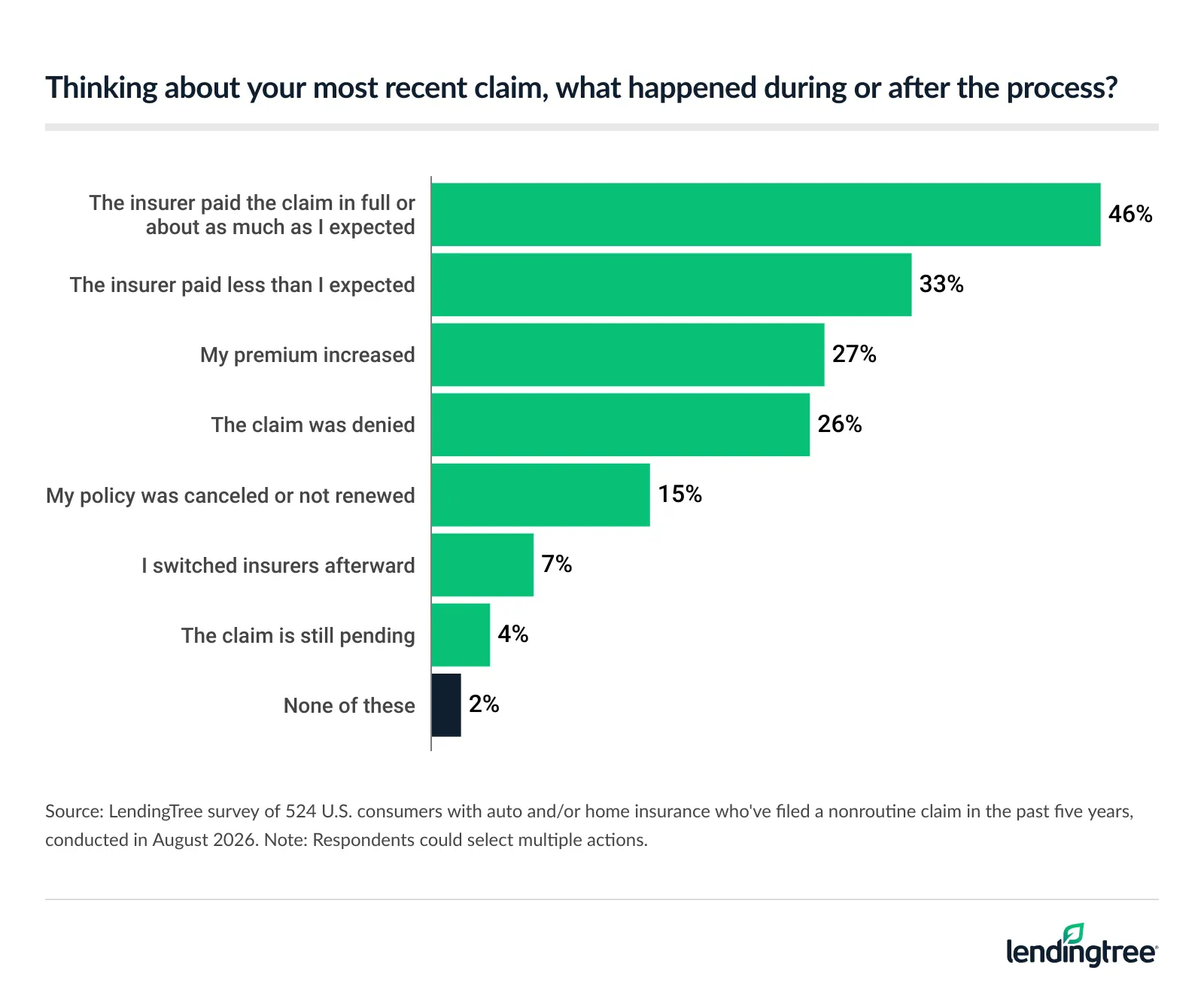
Beyond payout amounts, 26% had a claim denied outright, and 27% saw their premium go up as a result of filing. The fallout can go even further: For 15%, their policy was canceled or not renewed afterward. Meanwhile, 7% switched insurers as a result, and 4% say their claim is still pending.
Unfortunately, Bhatt says, insurance claims often don’t go as smoothly as people hope.
“It’s important to follow up with your insurance company every year or so to make sure the coverage you have matches your needs,” he says. “It’s also important to create and maintain a home inventory for home or renters insurance. A good home inventory includes a list of your possessions with purchase details, receipts for big-ticket items and pictures showing your items in your home. You only need a smartphone camera and spreadsheet to create one. You can store this information in the cloud so it’s easy to access if you ever need to file a claim.”
And for major home insurance claims, Bhatt believes it may be worth hiring a licensed public adjuster. “A public adjuster can help you gather the documentation you need to file a claim and represent your interests to your insurance company,” he says. “They usually don’t have upfront fees. Instead, they take a percentage of your insurance settlement as payment. It’s good to look up a public adjuster on your state insurance commissioner’s website to make sure they have a valid license before you hire them.”
Avoiding a claim can create its own set of problems
Choosing not to file doesn’t mean choosing a problem-free path. Just 16% of claim avoiders say there were no noticeable downsides to their decision. Far more commonly, people report delaying other spending to cover the cost (23%), emotional stress (20%), financial stress (20%), the damage or problem becoming worse (18%) and going into debt or increasing existing debt (17%).
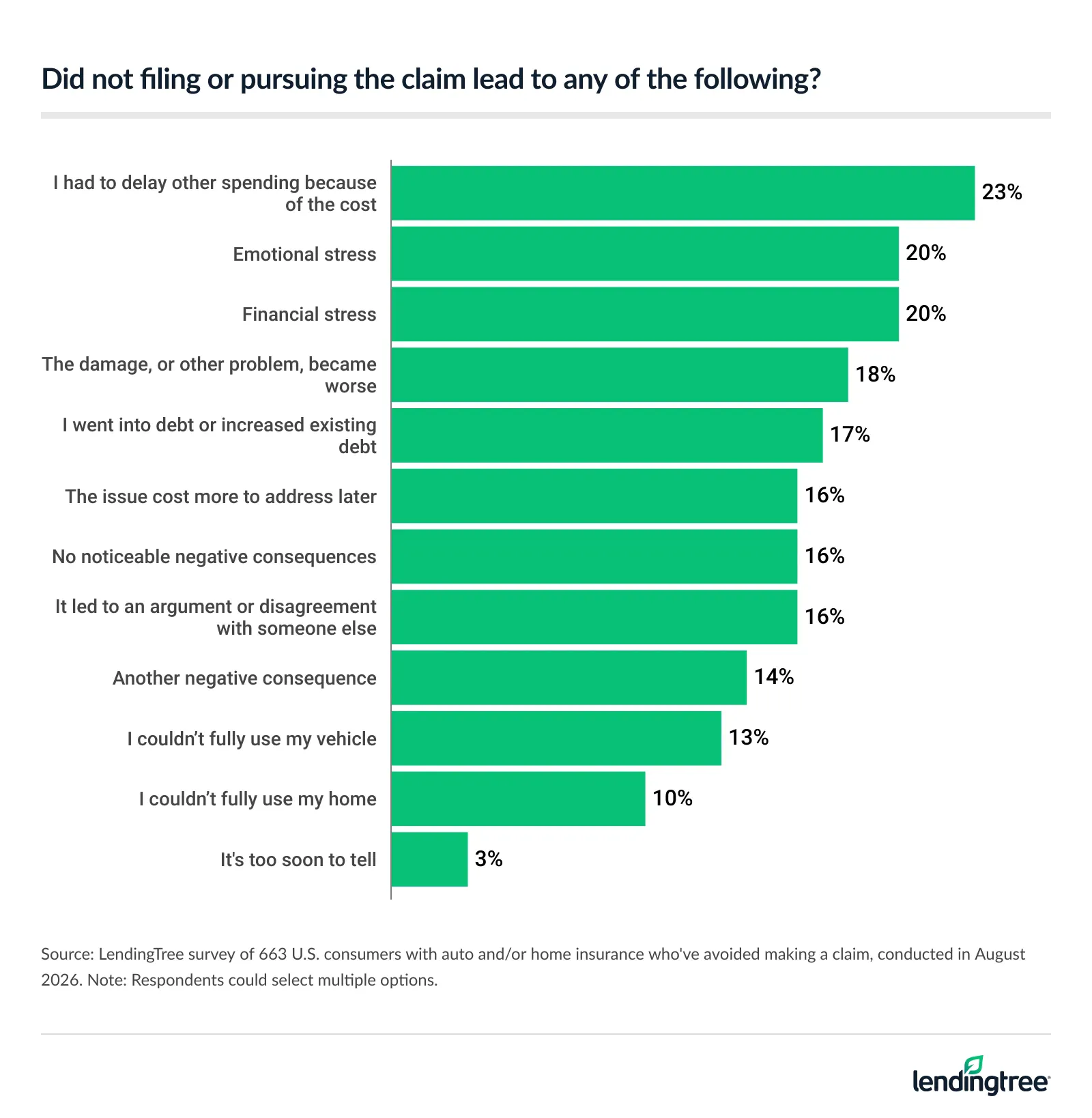
In other words, the very costs and complications that people are trying to dodge by not filing a claim often show up anyway, just in a different form.
Bhatt says it’s understandable that consumers may struggle with their decision.
“Many people have been feeling financial strains in recent years, and having to cover repair costs after an accident or disaster only heightens this type of stress,” he says. “One thing to keep in mind, though, is that investing in repairs to your car or home helps them retain their value. Some people may find solace in this.”
On the other hand, the headaches that can arise from avoiding a claim may be worse than the ones you get from filing one. “In some situations, the convenience of letting insurance pay for your repairs may be worth the price of higher insurance rates for a while later,” he says.
Top expert tips on weighing the costs before filing a claim
Deciding whether to file an insurance claim isn’t always straightforward. We offer the following advice:
- Document the damage. “Take photos and notes, gather contact and insurance information from other parties and witnesses when applicable, and take reasonable steps to prevent further damage,” Bhatt says. “A well-funded rainy-day fund can also give you more flexibility to cover smaller repairs yourself.”
- Get repair estimates. “Find out what repairs are likely to cost as soon as possible,” he says. “Knowing the price can help you determine whether paying out of pocket is realistic or whether filing a claim makes more financial sense.”
- Check your coverage first. “Contact your insurer to ask whether the damage is covered, what your deductible is and whether a claim could affect your rate,” he says. “Make it clear that you’re only inquiring and don’t want to open a claim yet.”
Methodology
LendingTree commissioned QuestionPro to conduct an online survey of 2,000 U.S. consumers from Aug. 5 to 9, 2026. The survey was administered using a nonprobability-based sample, and quotas were used to help ensure the sample reflected the overall population. Researchers reviewed all responses for quality control.
Generations were defined as the following age groups in 2026:
- Generation Z: 18 to 29
- Millennials: 30 to 45
- Generation X: 46 to 61
- Baby boomers: 62 to 80