Half of Gen Zers Get Financial Help From Parents, and 38% Say They’d Struggle Without It


The Bank of Mom and Dad doesn’t close when kids turn 18.
This LendingTree survey finds that most parents of adult children have opened their wallets at some point — and for a large share, that support is a regular, ongoing arrangement rather than a one-time favor.
Here’s what parents and their adult children say about who’s paying for what, how much it’s costing and how everyone involved feels about it.
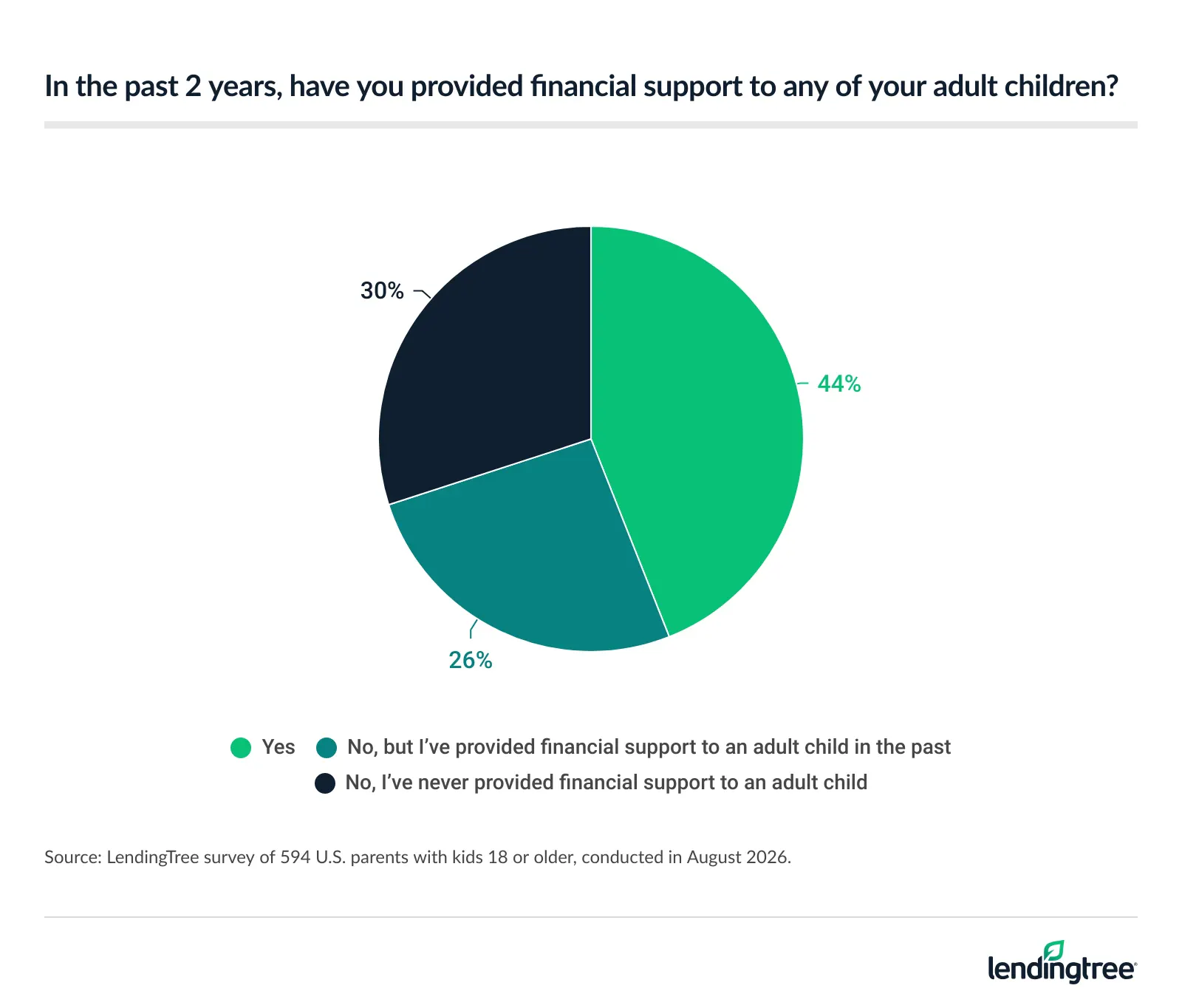
- More than 7 in 10 (71%) parents with children 18 or older have financially supported an adult child — and for many, the Bank of Mom and Dad is still open. 44% of parents of adult children have provided support in the past two years. Among these recent supporters, 32% provide money multiple times a month. And 3 in 10 expect to keep helping indefinitely, or as long as needed.
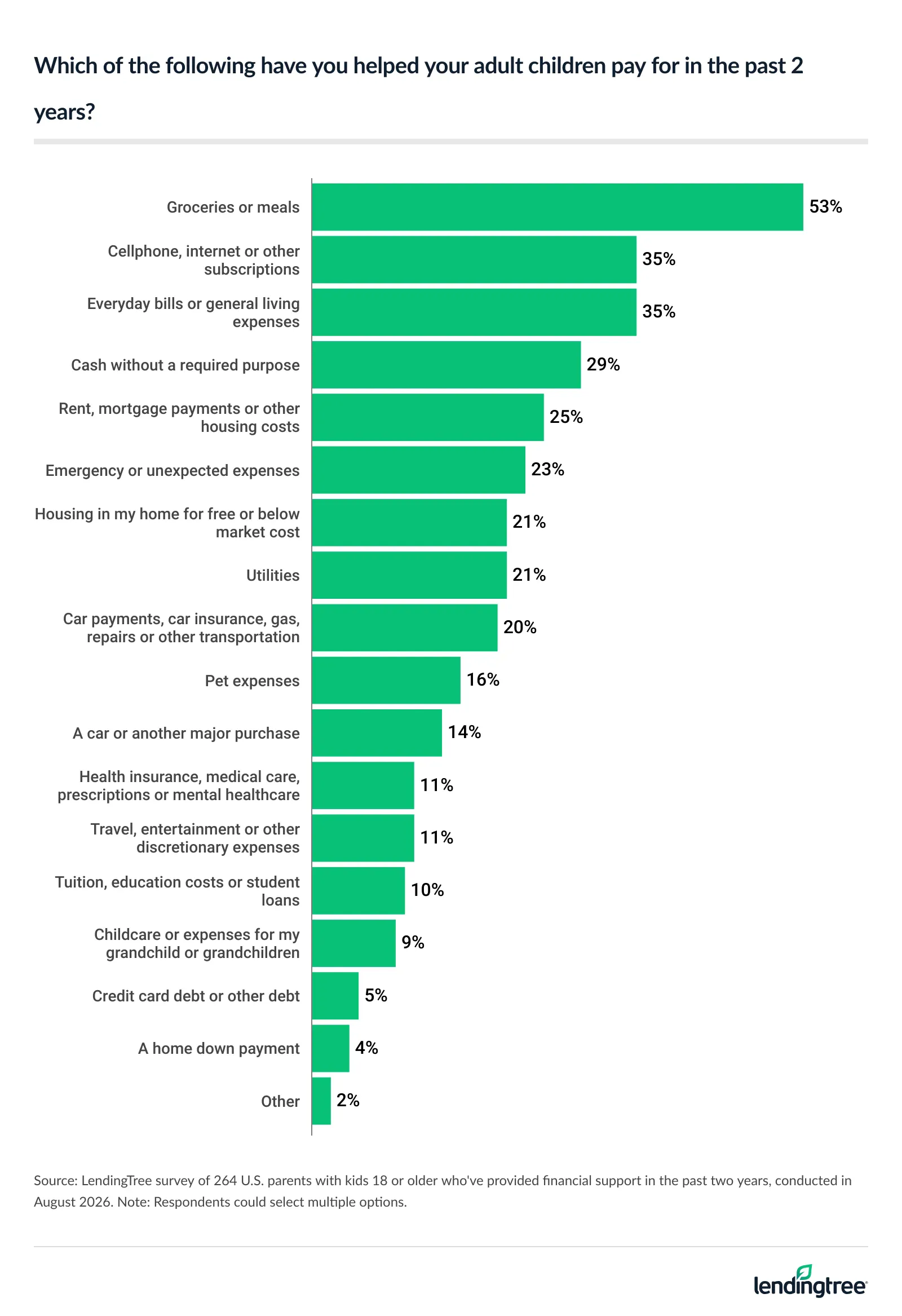
- Parents are helping adult children cover everyday essentials, and the support can add up to thousands of dollars. Groceries or meals (53%) top the list, followed by cellphone, internet or other subscriptions (35%), everyday bills or general living expenses (35%), cash without a required purpose (29%) and housing costs (25%). A third (33%) say they’ve given their adult children $2,500 or more in the past two years.
- Young adults are especially reliant on parental help, and many recipients aren’t confident financial independence is around the corner. Across all Americans, 50% of Gen Zers and 41% of millennials say they’ve received financial support from their parents in the past two years. Among those who’ve received support, 38% say their current living expenses would be difficult or impossible to manage without their parents’ help, and just 44% are very confident they could become financially independent in the next two years.
- Helping adult children is taking a financial and emotional toll on parents. Nearly two-thirds (64%) of parents who’ve provided support in the past two years say they’ve felt financially stressed because of it at least sometimes. Parents say the support has made them less able to cover everyday expenses (18%), pay off debt (16%), build or maintain savings (13%) and save for retirement (11%).
Most parents have helped an adult child financially — and for many, it hasn’t stopped
The vast majority of parents with grown children have stepped in financially at some point: 71% say they’ve provided money to an adult child, and 44% have done so within the past two years.
Matt Schulz, LendingTree chief consumer finance analyst and author of “Ask Questions, Save Money, Make More: How to Take Control of Your Financial Life,” says that’s an important indicator for parents.
“It tells you there’s no magic age when parenting stops, and for many families, financial support has become part of parenting an adult child,” he says. “However, help can become dangerous when it keeps parents from paying their own bills, tackling debt, saving for emergencies, preparing for retirement or pursuing other big financial goals. You can’t help your kid by putting your financial future at risk.”
For nearly a third (32%) of parents who’ve provided financial support in the past two years, the support they’ve provided isn’t occasional — they’re sending money multiple times a month. Meanwhile, 26% send money once a month and 18% send money every few months. Others send aid less frequently, as 10% say they’ve sent money once in the past 12 months, 4% say they’ve done so within the last 12 months to two years and 11% say the frequency of their help varies significantly.
Sons and daughters are getting roughly equal help, with 58% of these parents supporting at least one adult son financially and 55% supporting at least one adult daughter. The arrangement also tends to be lasting: Only 12% of parents who provide support say the amount has decreased significantly over the past two years, while 28% say it’s held steady. Just 13% say they only started providing support in the last two years.
It’s little wonder, then, that 3 in 10 (30%) expect to keep helping indefinitely, or for as long as their child needs it — a group that may overlap with the 31% whose adult children live with them at their home. Meanwhile, 30% expect they’ll help for five years or less, and 18% don’t anticipate continuing to financially support their kids in the future.
In fact, many of these parents indicate they’d continue supporting their kids even if they were struggling themselves — 22% say that even if their own finances worsened, they’d be unlikely to reduce the amount of support they provide.
Parental support covers the basics, and it adds up fast
When parents help, they’re mostly covering everyday survival costs. Among parents who’ve provided support in the past two years, 53% say they’ve helped pay for groceries and meals — the most common response. That’s followed by cellphone, internet or other subscriptions (35%), everyday bills or general living expenses (35%), cash without a required purpose (29%) and housing costs (25%).
A third (33%) of helping parents say they’ve handed over $2,500 or more in the past two years alone. Meanwhile, 21% have sent $1,000 to $2,499 and 36% have sent $999 or less.
When it comes to distinguishing between occasional help and a level of support that may be masking an unsustainable budget or debt problem, Schulz says communication is key.
“It starts with a potentially awkward conversation to find out what’s going on,” he says. “If your adult child is going through a rough patch, that’s one thing. If they repeatedly need money for groceries, housing or monthly bills, that’s something else entirely. Parents need to get to the root of the problem and then help their child make a plan to make things better. It may be challenging every step of the way, but it’s important to continue taking those steps.”
Adult children receiving help largely confirm the areas where their parents are assisting, though the rankings shift slightly, with 40% saying their parents have helped with groceries or meals and 25% with subscriptions. Another 23% say they were given cash without a required purpose. That’s followed by:
- Everyday bills or general living expenses (22%)
- Emergency or unexpected expenses (22%)
- Utilities (20%)
- Rent, mortgage payments or other housing costs (20%)
- Health insurance, medical care, prescriptions or mental healthcare (20%)
- Childcare or expenses for their own kid or kids (20%)
- Car payments, car insurance, gas, repairs or other transportation (17%)
- Travel, entertainment or other discretionary expenses (16%)
- Credit card debt or other debt (15%)
- Housing in their home for free or below market cost (14%)
- Tuition, education costs or student loans (12%)
- A car or another major purchase (12%)
- Pet expenses (11%)
- A home down payment (9%)
- Other (3%)
Most of the time, kids are the ones asking for financial assistance — 45% say they requested the help. But parents don’t always wait to be asked, as 29% of adult children say their parents offered support before they even brought it up.
Younger generations lean on parents the most, and many don’t feel close to standing on their own
Reliance on parental support skews heavily toward younger adults. Half (50%) of Gen Zers and 41% of millennials say they’ve received financial help from their parents in the past two years.
Interestingly, higher-earning adults are more likely to receive help from parents than lower-earning adults. While 33% of six-figure earners receive parental assistance, only 23% of those earning less than $30,000 do.
For many, the help they receive is a necessity. A sizable 38% of recipients say their current living expenses would be difficult or impossible to manage without it. Meanwhile, confidence about the future is shaky, too. Only 44% say they’re very confident they could become financially independent within the next two years.
Schulz says that given the current financial reality, it’s understandable that so many young people rely on their parents.
“Life is really expensive in 2026, and it isn’t likely to get much better anytime soon,” he says. “Many young adults appear to be struggling with the basic math of everyday life, including food, housing, clothing and gas. Add in student loan debt, credit card bills and other types of debt that many face, and things get messy in a hurry. Unfortunately, that’s what many young Americans face today, and our data shows many expect to continue to struggle for years to come.”
Helping adult children comes at a real cost to parents — financially and emotionally
Parents supporting a grown child are paying in both dollars and stress. Notably, nearly two-thirds (64%) say they’ve felt financially stressed — at least sometimes — because of the support they provide.

That strain can show up throughout their own finances, with 18% saying it has had the biggest effect on their ability to cover everyday expenses. Meanwhile, 16% say it’s hurt their ability to pay off debt, 13% say it’s affected their savings and 11% say it’s set back their retirement planning. It’s also prevented parents from:
- Taking a vacation or making another major purchase (9%)
- Buying or replacing a vehicle (4%)
- Deciding when to retire (3%)
- Buying a home, moving or making home repairs (3%)
- Saving for another child or family member (2%)
- Another financial goal (2%)
Schulz says delaying many of those goals is a big risk. “That money you’re giving to your kids today is money that can’t grow and help you toward other financial goals, including retirement or debt payoff,” he says. “Of course, it’s noble to want to help your kids thrive, but it doesn’t make sense to jeopardize your financial future in the process. Be generous but be careful.”
Not everyone feels the pinch, though — a fifth of parents (20%) say the support they’ve provided hasn’t affected any of their financial goals.
The emotional picture, however, is more mixed than the financial one. Positive feelings lead the way, with 42% of parents saying they feel grateful they’re able to help, and 39% saying they’re happy to do it. But plenty of parents are wrestling with more challenging emotions: 27% feel guilty they can’t provide more, 25% feel financially stressed and 24% say they worry about their child’s financial future. Other common feelings include:
- Frustrated (19%)
- Hopeful that it’ll help them become financially independent (18%)
- Taken for granted (17%)
- Responsible or obligated (16%)
- Proud (15%)
- Concerned that the support is delaying their child’s financial independence (14%)
- Resentful (8%)
Separately, 39% of parents say providing support has caused disagreements or tension with their adult children.
How to build financial independence with a plan
Financial support from parents can provide valuable breathing room, but it can also be an opportunity to build a stronger foundation for eventually managing your finances on your own. We offer the following advice:
- Know your numbers. “Create a bare-bones budget that shows how much money is coming in, what’s going out and how much support you receive from your parents,” Schulz says. “You need to understand the real numbers before you can make a realistic plan for financial independence.”
- Build your own credit. “Take small, consistent steps to establish and strengthen your credit,” he says. “Good credit can make borrowing less expensive and give you more financial options as you become more self-sufficient.”
- Make saving a priority. “Even a few dollars from every paycheck can make a meaningful difference when saved consistently,” he says. “If your parents are helping financially, consider asking whether they’d be willing to match some of your savings to help you build your own safety net faster.”
Methodology
LendingTree commissioned QuestionPro to conduct an online survey of 2,000 U.S. consumers — including 594 U.S. parents with children 18 or older — from Aug. 5 to 9, 2026. The survey was administered using a nonprobability-based sample, and quotas were used to help ensure the sample reflected the overall population. Researchers reviewed all responses for quality control.
Generations were defined as the following age groups in 2026:
- Generation Z: 18 to 29
- Millennials: 30 to 45
- Generation X: 46 to 61
- Baby boomers: 62 to 80
View mortgage loan offers from up to 5 lenders in minutes
Recommended Articles