3 in 10 Americans Admit to Shoplifting, Up From 23% in 2024


Shoplifting appears to be becoming more common as many American consumers continue to face financial pressure. According to a LendingTree survey, 3 in 10 Americans say they’ve shoplifted, up from 23% in 2024.
Most respondents who say they shoplifted in the past year cite inflation and broader economic conditions as contributing factors. The survey also examines which consumers are most likely to shoplift, what items they report stealing and the types of stores they most often target.
- 30% of Americans say they’ve shoplifted, up significantly from 23% in 2024. The behavior is most common among younger consumers, with 39% of Gen Zers and 38% of millennials reporting they’ve shoplifted. Among those who’ve shoplifted, 37% say they did so within the past year, up from 23% in 2024.
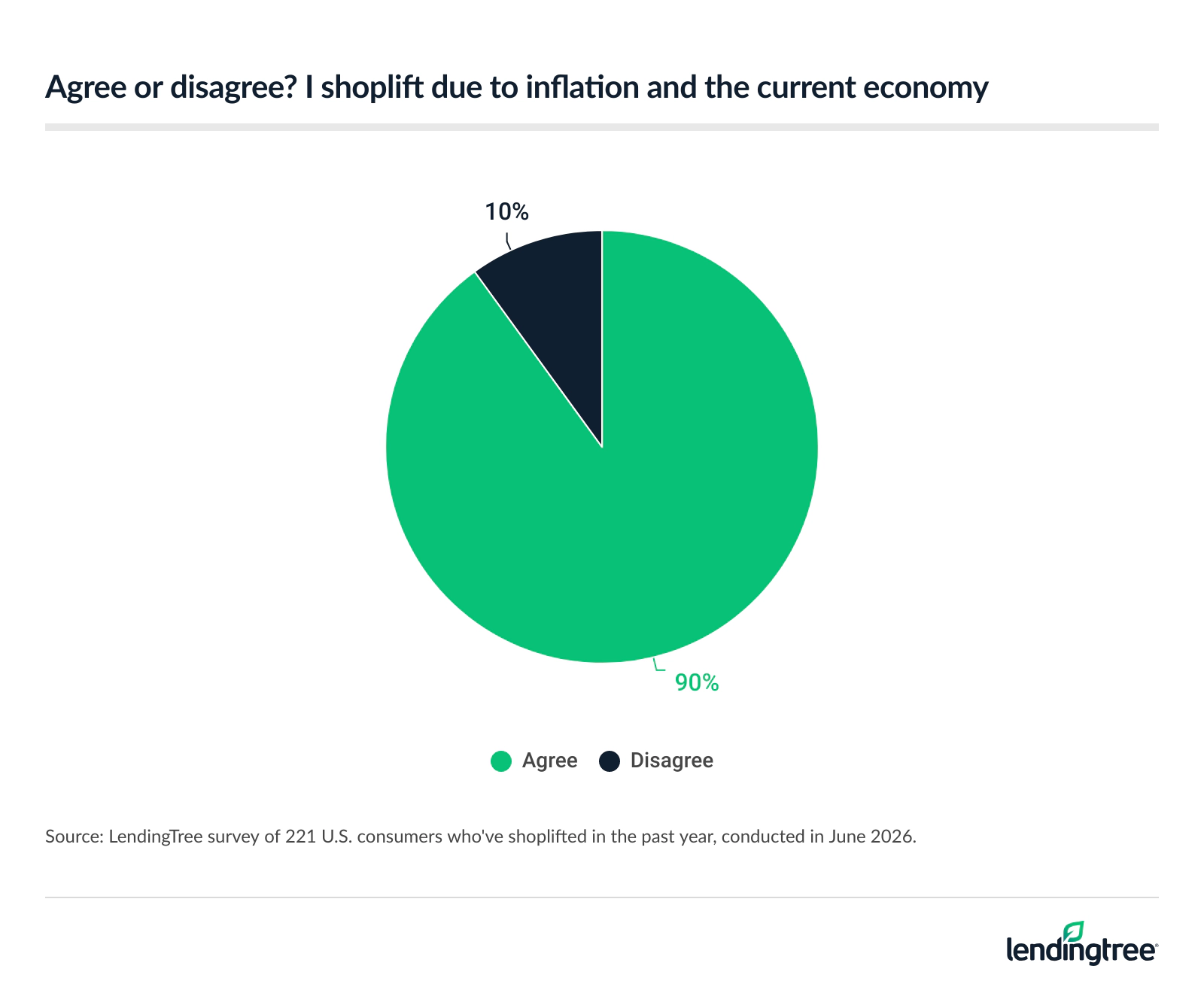
- Economic conditions remain a leading factor cited by respondents who shoplift. Among those who say they shoplifted in the past year, 90% cite inflation and the broader economy as contributing factors. Across all respondents who say they’ve shoplifted, the most commonly cited reasons include financial struggles (28%) and items being too expensive to afford (19%).
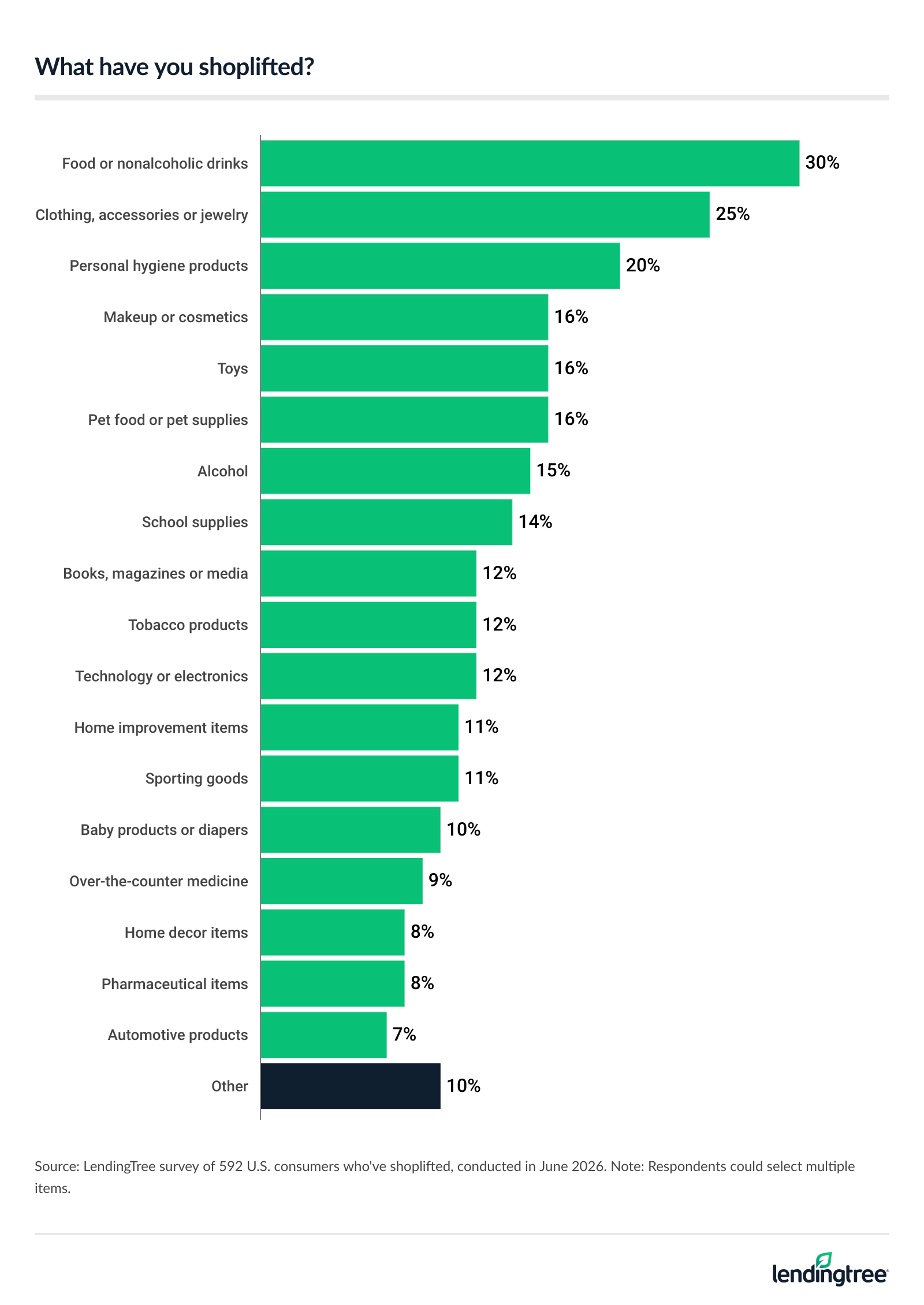
- Respondents who shoplift most commonly report stealing everyday essentials, particularly from major retailers. Food and nonalcoholic drinks remain the most commonly stolen items (30%), followed by clothing, accessories or jewelry (25%) and personal hygiene products (20%). They’re slightly more likely to steal from chain stores (36%) than local stores (33%).
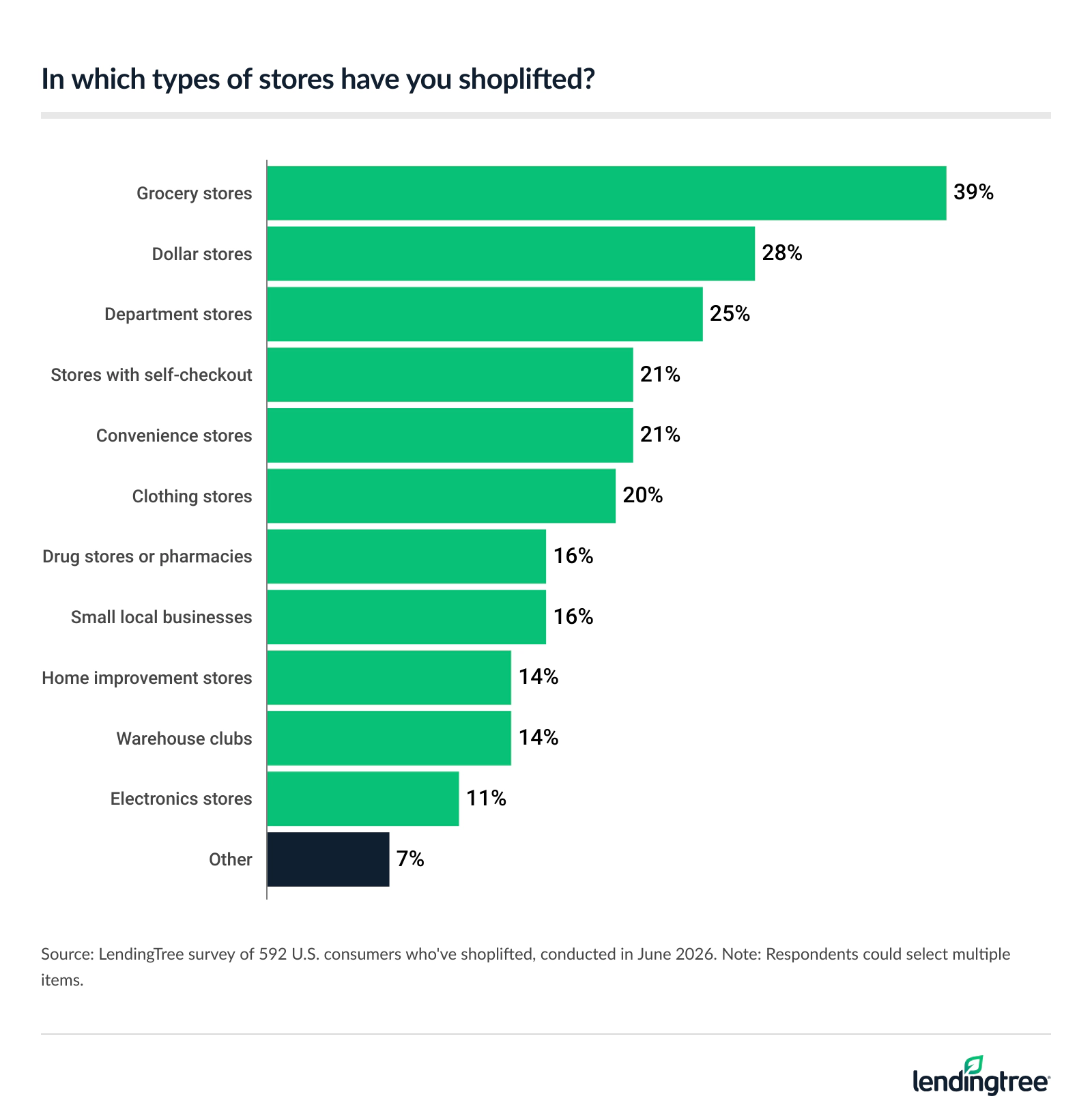
- Grocery stores remain the most commonly reported shoplifting location, cited by 39% of respondents who say they’ve shoplifted. They’re followed by dollar stores (28%) and department stores (25%). Walmart is most frequently identified as one of the easiest stores to shoplift from (47%), followed by Family Dollar (21%), Amazon Fresh (14%) and Kroger (11%).
Shoplifting rates rise, with younger generations reporting the highest rates
Three in 10 Americans (30%) say they’ve shoplifted at least once, according to our survey. The behavior is most common among younger generations, with 39% of Gen Zers ages 18 to 29 and 38% of millennials ages 30 to 45 reporting they’ve shoplifted. By comparison, 24% of Gen Xers ages 46 to 61 and 18% of baby boomers ages 62 to 80 say they’ve shoplifted.
Survey data also indicates that men are more likely than women to report having shoplifted, at 36% versus 23%.
The share of Americans who say they’ve shoplifted has increased. In LendingTree’s 2024 survey, 23% reported having shoplifted, compared with 30% this year — an increase of 30%.
The increase also extends to more recent shoplifting. Among respondents who say they’ve shoplifted, more than a third (37%) report doing so within the past year, up from 23% in 2024. Meanwhile, 12% say they shoplift regularly and 60% say they’ve shoplifted over the age of 16.
Most respondents who shoplift say they haven’t been caught
More than half of respondents who say they’ve shoplifted (52%) report never being caught. Among those who’ve been caught, the most commonly reported consequence is receiving a warning (38%), while 27% say they were arrested. Other reported consequences include being fined or banned from a store. Meanwhile, 7% say they faced no penalty.
Despite the risk of being caught, security measures don’t deter all respondents. One-quarter (25%) of Americans say anti-theft technology doesn’t discourage them from shoplifting.
“Shoplifting may feel like a way to solve an immediate cash-flow problem, but getting caught can create a much bigger one,” says Matt Schulz, LendingTree chief consumer finance analyst and author of “Ask Questions, Save Money, Make More: How to Take Control of Your Financial Life.”
“It can lead to short-term financial costs, including fines and legal fees, as well as longer-term consequences, such as making it harder to get a job or rent an apartment,” he says.
Inflation and economic pressures are prominent factors behind shoplifting
Respondents overwhelmingly cite financial strain as a motivation for shoplifting. Among those who say they’ve shoplifted in the past year, 90% say inflation and broader economic conditions contributed to their decision.
Financial hardship is the second most commonly cited reason respondents give for shoplifting, just behind being much younger at the time (33%). More than a quarter (28%) cite financial struggles, while 19% say items are too expensive to afford. Another 17% say they shoplift to make ends meet and 17% say they do so to save a few dollars.
“These findings are concerning because they suggest many people aren’t shoplifting for thrills or resale, but because they feel squeezed by basic affordability challenges,” Schulz says.
“That doesn’t excuse shoplifting, but it does highlight how financially vulnerable many consumers are. When people are risking arrest or fines to obtain food, hygiene products or other essentials, it suggests inflation and stagnant cash flow may push some households toward desperate choices.”
Those findings are consistent with broader indicators of financial stress among U.S. households. More than one-third of U.S. households face financial insecurity, according to LendingTree data. Separately, a recent Gallup poll found that 31% of Americans identified the high cost of living as their biggest financial problem.
Shoplifting isn’t limited to lower-income households. Although financial strain is the most commonly cited motivation, respondents across all income levels report having shoplifted. Forty percent of those with household incomes of $100,000 or more say they’ve shoplifted, compared with 27% of those earning less than $30,000 and 29% of those earning between $30,000 and $49,999.
Most Americans believe inflation has made people more likely to shoplift
Most Americans believe rising prices have contributed to higher rates of shoplifting. Four in 5 consumers (80%) say inflation has made people more likely to shoplift.
Many respondents also believe retailers can absorb the financial impact of shoplifting. Nearly two-thirds (62%) say large corporations can handle the financial losses associated with shoplifting. Younger consumers are especially likely to share that view, with 72% of Gen Zers and millennials agreeing. By comparison, 59% of Gen Xers and 45% of baby boomers agree.
Everyday essentials remain the most commonly stolen items
The items respondents report stealing reflect ongoing financial pressures. Food and nonalcoholic drinks are the most commonly stolen items, with 30% of respondents who’ve shoplifted saying they’ve taken them. LendingTree research from May 2026 found annual grocery bills exceed $10,000 in some states, highlighting the rising cost of basic necessities. Clothing, accessories or jewelry ranks second at 25%, while 20% say they’ve stolen personal hygiene products.
Shopping patterns also vary across demographic groups. Among parents with children younger than 18, 22% say they’ve shoplifted toys, while 19% report taking technology or electronics and 17% say they’ve stolen school supplies. Among Gen Z respondents who shoplift, clothing, accessories or jewelry (32%) is more commonly stolen than food or nonalcoholic drinks (28%).
Respondents who shoplift are slightly more likely to report stealing from chain stores (36%) than local businesses (33%), while 31% say they steal from both.
“Chain stores may be targeted more often because they’re more accessible, offer greater anonymity and tend to attract more shoppers,” Schulz says. “Large retailers often have heavy foot traffic, expansive layouts, self-checkout lanes and a wide selection of everyday essentials, making it easier for someone to blend in.
“There’s also a practical explanation. Chain stores are where many people already shop for groceries, clothing, hygiene products and household essentials. If the items being stolen are everyday necessities, it’s not surprising that retailers selling the most of those products are frequent targets.”
When asked how they conceal stolen merchandise, respondents most commonly say they hide items on their bodies (33%). And 29% say they simply walk out with merchandise in plain sight.
Other common methods of shoplifting include:
- Hiding merchandise in a purse or bag (26%)
- Taking advantage of a cashier’s mistake (24%)
- Concealing items in other merchandise (22%)
- Switching price tags or packaging (20%)
- Pretending to pay or distracting store staff (20%)
Half have seen someone shoplift
Half (50%) of consumers say they’ve witnessed someone shoplifting. Among those who have, most (59%) say they didn’t do anything to try to stop them.
Despite how common shoplifting appears to be, many consumers still believe there should be stronger penalties for it. A majority (61%) say there should be stricter consequences for retail theft.
Grocery stores are the most commonly reported shoplifting location
Grocery stores are the most commonly reported location for shoplifting, with 39% of respondents who say they’ve shoplifted reporting they steal from them. They’re followed by dollar stores (28%), department stores (25%), retailers with self-checkout (21%) and convenience stores (21%).
When asked which retailers are easiest to shoplift from, respondents most frequently identify Walmart (47%), followed by Family Dollar (21%), Amazon Fresh (14%), Kroger (11%) and Costco (10%). Another 14% say they aren’t sure which retailers are the easiest to shoplift from.
Many consumers wouldn’t return an item they accidentally left a store without paying for
Not every unpaid item is taken intentionally. More than one-third of consumers (37%) say they’ve accidentally left a store without paying for an item.
Respondents report a range of reactions when this happens. Twenty-seven percent say they feel guilty, 22% say they feel embarrassed and 23% say they didn’t realize the mistake until much later. Another 12% say they feel happy they received something without paying for it.
Not everyone tries to correct the mistake. Still, 58% of respondents who say they accidentally left without paying report returning to the store to either bring back the item or pay for it. Younger adults are especially likely to do so, with 66% of Gen Zers and 63% of millennials saying they went back to the store, compared with about half of Gen Xers and baby boomers. Men (63%) are also more likely than women (53%) to return to the store.
Separately, 33% of consumers say they’ve remained silent when a cashier failed to ring up an item during checkout.
Tips for consumers managing rising costs
Rising prices continue to strain household budgets. If you’re having trouble covering everyday expenses, these strategies may help ease financial pressure without creating more serious financial or legal consequences.
- Build a realistic “essentials-first” budget: Prioritize necessities such as food, housing and transportation before allocating money to discretionary purchases. “Rebuild your budget around today’s prices,” Schulz says. “People should look at where their money is going now, not where it went a year ago, because higher prices can quietly make an old budget unrealistic. Groceries, utilities, insurance and transportation may all require larger allocations than they did before.”
- Look for legitimate ways to save: Use store loyalty programs, coupons, cash-back apps, discount retailers and seasonal promotions to reduce the cost of everyday essentials.
- Compare prices before you shop: “It’s one of the oldest and simplest pieces of personal finance advice, but it’s still effective,” Schulz says. Small changes — such as shopping at a different store or choosing store brands instead of name brands — can add up over time.
- Seek assistance when needed: “Food banks, utility-assistance programs, school or community resources and hardship programs offered by lenders and service providers can help before a financial crisis worsens,” Schulz says. “The key is being willing to ask for help.”
- Pay down high-interest debt: If a large portion of your monthly budget goes toward interest payments, reducing high-interest debt can improve your financial flexibility. As balances decline, more of your income can go toward everyday necessities instead of finance charges.
- Pause before making impulse decisions: Financial stress can make short-term solutions seem more appealing. Taking a moment to consider your options before leaving the checkout line can help you avoid decisions that could lead to long-term financial or legal consequences.
Although rising prices continue to pressure household budgets, Schulz says seeking help early and making incremental financial adjustments is far less costly than facing the legal and financial consequences of shoplifting.
Methodology
LendingTree commissioned QuestionPro to conduct an online survey of 2,000 U.S. consumers ages 18 to 80 from June 2 to 11, 2026. The survey was administered using a nonprobability-based sample, and quotas were used to help ensure the sample reflected the overall population. Researchers reviewed all responses for quality control.
We defined generations as the following ages in 2026:
- Generation Z: 18 to 29
- Millennials: 30 to 45
- Generation X: 46 to 61
- Baby boomers: 62 to 80
Get debt consolidation loan offers from up to 5 lenders in minutes