Best Rhode Island Homeowners Insurance for 2026
Amica is the overall best choice, but AIG is great for its customer service


Advertising Disclosures
Loading Disclosures…
- Amica has Rhode Island’s best homeowners insurance, thanks to its combo of low rates and excellent customer service.
- Rhode Island home insurance costs $2,165 per year on average.
- Rhode Islanders pay more on average for home insurance than residents of nearby Massachusetts and New York, but less than its neighbor, Connecticut.
Best homeowners insurance in Rhode Island
The best home insurance option for you will depend on many factors, from price and coverage to customer service.
Amica has the lowest rates in the state, plus great customer service, which makes it the best option for most Rhode Island homeowners. Other good choices are AIG for its stellar customer service and Farmers for its robust offering of discounts.
Best overall: Amica

Average annual rate: $1,521

Why we chose it: With Amica, you get the lowest home insurance rates in the state, along with a range of discounts, excellent customer service and the option to upgrade for more coverage options, including water backup and sump pump protection and claim forgiveness. Plus, you’ll find modern conveniences, like online claims filing and an app that lets you view your policy information and track claims.
The only potential drawback with Amica is that its range of optional coverages is available only through two upgrade packages, not individually.
Who it’s best for: RI homeowners who want to get the best deal with their policy without sacrificing reliable customer service.
PROS
- Lowest rates in the state
- Opportunity to bundle policies for savings
- Great customer service
CONS
- Optional add-ons not available individually
- Deepest discounts typically require a device that’s monitored by a third-party
Best for customer service: AIG

Average annual rate: $1,930

Why we chose it: AIG gets the highest scores in Rhode Island for customer service, plus its average rates are well below the state average of $2,307. The insurer also offers a wide array of coverages, including guaranteed replacement cost coverage, which pays to rebuild your home back to its original condition. Farmers does not offer discounts, however.
Who it’s best for: Homeowners who value both customer service and savings
PROS
- Highly rated customer service
- Low average rates
CONS
- No discounts
- No online quotes offered
Best for discounts: Farmers

Average annual rate: $2,199
Why we chose it: Farmers has the widest range of discounts in the Ocean State, so even though their rates aren’t the lowest, they do offer ways to potentially bring your costs down to more competitive levels. Farmers also has a good selection of add-ons, too, including guaranteed replacement cost coverage should you need to repair or rebuild your home and water backup protection.
Who it’s best for: Homeowners looking to cash in on savings opportunities
PROS
- More discounts than other companies
- Nice selection of coverage options
CONS
- Several other insurers offer lower rates
- No replacement cost coverage for personal property
Compare home insurance rates and ratings in Rhode Island
In Rhode Island, rates can vary significantly between insurers — comparing multiple options can help you find better pricing and coverage.
| Company | Average annual rate * | LendingTree rating | Complaint rating* | |
|---|---|---|---|---|
 | Amica | $1,521 |  5/5 | 0.2 |
 | NLC Insurance | $1,631 | N/A | N/A |
 | AIG | $1,930 |  3.5/5 | 0.1 |
 | Allstate | $2,060 |  4/5 | 1.2 |
 | Farmers | $2,199 | 3.5/5 | 0.7 |
 | Narragansett Bay | $2,983 |  2.5/5 | 0.2 |
 | Andover | $3,120 | 3.5/5 | N/A |
 | Nationwide | $3,255 | 3.5/5 | 1.2 |
LendingTree analyzed thousands of quotes from top insurers across Rhode Island to identify the best options for homeowners.
Our team evaluated pricing, customer experience, financial reliability and coverage features to determine the top home insurance companies in the state.
See full methodology.
How much is homeowners insurance in Rhode Island?
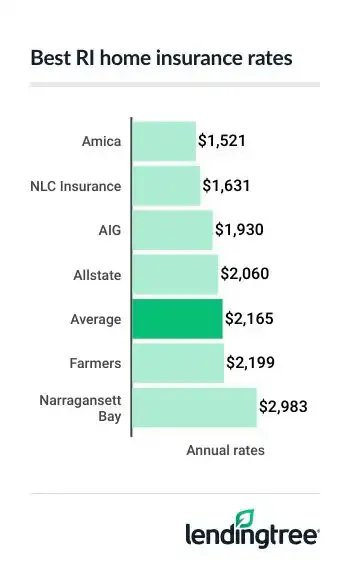
The average cost of home insurance in Rhode Island is $2,165 per year.
That means homeowners in the Ocean State typically pay $180 per month for home insurance coverage. That’s significantly below the national average rate of $2,628, or $219 per month. Even so, homeowners in the state are still paying much higher rates than they were just five years ago.
Average home insurance rates by dwelling coverage amount
Your home insurance rates can vary widely depending on your coverage needs.
| Company | $300,000 | $400,000 | $550,000 | $750,000 |
|---|---|---|---|---|
| Amica | $1,223 | $1,521 | $1,865 | $2,303 |
| AIG | $1,591 | $1,930 | $2,470 | $3,093 |
| Allstate | $1,815 | $2,060 | $2,582 | $3,403 |
| Farmers | $1,538 | $2,199 | $3,049 | $4,615 |
| State average | $1,876 | $2,337 | $3,061 | $4,087 |
Home insurance rates in Rhode Island by city
Residents of Cumberland, Cumberland Hill and Valley Falls, all located in the northeast corner of the state, enjoy the lowest homeowners rates in Rhode Island.
The highest homeowners rates are clustered around the state’s southern coast, which gets hit hardest with severe weather events like tropical cyclones and coastal flooding. Most expensive are home insurance policies in Narragansett, Narragansett Pier and most of all, Block Island.
| City | Average rate |
|---|---|
| Albion | $1,977 |
| Ashaway | $2,113 |
| Barrington | $1,991 |
| Block Island | $2,712 |
| Bradford | $2,318 |
| Bristol | $2,045 |
| Carolina | $2,097 |
| Central Falls | $2,084 |
| Charlestown | $2,502 |
| Chepachet | $2,022 |
| Clayville | $2,044 |
| Coventry | $2,085 |
| Cranston | $2,072 |
| Cumberland | $1,932 |
| Cumberland Hill | $1,930 |
| East Greenwich | $2,181 |
| East Providence | $1,987 |
| Exeter | $2,154 |
| Fiskeville | $2,146 |
| Forestdale | $2,000 |
| Foster | $2,080 |
| Glendale | $1,982 |
| Greene | $2,210 |
| Greenville | $2,033 |
| Harmony | $2,060 |
| Harrisville | $1,967 |
| Hope | $2,032 |
| Hope Valley | $2,138 |
| Hopkinton | $2,097 |
| Jamestown | $2,296 |
| Johnston | $2,067 |
| Kenyon | $2,081 |
| Kingston | $2,247 |
| Lincoln | $1,995 |
| Little Compton | $2,433 |
| Manville | $1,975 |
| Mapleville | $1,996 |
| Melville | $2,273 |
| Middletown | $2,392 |
| Misquamicut | $2,415 |
| Narragansett | $2,518 |
| Narragansett Pier | $2,518 |
| Newport | $2,382 |
| Newport East | $2,392 |
| North Kingstown | $2,239 |
| North Providence | $2,089 |
| North Scituate | $2,016 |
| North Smithfield | $2,024 |
| Oakland | $1,966 |
| Pascoag | $2,032 |
| Pawtucket | $2,033 |
| Peace Dale | $2,236 |
| Portsmouth | $2,154 |
| Providence | $2,185 |
| Prudence Island | $2,407 |
| Riverside | $2,020 |
| Rockville | $2,093 |
| Rumford | $2,047 |
| Saunderstown | $2,286 |
| Shannock | $2,122 |
| Slatersville | $1,999 |
| Slocum | $2,118 |
| Smithfield | $2,039 |
| Tiverton | $2,165 |
| Valley Falls | $1,931 |
| Wakefield | $2,225 |
| Wakefield-Peacedale | $2,289 |
| Warren | $2,030 |
| Warwick | $2,197 |
| West Greenwich | $2,197 |
| West Kingston | $2,230 |
| West Warwick | $2,187 |
| Westerly | $2,416 |
| Wood River Junction | $2,185 |
| Woonsocket | $1,997 |
| Wyoming | $2,124 |
Current state of homeowners insurance in Rhode Island
Rhode Islanders home insurance rates are slightly higher than some of their neighbors and lower than others. For example, in Massachusetts and New York, annual rates are $1,836 and $1,587 per year, respectively, for $400,000 in coverage. Rhode Island residents pay an average of $2,165 per year. But that’s still a lot less than the $2,595 per year homeowners in Connecticut pay on average.
Like the rest of the country, home insurance rates in Rhode Island have steadily gone up over the past five years, but there is some positive news on that front: Rhode Island saw a much smaller increase in home insurance rates (2.9%) last year than the prior two years. In 2023 and 2024, Rhode Islanders faced rate hikes surpassing 11%.
Rhode Island’s 2025 home insurance rate increase was also significantly lower than the national average increase (5.6%) as well as those seen in nearby states like Connecticut (5.9%) and New York (4.3%). (Massachusetts was only slightly lower at 2.8%.)
However, when you look at the cumulative homeowners insurance rate increases between 2021 and 2025, Rhode Island’s rates rose a significant 39.2%. So while rate increases have abated in the past year, these prior hikes are still having an impact on RI homeowners’ wallets.
How to compare homeowners insurance in Rhode Island
Finding the best home insurance for you isn’t just about finding the lowest rates. It’s also about factors like:
- Coverage limits: This is the amount you would need your insurance company to pay to rebuild your home after a covered event. It’s normal for your home’s replacement cost estimates to vary slightly in quotes from different companies, but as long as they each list your home’s size and features accurately, you’ll be able to compare them fairly.
- Deductibles: Higher deductibles mean lower premiums, but just be sure you can pay the deductible when it comes time to file a claim.
- Exclusions: Make sure to know exactly what falls under a policy’s coverage and what doesn’t.
- Add-ons: If you have high-value items, you might consider add-ons to boost your coverage.
Also, if you own one or more vehicles, you might consider bundling your home and auto insurance. Many insurance companies offer big discounts for this.
How LendingTree helps you find the right policy
Shopping for home insurance isn’t always straightforward — especially when availability and pricing can vary widely. LendingTree makes it easier by helping you explore options from multiple insurers, so you can find coverage that fits your home, location and budget.
How it works
Tell us about your home
Answer a few quick questions about your home, location and coverage needs.
Compare options from insurers
See quotes and typical rates from insurers that offer coverage in your area.
Choose the right policy
Review your options and pick the coverage that fits your needs and budget.
Frequently asked questions
No, it is not legally mandatory to have homeowners insurance if you own a home in Rhode Island. However, if you have a mortgage, your lender will almost always require that you get a home insurance policy as part of the loan agreement. Even if you own your home outright, it’s still a good idea to get home insurance to protect yourself financially.
Rhode Islanders pay an average of $2,165 per year for home insurance coverage. However, prices can vary widely depending on your insurer as well as your coverage needs. That’s why it’s vital to shop around to find the best rate for your desired coverage.
Regular home insurance will not cover floods. To get coverage, you’ll need to get a separate flood insurance policy either from a private insurer or from the National Flood Insurance Program (NFIP).
Methodology
How we chose the best homeowners insurance in Rhode Island
The rates shown in this article are based on an analysis of non-binding quotes obtained in February 2026 from Quadrant Information Services for sample homes in every Rhode Island ZIP code. Unless otherwise noted, policies include:
- Dwelling coverage: $400,000
- Other structures: $40,000
- Personal property: $200,000
- Loss of use: $80,000
- Personal liability: $100,000
- Guest medical payments: $5,000
- Deductible: $1,000
How we create LendingTree ratings
Our team of insurance experts evaluates insurance companies across several categories, including average rates, discounts, coverage options, third-party customer service ratings and app/website experience. We use this information to create LendingTree ratings, which help us identify and recommend the best insurance companies for consumers.
For third-party customer service ratings, we included NAIC’s Complaint Index scores and financial strength ratings from A.M. Best. NAIC Complaint Index scores show how well companies treat customers over things like claims, while financial strength ratings from A.M. Best reflect the ability to pay out claims.
See our home insurance ratings methodology and full editorial guidelines for further details.
*USAA is only available to current and former members of the military and their families.