Compare Home Insurance Rates and Quotes in 2026
See average home insurance rates, and learn how to find the right coverage for the best price.


Advertising Disclosures
Loading Disclosures…
- State Farm has the cheapest average home insurance rates nationwide, but the cheapest company for you depends on factors like your home and location.
- The average homeowners insurance premium in the U.S. is $2,628 per year.
- When comparing quotes, make sure they have the same coverage limits and deductibles.
Compare home insurance rates by company
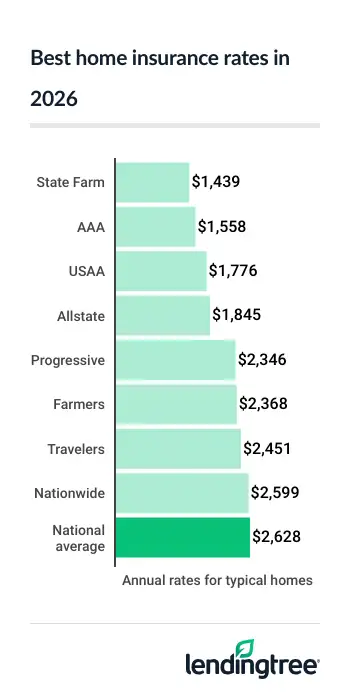
State Farm offers the lowest average home insurance rate, at $1,439 per year. This is 45% lower than the national average of $2,628.
AAA’s homeowners insurance premiums are second-cheapest, averaging $1,558 annually.
Average rates are a helpful benchmark, but your premium is based on your unique situation. Factors like your ZIP code, your home’s features, the coverage you choose and your claims history all play a role in determining your rate.
Home insurance rates by company and dwelling amount
Throughout this page, we use $400,000 in dwelling coverage as our standard example, but you may need more or less coverage depending on your home.
Below, you’ll find average rates for four common dwelling coverage limits: $300,000, $400,000, $550,000 and $750,000.
State Farm is cheapest for all of the dwelling coverage limits we analyzed, except for the $300,000 limit, where AAA wins (but State Farm is close behind).
| Company | $300K | $400K | $550K | $750K |
|---|---|---|---|---|
| AAA | $1,163 | $1,558 | $2,133 | $3,727 |
| State Farm | $1,217 | $1,439 | $1,752 | $2,619 |
| USAA* | $1,461 | $1,776 | $2,220 | $3,774 |
| Allstate | $1,531 | $1,845 | $2,289 | $3,719 |
| Farmers | $1,794 | $2,368 | $3,325 | $5,521 |
| Chubb* | N/A | N/A | $3,441 | $5,050 |
| Travelers | $2,002 | $2,451 | $3,167 | $5,469 |
| Progressive | $2,004 | $2,346 | $2,862 | $4,927 |
| Nationwide | $2,036 | $2,599 | $3,460 | $6,220 |
| American Family | $2,128 | $2,667 | $3,443 | $5,496 |
Best home insurance rates by state
Because each state and ZIP code has its own unique climate hazards, home insurance premiums vary widely. Comparing your quote to your state’s average is a smart way to gauge how competitive your offer really is.
Just like with the national averages, State Farm has the lowest average home insurance rates in the highest number of states, at 23 states in all.
Still, insurance is personalized. Each company has a different way of calculating rates, and no two homes are alike. One company may be low for most, but that doesn’t mean it’ll offer the cheapest home insurance for you. This is why it’s so important to shop around.
| State | Average rate | Cheapest company | Cheapest premium |
|---|---|---|---|
| Alabama | $3,614 | Farmers | $1,074 |
| Alaska | $1,519 | Umialik | $1,075 |
| Arizona | $2,455 | State Farm | $1,173 |
| Arkansas | $3,902 | State Farm | $2,794 |
| California | $1,574 | Travelers | $820 |
| Colorado | $4,717 | Allstate | $2,509 |
| Connecticut | $2,595 | State Farm | $1,203 |
| District of Columbia | $1,309 | NA | NA |
| Delaware | $1,320 | State Farm | $819 |
| Florida | $3,046 | Security First | $864 |
| Georgia | $2,939 | State Farm | $1,909 |
| Hawaii | $928 | DB Insurance | $376 |
| Idaho | $1,975 | State Farm | $1,144 |
| Illinois | $2,987 | Allstate | $1,079 |
| Indiana | $2,940 | Allstate | $1,105 |
| Iowa | $3,492 | Farmers | $2,502 |
| Kansas | $4,595 | State Farm | $1,886 |
| Kentucky | $3,495 | Allstate | $2,114 |
| Louisiana | $2,903 | State Farm | $1,046 |
| Maine | $1,433 | Vermont Mutual | $799 |
| Maryland | $2,345 | State Farm | $1,497 |
| Massachusetts | $1,836 | Norfolk & Dedham | $585 |
| Michigan | $2,545 | Allstate | $1,410 |
| Minnesota | $3,150 | Auto-Owners | $2,259 |
| Mississippi | $3,154 | State Farm | $2,040 |
| Missouri | $2,936 | AAA | $1,900 |
| Montana | $3,021 | Chubb | $1,048 |
| Nebraska | $5,519 | State Farm | $3,406 |
| Nevada | $1,829 | State Farm | $1,028 |
| New Hampshire | $1,150 | Vermont Mutual | $806 |
| New Jersey | $1,606 | Cumberland Mutual | $1,056 |
| New Mexico | $3,242 | State Farm | $1,576 |
| New York | $1,587 | NYCM | $658 |
| North Carolina | $2,874 | State Farm | $876 |
| North Dakota | $2,751 | American Family | $2,341 |
| Ohio | $2,232 | State Farm | $1,464 |
| Oklahoma | $5,533 | State Farm | $3,170 |
| Oregon | $1,518 | State Farm | $983 |
| Pennsylvania | $1,893 | Penn National | $1,308 |
| Rhode Island | $2,165 | Amica | $1,521 |
| South Carolina | $3,477 | Chubb | $1,262 |
| South Dakota | $3,637 | State Farm | $2,301 |
| Tennessee | $3,757 | State Farm | $2,180 |
| Texas | $4,458 | Mercury | $1,640 |
| Utah | $1,858 | State Farm | $1,065 |
| Vermont | $1,047 | Vermont Mutual | $638 |
| Virginia | $2,762 | State Farm | $1,067 |
| Washington | $1,756 | Grange | $1,180 |
| West Virginia | $2,117 | State Farm | $1,276 |
| Wisconsin | $1,897 | West Bend | $1,179 |
| Wyoming | $2,396 | State Farm | $2,168 |
Find the best home insurance with these quick tips
How to compare home insurance quotes in 3 steps
Finding the best home insurance company can take some research, but an informed shopper is a savvy shopper. Knowing how to handle each step of the process should help you feel more confident when you’re ready to buy.
1. Before you get quotes
- Gather details on your house, like square footage, roof style and the year it was built
- Take an inventory of your belongings, and estimate their combined value
- Have your current policy details handy (if you’re insured)
2. While you’re comparing quotes
-
Consider how much your deductible
should beYour deductible is the amount you pay out of pocket for a covered claim before your insurance company pays the rest, up to your policy limit.
- Be sure to get the same coverage options, limits and deductibles from each company
- Pay attention to the customer service, and check the insurance company’s ratings
3. Before you choose a policy
- Try to request quotes from at least three companies
- Compare optional coverages and endorsements, not just price
- Review the policy details to know exactly what’s covered and what’s not
Track home insurance rate increases over time
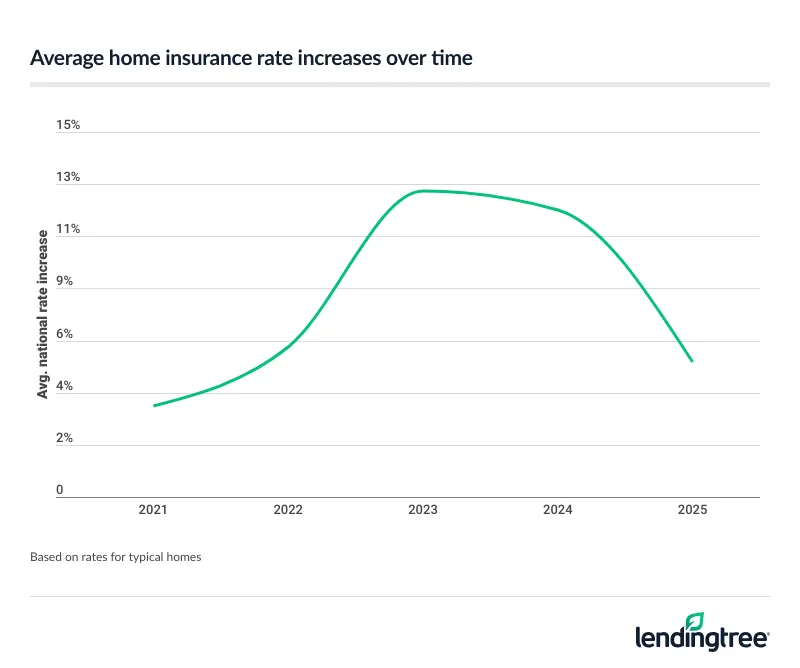
Home insurance affordability is top of mind for many U.S. homeowners. According to LendingTree research, average home insurance rates increased almost 47% from 2020 to 2025.
The silver lining is that although premiums aren’t necessarily going down, rate hikes seem to be leveling off. In 2025, average rates went up by 5.6%, an improvement over the 12.6% jump in 2023 and 11.8% rise in 2024.
Understanding your homeowners insurance policy
Knowing how home insurance works can help you choose the right coverage without underinsuring your home or paying for more than you need.
Coverage options
Rates are important, but so is the type of coverage you choose.
Standard coverages
Below you’ll find the usual coverages for a standard homeowners policy. Each coverage has its own limit, or maximum amount the insurance company will pay after a covered claim.
This repairs structural damage to your home and its attached structures, like a garage. You should carry enough dwelling coverage to rebuild your home in today’s market, not how much you paid for it.
Insurance companies have tools that help determine how much dwelling coverage you need, based on your home’s features.
This pays to repair sheds, fences and other unattached structures on your property. Most policies include a default limit of 10% of your dwelling coverage. You may need more if you have an expensive structure, like a mother-in-law suite.
This covers your belongings, including furniture, electronics, clothes, recreational gear and movable appliances like a refrigerator. A common default limit is 50% of your dwelling coverage, but you may need a higher or lower amount, depending on the value of your possessions.
Some items may only be covered up to a specific amount per claim, regardless of their value. This usually applies to high-value items. For instance, if your $5,000 guitar is destroyed in a fire, but your policy limits musical instruments to $1,000 per claim, then you’d only get $1,000 for your guitar.
This pays for temporary living expenses after a covered claim, including lodging and daily expenses like groceries and pet boarding. The default limit is usually 20% to 30% of your dwelling coverage.
How much loss of use coverage you carry depends on your risk tolerance. A Florida homeowner might want to carry a higher limit in case of a hurricane, for example. Claims can take a long time to settle, and so can repairing or rebuilding.
Personal liability coverage helps pay for injuries or property damage you or a member of your household accidentally causes to others. If someone is injured on your property and you’re legally responsible, it can help cover court and medical costs. It also covers accidental property damage, like spilling a drink on your neighbor’s expensive rug.
Of the standard home insurance coverages, personal liability is usually among the cheapest. Lawsuits, on the other hand, can be incredibly expensive. The small additional cost for a higher limit may be worth the peace of mind.
This covers medical treatment for a guest injured at your home. Medical payments do not apply to you, your household members, your tenants or any contractors you hire. Default limits range from $1,000 to $5,000.
Unlike personal liability coverage, medical payments coverage can pay for a guest’s minor injuries without deciding who was at fault, legally. Since limits are lower, this coverage is best for smaller claims, like health insurance deductibles.
Optional coverages
An optional coverage (also called an endorsement, add-on or rider) is an extra coverage that you can include on your policy for an additional cost. This allows you to customize your quote. Not all companies offer the same optional coverages, which is one reason to shop around.
Below are some popular optional coverages, though there are many others:
- Guaranteed replacement cost increases your dwelling limit if rebuilding costs more than your coverage. This can be especially useful during times of inflation, when construction costs are high.
- Water backup and sump pump covers repairs if dirty water comes up through your drains because of a failed sewer line or sump pump. It also applies if water backs up into your home due to tree roots and certain other blockages.
- Scheduled personal property provides extra coverage for high-value items like jewelry, antiques and musical instruments. Think of it as an enhancement to your personal property coverage.
What does home insurance cover?
Homeowners insurance covers damage caused by certain risks, usually called “perils.” A policy may cover:
- Open perils, meaning all perils except those specifically excluded.
- Named perils, meaning only the perils listed in your policy.
With most standard homeowners policies, your home’s structure has open-peril coverage, and your personal belongings have named-peril coverage.
Most common 16 named perils covered by standard home insurance:
- Fire or lightning
- Windstorm or hail
- Explosion
- Riot or civil commotion
- Aircrafts
- Vehicles
- Smoke
- Vandalism and malicious mischief
- Theft
- Volcanic eruption
- Falling objects
- Weight of snow, ice or sleet
- Sudden and accidental discharge of water or steam
Tying it all together: On most policies, your home is covered unless a risk is excluded. With belongings, it’s the opposite — they are only covered for the risks specifically listed in your policy.
What doesn’t home insurance cover?
Homeowners insurance companies usually exclude some perils completely. If a peril is excluded, then it will not be covered. You may be able to add optional coverage to fill gaps, but in some cases you might need to buy a separate policy. Flood insurance is an example of this.
Standard homeowners exclusions:
- Floods
- Earthquakes, sinkholes and mudslides
- Sewer backup and sump pump failure
- Lack of maintenance
- Wear and tear
- War and nuclear hazards
- Ordinance, law or government action
- Pests
- Power failure
- Intentional acts of damage
Deductibles
A deductible is an amount of money that you are responsible for paying when filing a claim. The insurance company pays for the rest of the damage, up to the limit of coverage you have.
Home insurance deductibles are usually only for dwelling and personal property coverage. Deductibles can be a flat amount ($500 to $5,000, typically) or a percentage of the insured value of your home (usually 1% to 10%).
Depending on where you live, some insurers also use separate deductibles for some kinds of claims. For example, Florida homeowners often have a separate deductible for hurricane damage.
Why is it important to compare home insurance quotes?
Companies change the way they set their rates from time to time. Your own rate qualifications can also change, especially if you improve your credit and avoid claims.
Comparing quotes before you buy or renew your policy protects you from overpaying, helping to reduce strain on your household budget.

How LendingTree helps you find the right policy
Shopping for home insurance isn’t always straightforward, especially in states where availability and pricing can vary widely. LendingTree makes it easier by helping you explore options from multiple insurers so you can find coverage that fits your home, location and budget.
How it works
Tell us about your home
Answer a few quick questions about your home, location and coverage needs.
Compare options from insurers
See quotes and typical rates from insurers that offer coverage in your area.
Choose the right policy
Review your options and pick the coverage that fits your needs and budget.
How to lower your home insurance rate
Shop around
It’s normal to get two completely different quotes from two different companies using the same information. The more quotes you get, the bigger pool you get to choose from, and the more likely it is that you find your best rate.
It’s a good idea to shop for insurance at every renewal and after major life events like moving or getting married.
Ask about bundling
Most insurance companies offer big discounts when you bundle your home and car insurance. Even if you don’t bundle, getting home and auto quotes at the same time can help you figure out whether you’re overpaying for car insurance.
Consider a higher deductible
Raising your deductible lowers the amount your insurance company pays if you have a claim. Insurance companies pass their savings along to you in the form of a lower rate. But keep in mind that deductibles come out of your own pocket, so you don’t want them to be too high.
Frequently asked questions
Not directly, no. Insurance premiums are highly regulated by your state and are not negotiable. However, you can drop coverage, increase your deductibles or see if you qualify for a discount to lower your rate.
When comparing quotes, make sure that all policy details match between companies to avoid choosing a quote that looks like the cheapest but in reality has subpar coverage.
It’s a good idea to get a home insurance quote before making an offer on a house. To avoid unexpected surprises, you should have an idea of the costs that will come with homeownership, including home insurance. According to LendingTree research, home insurance typically takes up 8.5% of a homeowner’s monthly housing budget.
Insurance quotes are generally based on the information you provide. Some insurers don’t run certain reports until you’re ready to purchase a policy. If new reports uncover information you didn’t include, like a claim or a detail about your home, your rate may change before your policy is finalized.
Methodology
The rates shown in this article are based on an analysis of nonbinding quotes obtained in February 2026 from Quadrant Information Services for sample homes across all 50 states. Unless otherwise noted, policies include:
- Dwelling coverage: $400,000
- Other structures: $40,000
- Personal property: $200,000
- Loss of use: $80,000
- Personal liability: $100,000
- Guest medical payments: $5,000
- Deductible: $1,000
See our home insurance ratings methodology and full editorial guidelines for further details.