Smallest Businesses Were Nearly 3 Times as Likely to Be Denied Financing


Having capital is one of the most important factors in running a small business, and taking out a loan is one way to get it. Denial rates may be high, but they’re falling: According to a LendingTree analysis, 19% of businesses that applied for a loan, line of credit (LOC) or merchant cash advance (MCA) in 2025 were denied — down from 21% in 2024.
Here’s a closer look at which loan types had the highest denial rates and the businesses most likely to be denied.
This study mostly analyzes three funding options for businesses. They are:
- Business loan: A lump sum of money that’s borrowed from a lender and repaid over a set term with interest. They’re often used for large, one-time expenses, such as equipment purchases or business expansions. Interest rates may be fixed or variable. The application process for these loans can be lengthy, as they often require collateral.
- Line of credit (LOC): You borrow as needed up to a set limit and repay that amount with interest. A line of credit provides flexibility for ongoing cash flow needs or unpredictable expenses, and you only pay interest on the amount you use. Interest rates are often variable and may be higher than traditional loan rates. The application process is generally simpler than for a loan, though it often requires collateral.
- Merchant cash advance (MCA): Unlike a loan, an MCA is an advance on future revenue, often repaid via a percentage of daily or weekly sales or fixed withdrawals. It’s used for short-term capital needs or quick business growth. There aren’t traditional interest charges — instead, repayment is based on a factor rate, making it more expensive than a loan or line of credit. The application process is often simple, approvals can be fast and collateral is generally not required.
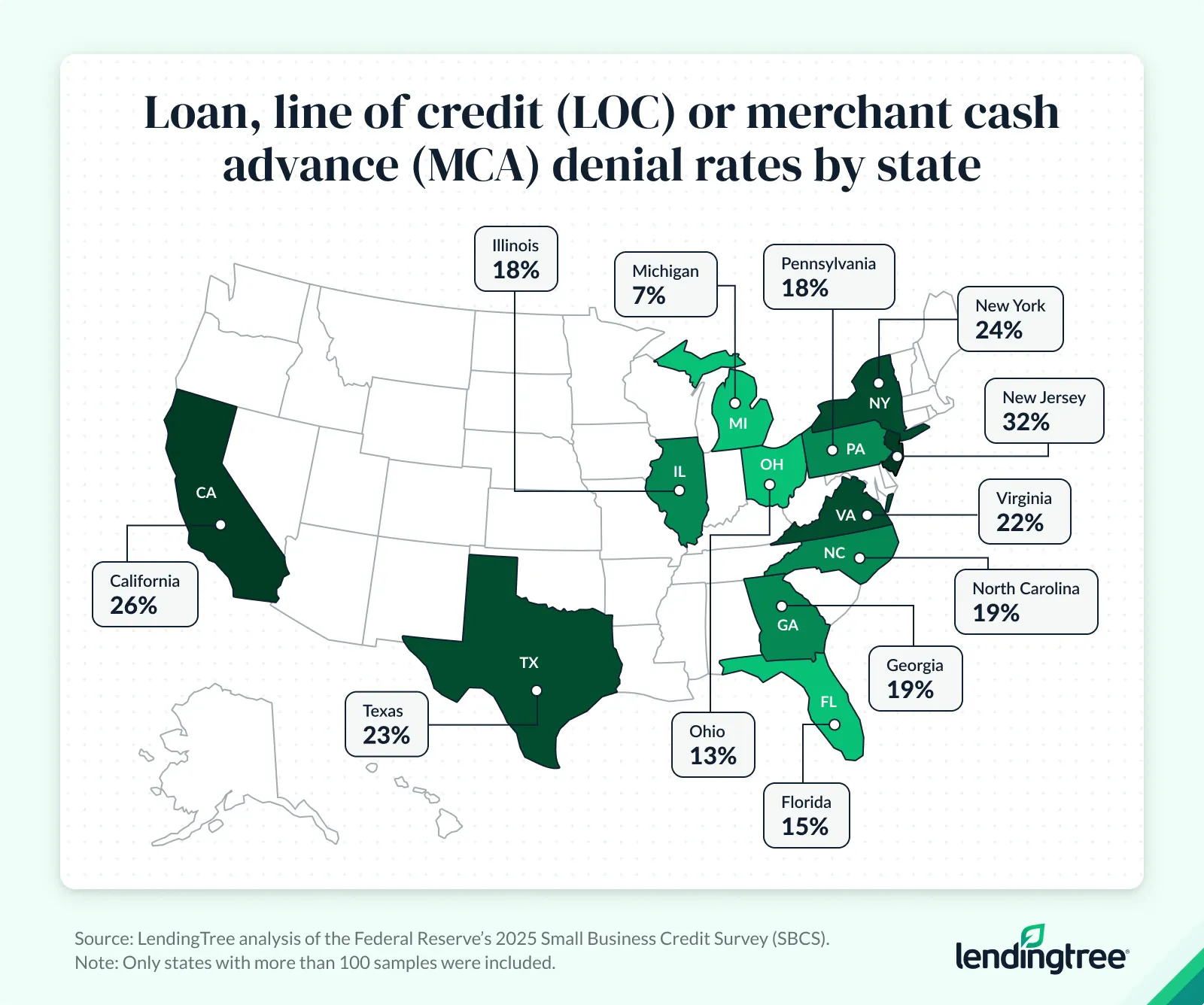
- In 2025, 19% of businesses that applied for a loan, line of credit (LOC) or merchant cash advance (MCA) were denied financing. This was down slightly from 21% in 2024. Overall, 38% of businesses applied for financing in 2025. Among the states with available data, New Jersey had the highest denial rate (32%), and Michigan had the lowest (7%).
- Among financing applications from employer firms, Small Business Administration (SBA) loans and SBA LOCs had the highest denial rate at 40%. Businesses that applied for home equity loans, home equity lines of credit (HELOCs) or personal loans were denied 30% of the time.
- Community development financial institutions (CDFIs) had the highest denial rate for loan, LOC and MCA applicants at 34%, followed by large banks at 31%. Credit unions had the third-highest denial rate at 29%.
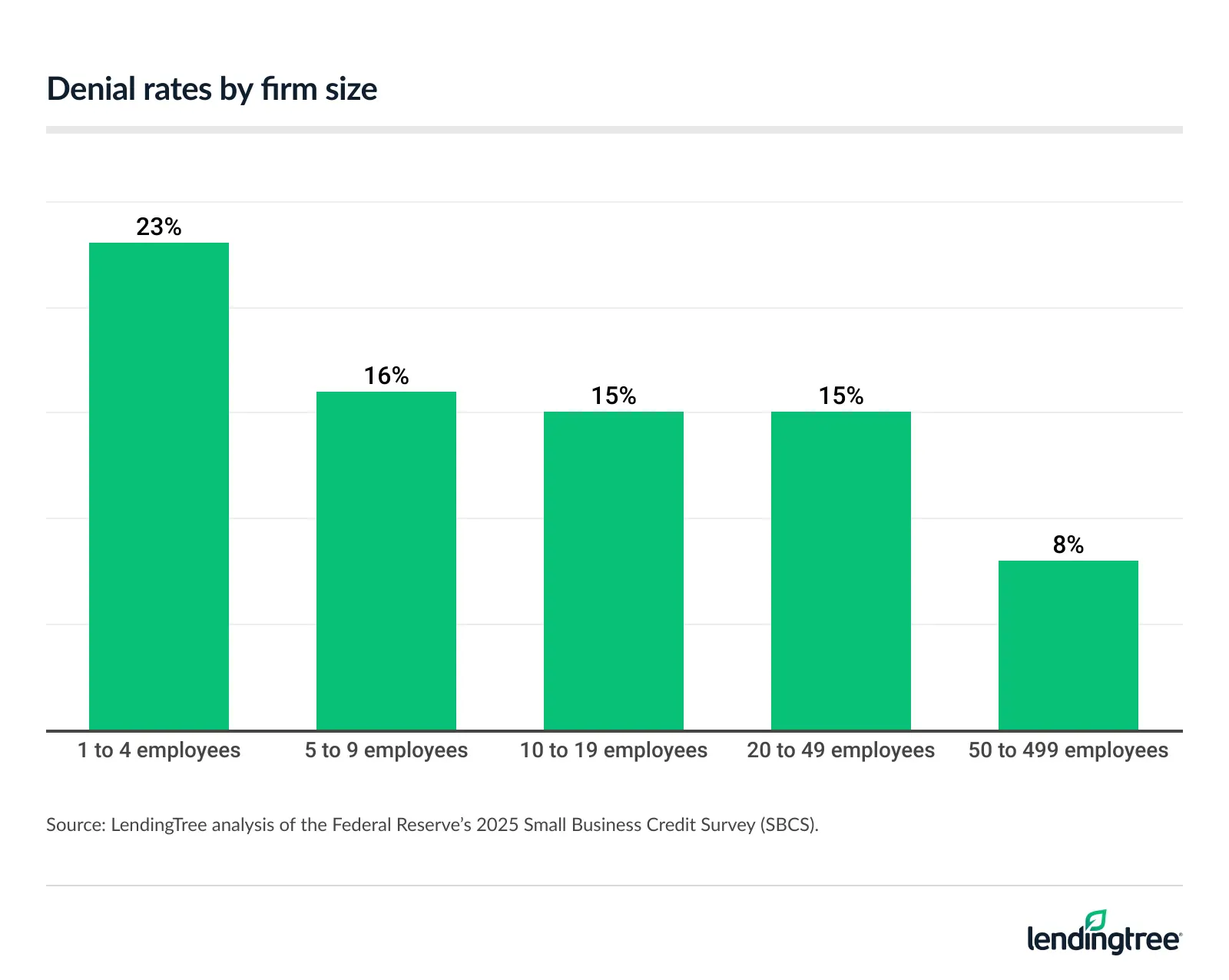
- The smallest firms were nearly three times as likely to be denied a loan, LOC or MCA as the largest firms. In 2025, the denial rate was 23% for businesses with one to four employees, compared with 8% for firms with 50 to 499 employees. By race, Black-owned businesses had the highest denial rate, with 36% of applicants denied in 2025.
Loan, line of credit and merchant cash advance denial rates are down
In 2025, 19% of businesses that applied for a loan, line of credit (LOC) or merchant cash advance (MCA) were denied. That’s down slightly from 21% in 2024 and 22% in 2023.
Overall, 38% of businesses applied for financing in 2025.
Among the 12 states with available data, New Jersey had the highest denial rate at a whopping 32%, followed by California (26%) and New York (24%). Michigan had the lowest rate — at just 7%, it was the only state with available data in the single digits. Ohio (13%) and Florida (15%) had the next lowest rates.
This overall decline in denial rates may be a sign that lending is opening up — though it’s far from wide open, says Matt Schulz, LendingTree chief consumer finance analyst and author of “Ask Questions, Save Money, Make More: How to Take Control of Your Financial Life.”
“Lenders are getting more comfortable in today’s uncertain economy, though they’re not giving money to everyone,” Schulz says. “Businesses with the strongest financials and fundamentals are still most likely to get what they want.”
Denial rates jump to 40% depending on loan type
By loan type, those applying for an SBA loan or SBA LOC were the most likely to be denied. In fact, these applicants saw a 40% denial rate in 2025 — more than double the 19% rate across all types.
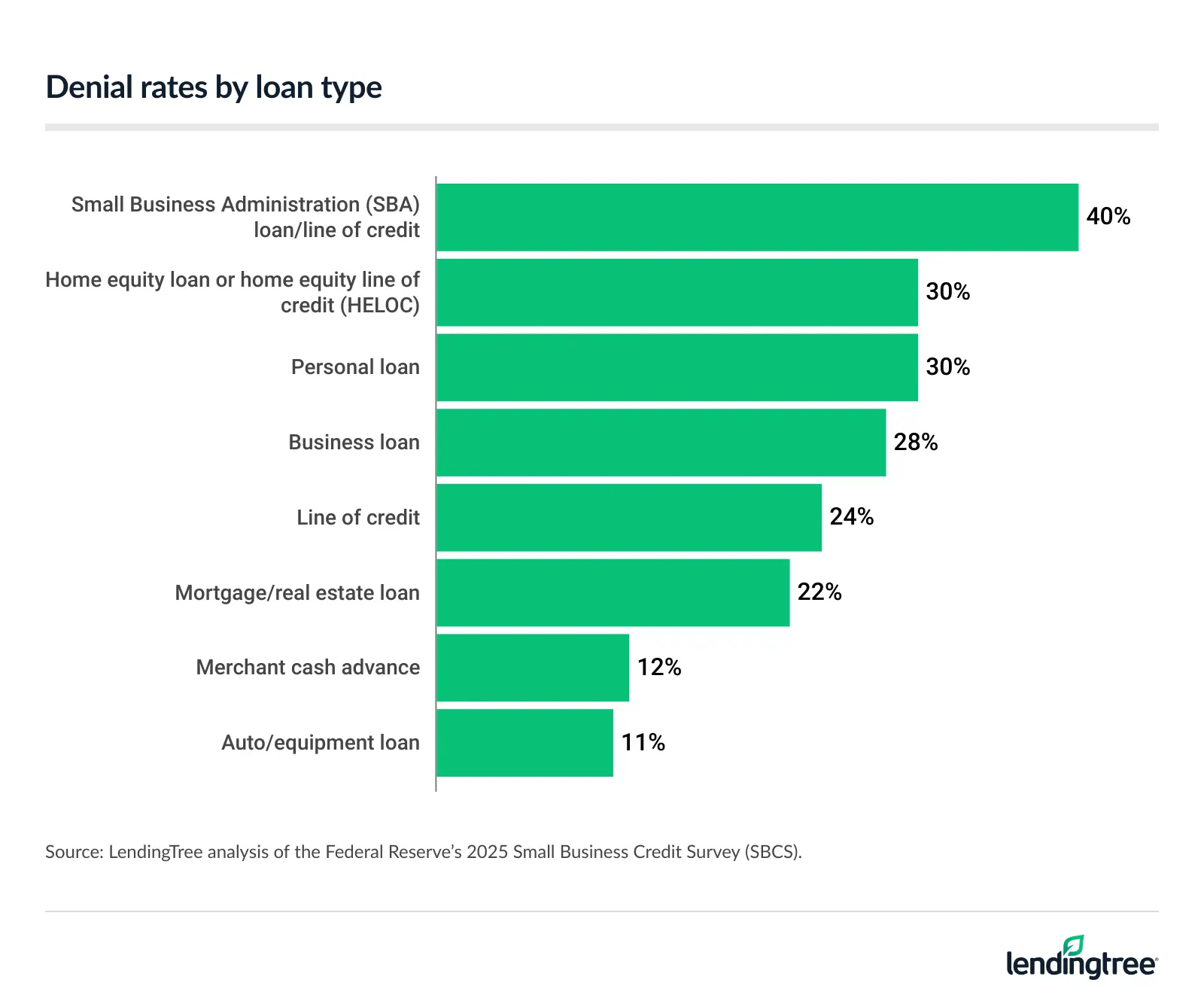
Businesses that applied for home equity loans, home equity lines of credit (HELOCs) or personal loans (often taken out by startups or new business owners who may have good credit but don’t qualify for business loans yet) were denied 30% of the time.
Conversely, auto or equipment loan applicants had the lowest denial rate at just 11%, with MCAs (12%) and mortgage/real estate loans (22%) following.
Schulz says some financing products are simply more difficult to qualify for than others because each one is vastly different.
“All of these loans serve a different purpose and carry a different level of risk,” he says. “The better the terms, generally, the higher the bar for qualification. SBA loans typically offer lower rates and longer repayment terms, so lenders can afford to be more selective. Other loans may rely heavily on the owner’s personal credit or home equity, creating a different approval process altogether.”
Denial rates vary by institution type
Like loan type, denial rates also vary by institution type. Loan, LOC or MCA applicants were denied most commonly by community development financial institutions (CDFIs) — specialized institutions dedicated to providing financing options to underserved communities that traditional financial institutions may not reach — at 34%. Large banks (31%) followed, while credit unions ranked third at 29%.
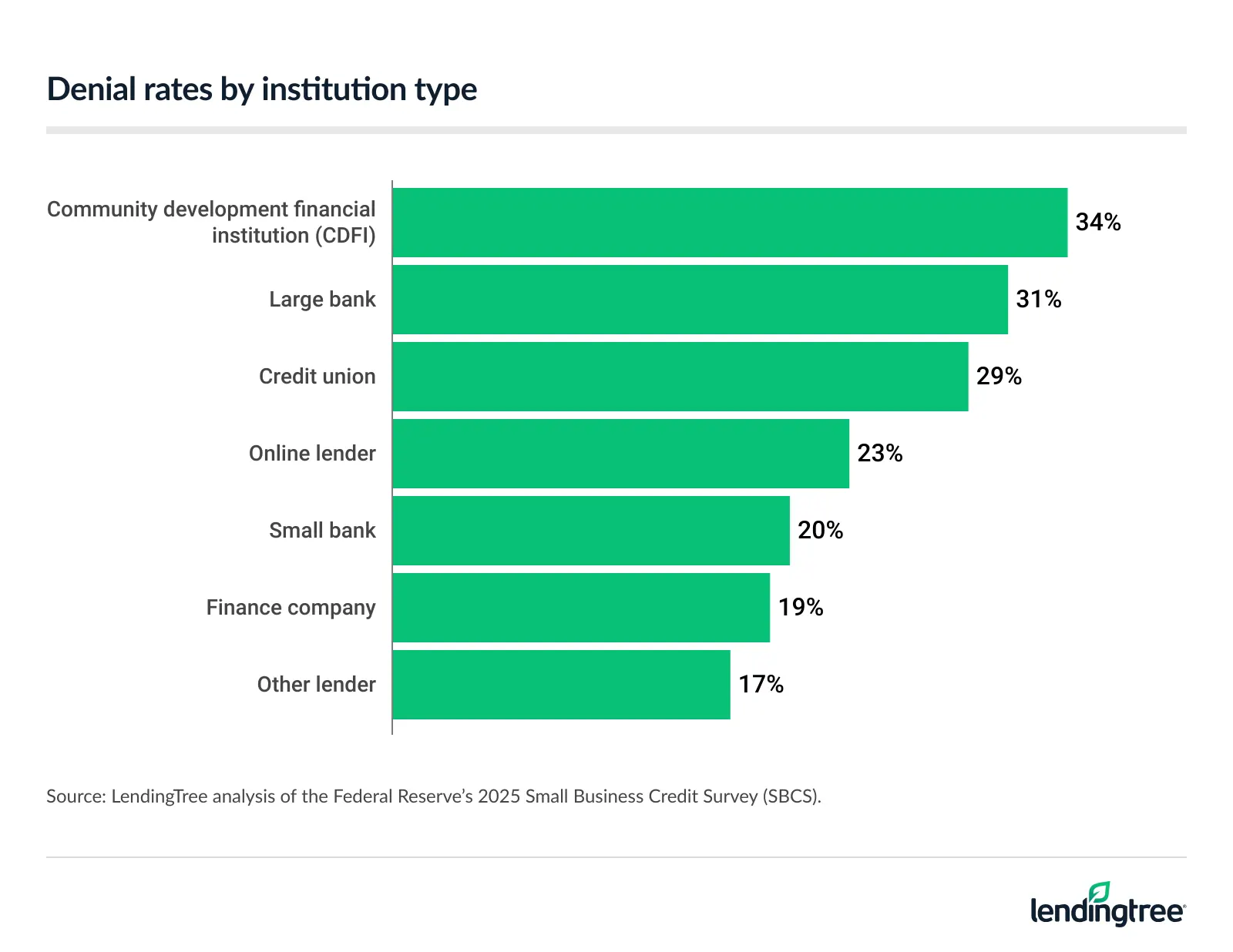
Meanwhile, denial rates were lowest among the category “other lenders” (17%). That was followed by finance companies — businesses that specialize in loans but don’t take cash deposits like banks — at 19% and small banks at 20%.
According to Schulz, where you apply matters almost as much as whether you apply. “However, approval rates are only one piece of the puzzle,” he says. “You should also compare interest rates, fees, repayment terms and other factors before signing on the dotted line. Just like with non-business-related loans, there can be major differences among lenders, so it can absolutely be worth your time to shop around.”
Small firms most likely to be denied
Looking at business demographics, small firms were almost three times more likely to be denied than the largest ones. Among businesses with one to four employees, the 2025 denial rate was 23%. In comparison, that rate was just 8% among large firms with 50 to 499 employees.
Schulz believes that the smallest businesses often face the toughest path to approval because they have the smallest margin for error.
“A company with just a handful of employees may have a shorter operating history, less predictable revenue, fewer assets to put down as collateral and a greater dependence on one or two customers,” he says. “From a lender’s perspective, that translates into more uncertainty and higher risk. Perhaps the best way to counter that is to focus on fundamentals, such as building business credit, maintaining consistent cash flow, keeping financial records organized and developing relationships with lenders before capital is urgently needed.”
Additionally, Black-owned businesses were significantly more likely to be denied than any other race, at 36%. Hispanic-owned businesses (31%) followed. Meanwhile, the denial rate was just 16% among Asian-owned businesses and 17% among white-owned businesses.
Looking at revenue, firms with annual revenues of $25,000 to $50,000 saw a 37% denial rate in 2025 — the highest among this group. Meanwhile, those earning more than $10 million had the lowest rate at 4%.
Denial rates by business demographics
| Race/ethnicity of owner(s) | % of applicants denied |
| Black or African American | 36% |
| Hispanic | 31% |
| White | 17% |
| Asian | 16% |
| Gender of owner(s) | % of applicants denied |
| Women-owned | 22% |
| Men-owned | 19% |
| Equally owned | 13% |
| Industry | % of applicants denied |
| Healthcare and education | 27% |
| Nonmanufacturing goods production and associated services | 24% |
| Manufacturing | 19% |
| Retail | 18% |
| Business support and consumer services | 17% |
| Leisure and hospitality | 16% |
| Professional services and real estate | 15% |
| Finance and insurance | 10% |
| Age of primary owner | % of applicants denied |
| Younger than 35 | 29% |
| 35 to 44 | 22% |
| 45 to 54 | 20% |
| 55 to 64 | 17% |
| 65 or older | 14% |
| Age of firm | % of applicants denied |
| 0 to 2 years | 27% |
| 6 to 10 years | 19% |
| 3 to 5 years | 18% |
| 16 to 20 years | 16% |
| 21+ years | 16% |
| 11 to 15 years | 13% |
| Revenue | % of applicants denied |
| $25,000 to $50,000 | 37% |
| Less than $25,000 | 30% |
| $50,000 to $100,000 | 21% |
| $500,000 to $1 million | 20% |
| $250,000 to $500,000 | 18% |
| $1 million to $5 million | 18% |
| $100,000 to $250,000 | 16% |
| $5 million to $10 million | 14% |
| More than $10 million | 4% |
By industry, denial rates were highest in healthcare and education (27%), nonmanufacturing goods production and associated services (24%) and manufacturing (19%).
Also worth noting, startups (businesses in operation for up to two years at the time of application) had a 27% denial rate — the highest by firm age. Businesses operating for 11 to 15 years faced the lowest denial rate, at 13%. Owners’ ages played a role, too, with those younger than 35 (29%) facing the highest denial rates and those 65 and older (14%) seeing the lowest.
And while business demographics matter, there’s no getting around perceived credit risk. A notable 37% of businesses considered a high credit risk (credit score under 620) were denied a loan, LOC or MCA in 2025. Among those considered a low credit risk, the denial rate was just 15%.
Denial rate by credit risk
| Credit risk | % of applicants denied |
|---|---|
| Low credit risk | 15% |
| Medium credit risk | 26% |
| High credit risk | 37% |
Looking at Q1 2026, financials were the main reason given for business loan denials, with 70.7% of businesses citing this reason. Credit history (18.6%) and collateral (5.0%) followed. (Note: This Q1 2026 data is specific to business loan denials, not the combined business loans, LOCs and MCAs.)
Finding funding as a small business: Top expert tips
Finding funding in this economic climate may be difficult, but it’s not impossible. We offer the following advice to increase your odds:
- Know your numbers. “Lenders want to see healthy cash flow, manageable debt and organized financial statements,” Schulz says. “Even if your business is profitable, you’ll have a harder time getting approved if you can’t clearly demonstrate where your money is coming from, where it’s going and how you’ll repay the loan.”
- Don’t wait until you’re desperate for funding. “It’s much easier to qualify when your business is healthy than when you’re trying to solve a cash crunch,” he says. “Building business credit, establishing a relationship with a lender and understanding your financing options before you need capital gives you more choices and puts you in a stronger negotiating position when opportunities or challenges arise.”
- Strengthen your credit profile. “That includes both your personal credit and your business credit score,” he says. “It’s certainly easier said than done, but it’s hard to overstate the importance of good credit when applying for business loans or personal loans.”
Methodology
LendingTree researchers analyzed data from the Federal Reserve’s 2025 Small Business Credit Survey (SBCS).
Denial rates reflect the percentage of applicants who, when asked about the best outcome of their loan, line of credit (LOC) or merchant cash advance (MCA) application(s), reported receiving “none” of the financing they requested.
Results are based on responses from employer firms that applied for these products during the previous 12 months (approximately September through November 2024 to September through November 2025).
Interest rate data is from the Federal Reserve Bank of Kansas City’s Small Business Lending Survey (SBLS), based on median rates for new fixed-rate and variable-rate term loans. The most common reasons for loan denials also come from the SBLS and reflect data from the first quarter of 2026. Unlike the SBCS analysis, the Q1 2026 SBLS data covers only business loans, not combined loan, LOC and MCA applications.
Compare business loan offers