Delaware, D.C. and Texas Have the Highest Business Bankruptcy Filing Rates in the US


Business bankruptcy filings are increasing across the U.S. In the 12 months ended March 31, 2026, filings rose to 25,796, an 11.4% increase from a year earlier.
Here’s a closer look at where business bankruptcy filings are most common, how they’re structured and what the data shows.
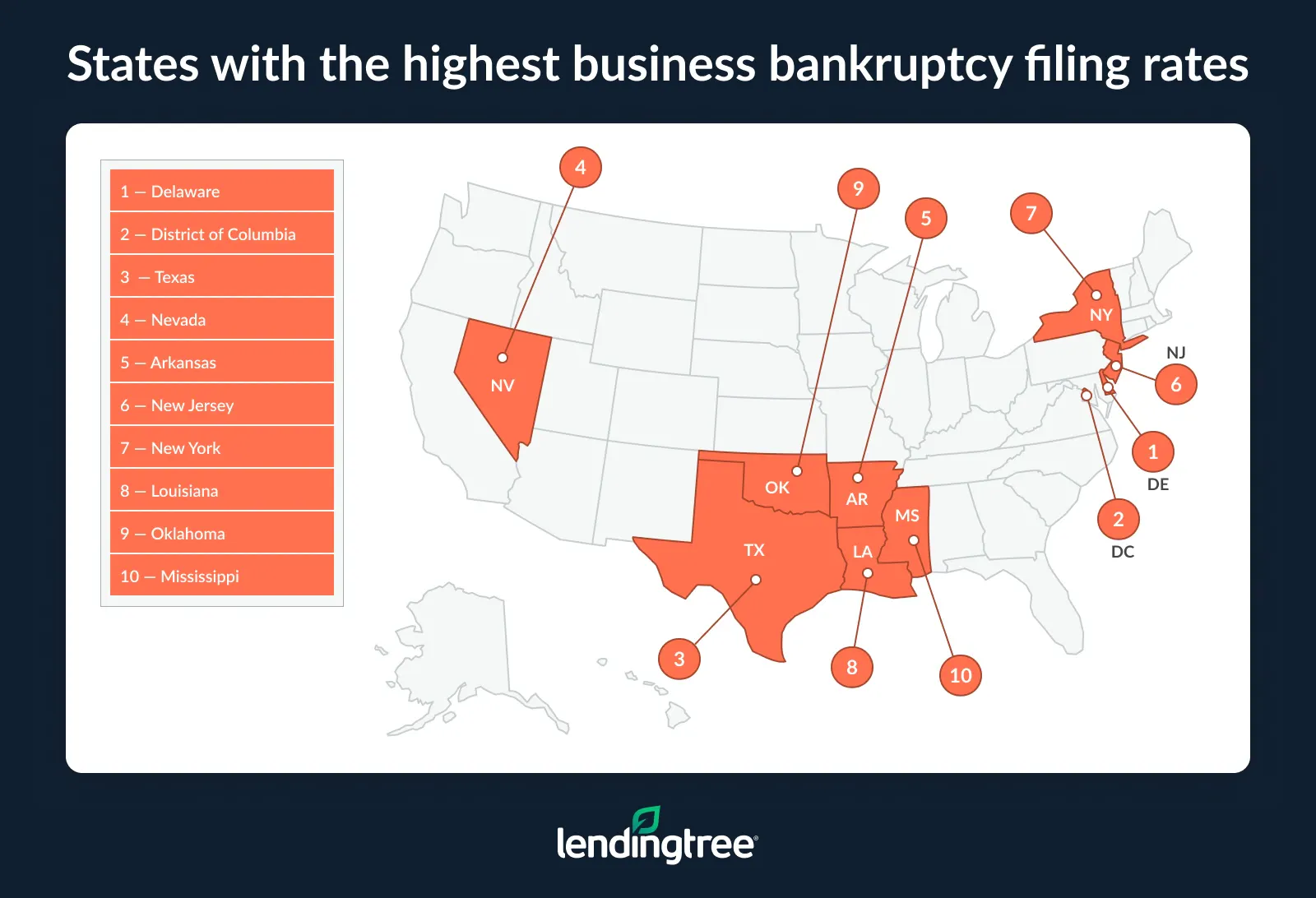
- Delaware had by far the highest business bankruptcy filing rate in the U.S. The state had 538.9 filings per 100,000 small businesses in our analyzed period — more than seven times the national rate of 71.1. The District of Columbia (147.6) and Texas (129.7) ranked second and third, respectively.
- National business bankruptcy filings increased 11.4% year over year. Filings increased from 23,154 in the 12 months ended March 31, 2025, to 25,796 in the 12 months ended March 31, 2026.
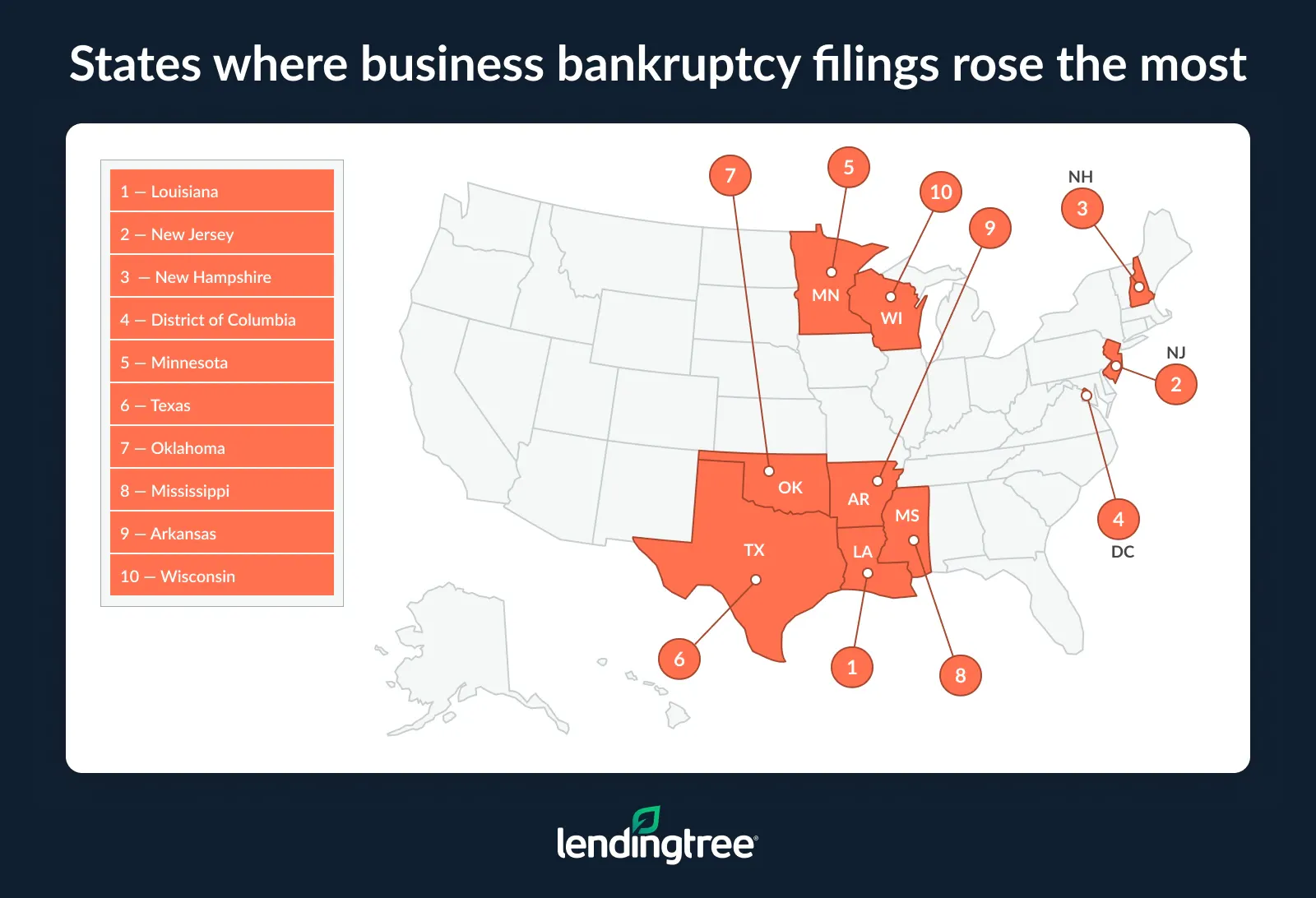
- Louisiana and New Jersey posted the largest year-over-year increases in business bankruptcy filings. Filings in Louisiana rose 83.8%, from 240 to 441, while filings in New Jersey increased 79.3%, from 546 to 979. These were the only states with increases exceeding 65.0%; New Hampshire ranked next at 61.3%.
- Chapter 7 and Chapter 11 filings accounted for nearly 93% of business bankruptcies nationwide. Chapter 7 represented 56.8% of filings, and Chapter 11 represented 36.1%. Chapter 13 filings accounted for 5.1%, while all other bankruptcy chapters combined accounted for 1.9%.
Delaware records the highest business bankruptcy filing rate
Delaware recorded the nation’s highest business bankruptcy filing rate during the analyzed period, with 538.9 filings per 100,000 small businesses — more than seven times the national rate of 71.1.
The state’s elevated filing rate is likely influenced in part by its status as a leading incorporation jurisdiction. More than two-thirds of Fortune 500 companies are incorporated in Delaware, according to the Delaware Division of Corporations.
Delaware also reported 2,157,482 active business entities in 2024, including 1,560,938 LLCs and 401,760 corporations, according to the Delaware Division of Corporations. The state’s unusually large number of registered businesses may contribute to its elevated bankruptcy filing rate.
Matt Schulz, LendingTree chief consumer finance analyst and author of “Ask Questions, Save Money, Make More: How to Take Control of Your Financial Life,” says Delaware’s ranking reflects incorporation patterns as much as business activity within the state. “Because so many businesses are legally based in Delaware, bankruptcy filings there often reflect a national corporate footprint rather than economic conditions within Delaware itself,” he says.
The District of Columbia (147.6 filings per 100,000 small businesses) and Texas (129.7) ranked second and third, respectively.
At the other end of the rankings, Connecticut recorded the lowest business bankruptcy filing rate, at 26.5 filings per 100,000 small businesses. Vermont (28.1) and South Dakota (32.0) followed.
Full rankings: States with the highest business bankruptcy filing rates
| Rank | State | Business bankruptcy filings | # of small businesses | Filings per 100,000 small businesses |
|---|---|---|---|---|
| 1 | Delaware | 600 | 111,346 | 538.9 |
| 2 | District of Columbia | 122 | 82,666 | 147.6 |
| 3 | Texas | 4,562 | 3,517,343 | 129.7 |
| 4 | Nevada | 365 | 353,621 | 103.2 |
| 5 | Arkansas | 275 | 292,728 | 93.9 |
| 6 | New Jersey | 979 | 1,051,630 | 93.1 |
| 7 | New York | 2,114 | 2,378,996 | 88.9 |
| 8 | Louisiana | 441 | 511,235 | 86.3 |
| 9 | Oklahoma | 332 | 395,520 | 83.9 |
| 10 | Mississippi | 237 | 294,768 | 80.4 |
| 11 | Georgia | 1,068 | 1,374,972 | 77.7 |
| 12 | California | 3,208 | 4,340,784 | 73.9 |
| 13 | Colorado | 530 | 730,887 | 72.5 |
| 14 | Florida | 2,513 | 3,485,976 | 72.1 |
| 15 | West Virginia | 82 | 118,045 | 69.5 |
| 16 | New Hampshire | 100 | 145,314 | 68.8 |
| 17 | Kansas | 180 | 273,419 | 65.8 |
| 18 | Illinois | 867 | 1,353,957 | 64.0 |
| 19 | Nebraska | 122 | 193,495 | 63.1 |
| 20 | Oregon | 254 | 417,747 | 60.8 |
| 21 | Arizona | 422 | 706,640 | 59.7 |
| 22 | Tennessee | 440 | 741,196 | 59.4 |
| 23 | Minnesota | 312 | 560,428 | 55.7 |
| 24 | Alabama | 256 | 465,610 | 55.0 |
| 25 | Washington | 379 | 695,695 | 54.5 |
| 26 | Maryland | 379 | 696,710 | 54.4 |
| 27 | Pennsylvania | 623 | 1,169,008 | 53.3 |
| 28 | Massachusetts | 369 | 756,096 | 48.8 |
| 29 | Wisconsin | 242 | 497,370 | 48.7 |
| 30 | Iowa | 140 | 289,962 | 48.3 |
| 31 | Ohio | 516 | 1,081,292 | 47.7 |
| 32 | Wyoming | 39 | 81,924 | 47.6 |
| 33 | Indiana | 277 | 591,671 | 46.8 |
| 34 | Idaho | 96 | 207,670 | 46.2 |
| 35 | Virginia | 401 | 880,366 | 45.5 |
| 36 | Rhode Island | 51 | 116,149 | 43.9 |
| 37 | Utah | 161 | 371,569 | 43.3 |
| 38 | North Carolina | 445 | 1,107,537 | 40.2 |
| 39 | Alaska | 31 | 77,814 | 39.8 |
| 40 | Montana | 55 | 141,011 | 39.0 |
| 41 | New Mexico | 66 | 172,113 | 38.3 |
| 42 | Missouri | 220 | 590,131 | 37.3 |
| 43 | Maine | 58 | 160,215 | 36.2 |
| 44 | Michigan | 338 | 983,079 | 34.4 |
| 45 | Hawaii | 49 | 144,375 | 33.9 |
| 46 | North Dakota | 26 | 78,219 | 33.2 |
| 47 | Kentucky | 129 | 393,860 | 32.8 |
| 48 | South Carolina | 170 | 530,402 | 32.1 |
| 49 | South Dakota | 31 | 96,770 | 32.0 |
| 50 | Vermont | 23 | 81,949 | 28.1 |
| 51 | Connecticut | 101 | 381,129 | 26.5 |
National business bankruptcy filings rose 11.4% year over year
Business bankruptcy filings increased from 23,154 in the 12 months ended March 31, 2025, to 25,796 in the 12 months ended March 31, 2026 — a rise of 2,642 filings, or 11.4%.
Schulz says that could be because companies are continuing to face higher debt burdens, elevated borrowing costs and inflation-driven expense pressures.
“Higher interest rates, lingering inflation and softer consumer demand have created a difficult combination for many businesses,” he says. “When borrowing costs rise at the same time customers become more cautious about spending, companies with thin margins or significant debt often find themselves running out of room to maneuver.”
Louisiana and New Jersey posted the largest increases in business bankruptcy filings
Among the states, Louisiana recorded the largest year-over-year increase in business bankruptcy filings. Filings rose 83.8%, from 240 to 441. New Jersey ranked second, with filings increasing 79.3%, from 546 to 979. These were the only two states to post increases exceeding 65.0%.
New Hampshire ranked third, with filings rising 61.3%, from 62 to 100.
Meanwhile, business bankruptcy filings declined in 14 states. Despite recording the nation’s highest filing rate, Delaware posted the steepest year-over-year decline in filings, falling 61.6% from 1,563 to 600. North Dakota recorded the second-largest decrease, with filings dropping 39.5% from 43 to 26. Connecticut ranked third, with filings declining 19.2% from 125 to 101.
Full rankings: States where business bankruptcy filings rose the most
| Rank | State | Previous 12-month filings | Current 12-month filings | # change | % change |
|---|---|---|---|---|---|
| 1 | Louisiana | 240 | 441 | 201 | 83.8% |
| 2 | New Jersey | 546 | 979 | 433 | 79.3% |
| 3 | New Hampshire | 62 | 100 | 38 | 61.3% |
| 4 | District of Columbia | 77 | 122 | 45 | 58.4% |
| 5 | Minnesota | 218 | 312 | 94 | 43.1% |
| 6 | Texas | 3,235 | 4,562 | 1,327 | 41.0% |
| 7 | Oklahoma | 236 | 332 | 96 | 40.7% |
| 8 | Mississippi | 170 | 237 | 67 | 39.4% |
| 9 | Arkansas | 199 | 275 | 76 | 38.2% |
| 10 | Wisconsin | 178 | 242 | 64 | 36.0% |
| 11 | Rhode Island | 38 | 51 | 13 | 34.2% |
| 12 | Nevada | 280 | 365 | 85 | 30.4% |
| 13 | Nebraska | 94 | 122 | 28 | 29.8% |
| 14 | Montana | 43 | 55 | 12 | 27.9% |
| 15 | Utah | 127 | 161 | 34 | 26.8% |
| 15 | Kansas | 142 | 180 | 38 | 26.8% |
| 17 | South Carolina | 136 | 170 | 34 | 25.0% |
| 18 | North Carolina | 357 | 445 | 88 | 24.6% |
| 19 | Massachusetts | 297 | 369 | 72 | 24.2% |
| 20 | Alaska | 25 | 31 | 6 | 24.0% |
| 21 | Florida | 2,043 | 2,513 | 470 | 23.0% |
| 22 | Indiana | 230 | 277 | 47 | 20.4% |
| 23 | Iowa | 117 | 140 | 23 | 19.7% |
| 24 | Oregon | 213 | 254 | 41 | 19.2% |
| 25 | Wyoming | 34 | 39 | 5 | 14.7% |
| 26 | Ohio | 456 | 516 | 60 | 13.2% |
| 27 | Idaho | 87 | 96 | 9 | 10.3% |
| 28 | Michigan | 309 | 338 | 29 | 9.4% |
| 29 | Washington | 347 | 379 | 32 | 9.2% |
| 30 | Colorado | 486 | 530 | 44 | 9.1% |
| 31 | Virginia | 369 | 401 | 32 | 8.7% |
| 32 | New York | 1,960 | 2,114 | 154 | 7.9% |
| 33 | South Dakota | 29 | 31 | 2 | 6.9% |
| 34 | California | 3,034 | 3,208 | 174 | 5.7% |
| 35 | Maryland | 360 | 379 | 19 | 5.3% |
| 36 | Tennessee | 438 | 440 | 2 | 0.5% |
| 37 | Kentucky | 129 | 129 | 0 | 0.0% |
| 38 | Pennsylvania | 648 | 623 | -25 | -3.9% |
| 39 | Illinois | 920 | 867 | -53 | -5.8% |
| 40 | Missouri | 235 | 220 | -15 | -6.4% |
| 41 | Arizona | 453 | 422 | -31 | -6.8% |
| 42 | New Mexico | 71 | 66 | -5 | -7.0% |
| 43 | Hawaii | 54 | 49 | -5 | -9.3% |
| 44 | Alabama | 285 | 256 | -29 | -10.2% |
| 45 | Vermont | 26 | 23 | -3 | -11.5% |
| 46 | West Virginia | 93 | 82 | -11 | -11.8% |
| 47 | Maine | 66 | 58 | -8 | -12.1% |
| 48 | Georgia | 1,231 | 1,068 | -163 | -13.2% |
| 49 | Connecticut | 125 | 101 | -24 | -19.2% |
| 50 | North Dakota | 43 | 26 | -17 | -39.5% |
| 51 | Delaware | 1,563 | 600 | -963 | -61.6% |
Chapter 7 and Chapter 11 filings account for nearly 93% of business bankruptcies
Nearly all business bankruptcy filings fall under two chapters of the U.S. Bankruptcy Code. Chapter 7 filings, which generally involve the liquidation of a business’s assets, accounted for 56.8% of filings. Chapter 11 filings, which allow businesses to reorganize their debts while continuing operations, represented 36.1%.
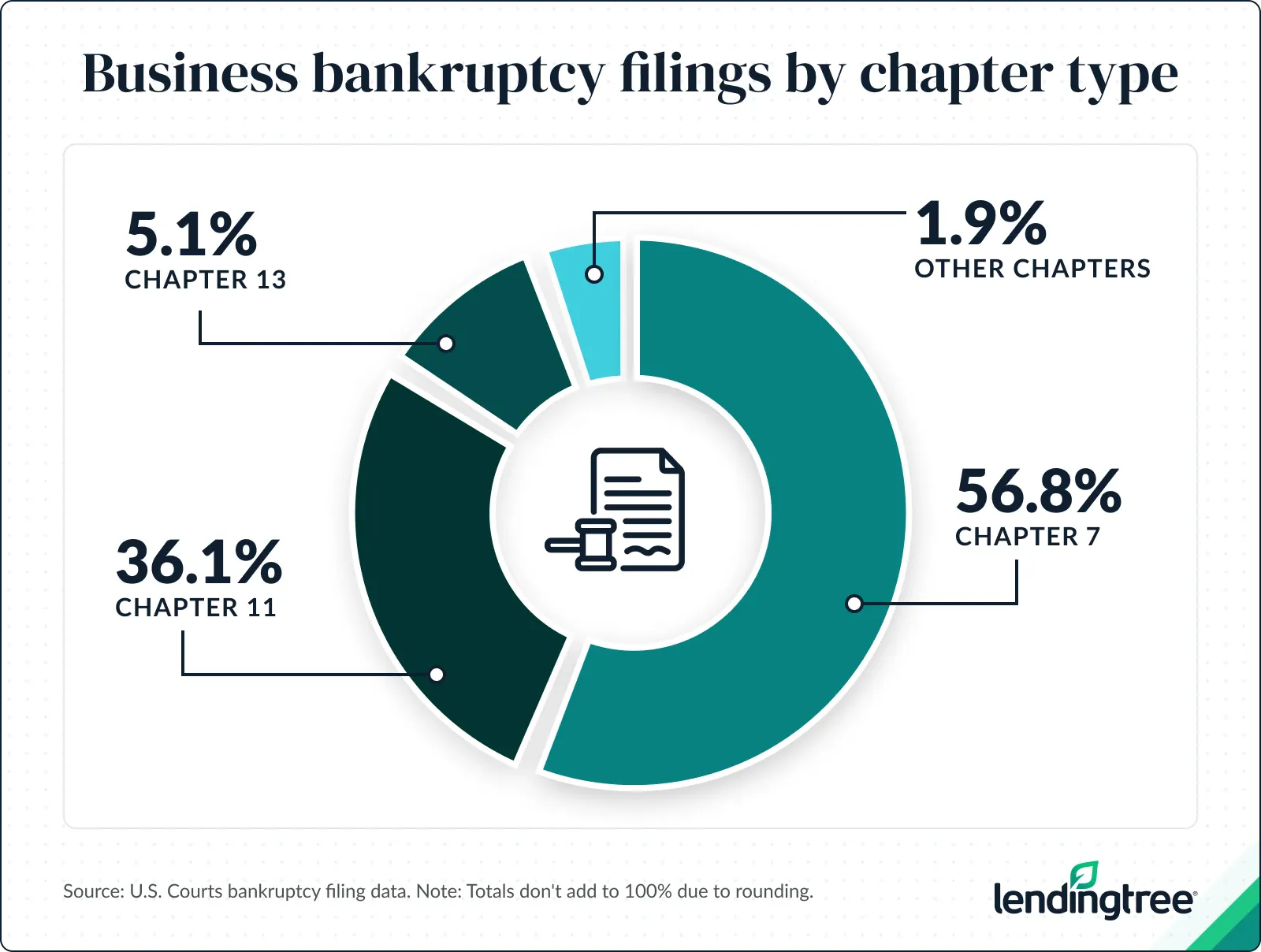
Chapter 13 filings accounted for 5.1% of business bankruptcies, while all other chapters combined represented 1.9%.
According to Schulz, several factors can influence whether a business files under Chapter 7 or Chapter 11.
“In many cases, the decision comes down to whether management sees a credible path to survival or believes losses will only deepen if the business continues operating,” he says. “Chapter 11 is designed for businesses that still have a viable future if they can restructure their debts. Chapter 7 is usually chosen when the business no longer has a realistic path to profitability and the costs, complexity and time involved in reorganization don’t make financial sense.”
Tips for protecting your business during periods of economic uncertainty
Economic uncertainty can strain even well-established businesses, making proactive financial management increasingly important. Schulz offers the following recommendations for business owners:
- Monitor cash flow closely and build emergency reserves. “Cash flow problems are one of the most common reasons businesses run into serious financial trouble,” Schulz says. “Owners should regularly review incoming and outgoing cash, identify potential shortfalls early and build as much of a financial cushion as possible to help weather unexpected disruptions.”
- Review debt obligations and operating expenses. “With borrowing costs still high compared to a few years ago, it’s worth reviewing every major debt obligation and recurring expense,” he says. “Even modest reductions in interest costs, overhead or unnecessary spending can improve financial flexibility and reduce pressure on the business.”
- Communicate early with lenders, vendors and key business partners. “Too many business owners wait until they’re facing a crisis before asking for help,” he says. “We often see the same thing with consumers when they hit tough times. Reaching out early can open the door to payment modifications, extended terms or other accommodations that may not be available once financial problems become severe.”
Methodology
LendingTree analyzed U.S. Courts bankruptcy filing data for the 12-month periods ended March 31, 2026, and March 31, 2025. Business bankruptcy figures reflect total business filings across all bankruptcy chapters.
To calculate filing rates, LendingTree divided each state’s business bankruptcy filings during the current 12-month period by its number of small businesses, based on the U.S. Small Business Administration (SBA) Office of Advocacy’s 2025 state small-business statistics, and multiplied the result by 100,000. According to the SBA, small businesses account for 99.9% of U.S. businesses, making small-business counts a reasonable proxy for measuring state-level business bankruptcy exposure.
Year-over-year changes compare business bankruptcy filings during the current 12-month period with those during the previous 12-month period.
Compare business loan offers