37% of Americans Would Let AI Buy a Home; 49% Would Consider a 3D-Printed One


AI is quickly working its way into the homebuying process, but that doesn’t mean Americans are ready to hand over the keys entirely.
This survey of 2,001 U.S. consumers finds that while most people would use AI for at least one task along the way, they still want a human involved when the stakes are highest. At the same time, a significant share of buyers say they’re open to a home built by very different technology — a 3D printer — though real hesitations remain there, too.
- Many Americans would consider using AI when buying or selling a home. Nearly three-quarters (72%) say they’d use AI for at least one homebuying or selling task. The most common use cases are searching for homes within their budget (35%), estimating their home’s value (28%) and finding down payment assistance programs (24%).
- More than one-third would let AI manage a home purchase from start to finish. While 37% say they’d be willing to let AI complete a home purchase with minimal human involvement, 41% say they wouldn’t. Looking ahead, 36% believe AI will reduce the cost of buying or selling a home over the next decade, and the same share expect AI to handle most or nearly all of the homebuying or selling process by 2036.
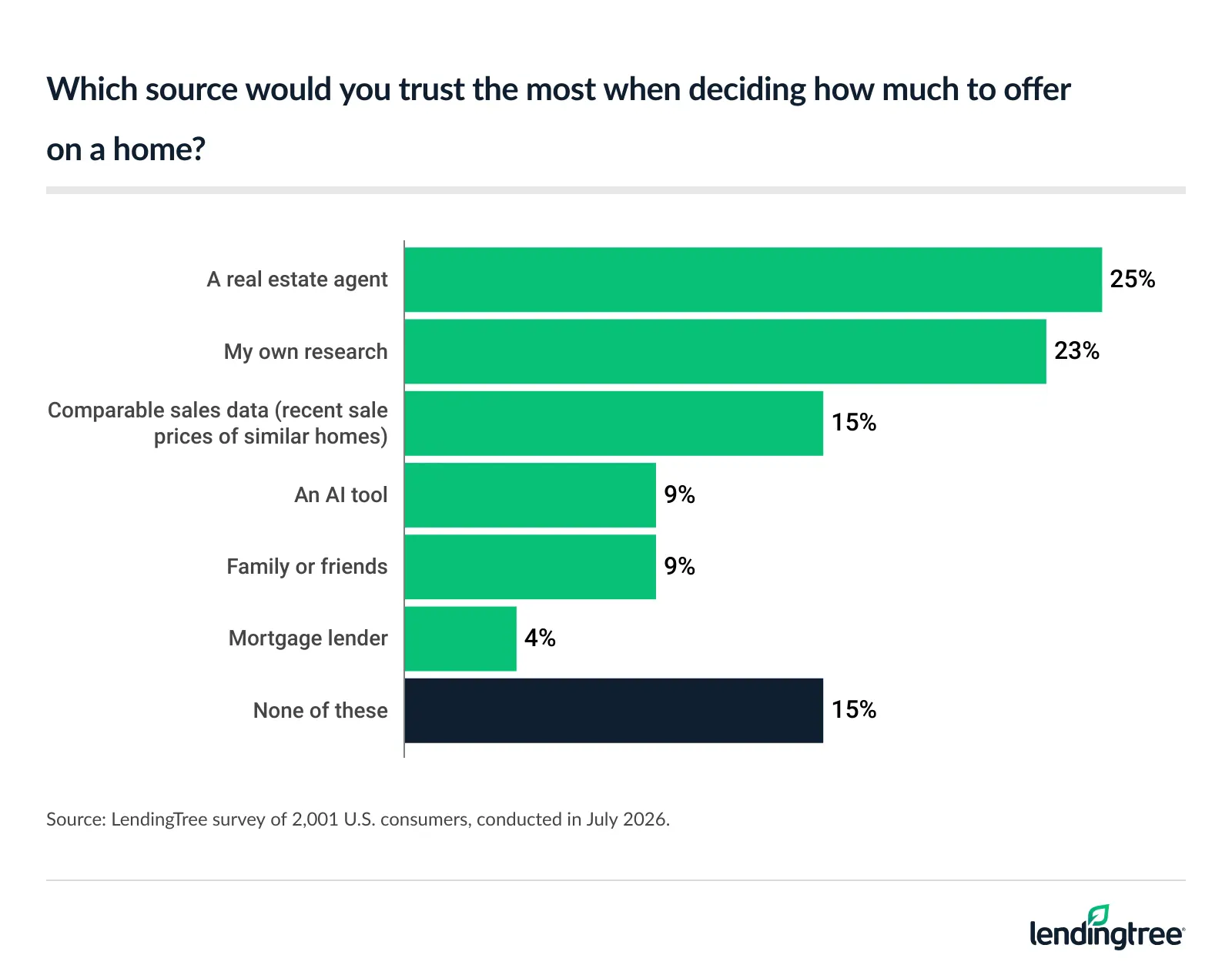
- Consumers still prefer human involvement in major homebuying decisions. When deciding how much to offer on a home, Americans are most likely to trust a real estate agent (25%) or their own research (23%). The leading concerns about using AI in the homebuying or selling process are inaccurate or misleading information (22%) and data security (16%).
- Nearly half of Americans are open to buying a 3D-printed home. About half (49%) say they’d consider purchasing one if it met their location and budget needs, compared with 25% who say they’re unlikely to do so. More than one-third (36%) believe 3D-printed homes will make homeownership more affordable over the next 10 years.
- Price alone is unlikely to address concerns about 3D-printed homes. The biggest barriers are durability (40%), construction quality (39%), building code compliance (31%) and resale value (29%). While 26% say they’d need at least a 20% price discount to consider buying one, 30% say they wouldn’t consider purchasing a 3D-printed home at any discount.
Many Americans would consider using AI when buying or selling a home
In total, 72% of Americans would use AI for at least one homebuying or selling task. When asked what they’d use it for, 35% said searching for homes within their budget — the most common response. That’s followed by estimating their home’s value (28%) and finding down payment assistance programs (24%).
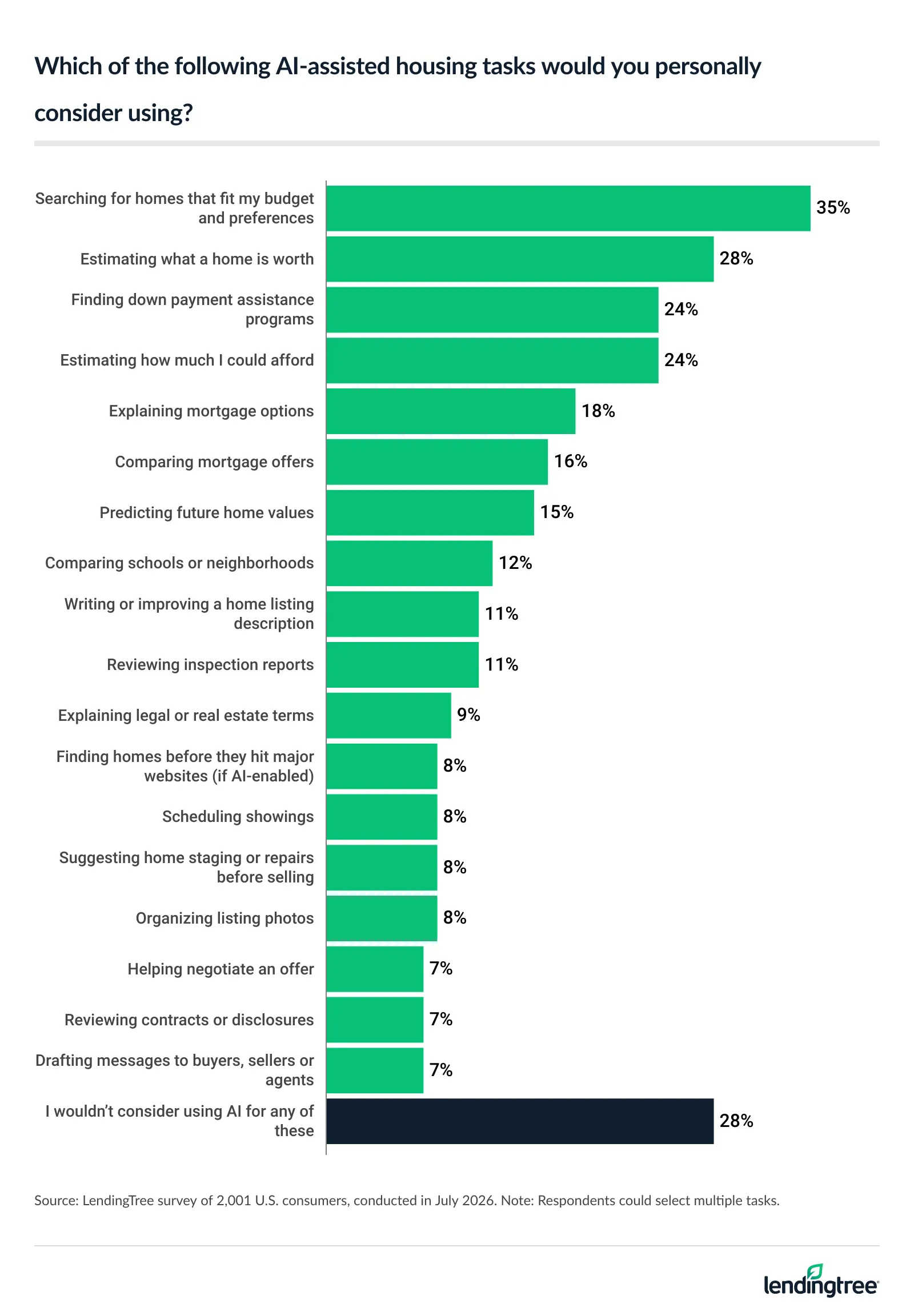
Still, 28% say they wouldn’t consider using AI for any housing tasks.
Matt Schulz, LendingTree chief consumer finance analyst and author of “Ask Questions, Save Money, Make More: How to Take Control of Your Financial Life,” says that AI’s biggest value for homebuyers is helping them get organized faster.
“It can help them find homes in their budget, understand different types of mortgages and find down payment assistance programs, among other things,” he says. “Those are time-consuming, information-heavy tasks where AI can help people ask better questions and narrow their options.”
Even so, Schulz says, human expertise and guidance are still important. “AI should be a starting point, not the final word,” he says. “A mortgage or real estate professional can help explain trade-offs, local market realities, loan rules and risks that a chatbot or online tool may miss.”
Here’s which tools Americans are using — and what they’re using AI for
Looking at technology usage over the past year, online home search sites and apps remain the most-used housing tech by far, with 34% of Americans saying they’ve turned to one in the past 12 months.
AI tools follow at 15%. That’s on par with real estate agent websites and apps (15%) and ahead of virtual home tours (14%), online affordability calculators (13%) and smart home technology like locks, thermostats or security cameras (13%). That’s followed by:
- Online mortgage calculators (12%)
- Mortgage rate comparison sites (10%)
- Online mortgage prequalification or refinance tools (7%)
- Online mortgage applications (5%)
Meanwhile, 35% say they haven’t used any of these tools in the past 12 months.
Among those who’ve tapped AI for housing-related tasks, the leading uses are researching or comparing neighborhoods (38%), searching for homes (35%) and estimating home values (33%). Other common uses include:
- Summarizing listings (32%)
- Asking mortgage questions (30%)
- Estimating monthly payments (29%)
- Learning the homebuying process (26%)
- Generating questions for an agent (23%)
- Comparing lenders (21%)
- Creating a homebuying budget (19%)
- Reviewing contracts/documents (18%)
- Writing listing descriptions (13%)
More than a third would let AI manage a home purchase from start to finish
A little over a third (37%) of Americans say they’d hand the reins to AI and let it handle a home purchase with barely any human input. Meanwhile, a slightly larger group — 41% — say they wouldn’t.
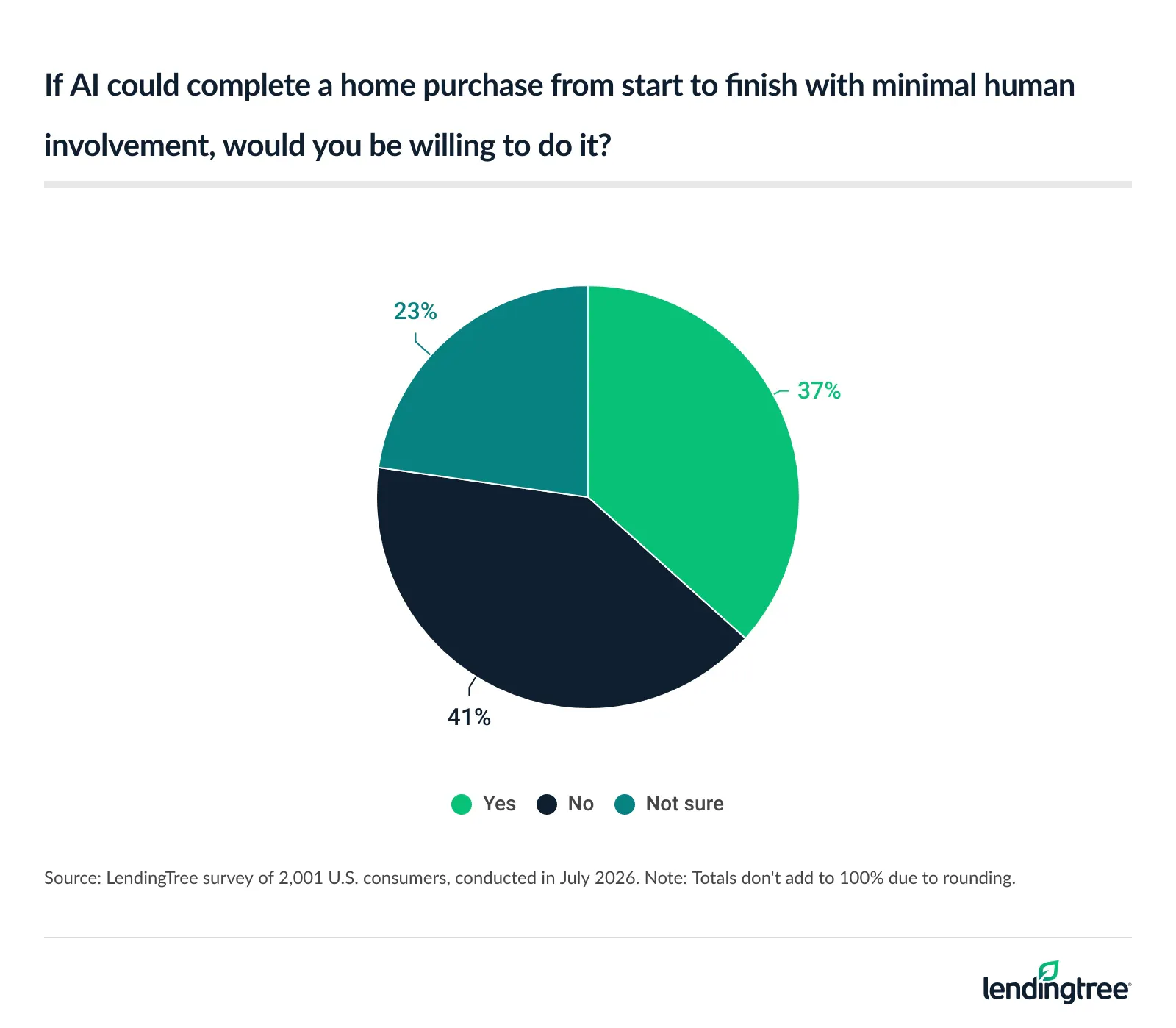
Looking a decade out, roughly the same share (36%) expect AI to bring down the amount it costs to buy or sell a home, and just as many predict AI will do the bulk of the homebuying and selling process by 2036. Still, 64% believe that AI will only do some tasks or have minimal involvement by then.
Schulz believes human input will always be important.
“AI will likely make the mortgage process faster, cheaper and less intimidating over the next decade,” he says. “That’s a big deal because buying a home is overwhelming, even for people who have done it before. However, the human touch will always be important, especially when the stakes are highest, such as when you’re deciding what you can afford or negotiating to get the best terms possible.”
Consumers still prefer human involvement in major decisions
When it’s time to settle on an offer price, consumers still lean on people over technology. When it comes to which source they’d trust the most when deciding how much to offer on a home, a real estate agent (25%) or their own research (23%) beats out AI as the go-to resource.
As far as what specifically is holding people back from trusting AI more, the main reason cited is getting bad or misleading information (22%). That’s followed by worries over data security (16%). Other concerns include:
- It wouldn’t be clear who’s responsible if something goes wrong (11%)
- There wouldn’t be enough human judgment or oversight (11%)
- It could miss important details (10%)
- It could be biased or unfair (7%)
- It wouldn’t understand consumers’ unique situations (6%)
In Schulz’s opinion, consumers are right to be concerned.
“The biggest risk is treating AI like an expert when it is more like a very useful assistant,” he says. “It’ll make mistakes from time to time, and those can cost you money. Data security matters, too, because mortgage shopping involves some of the most sensitive financial information people have.”
Rather than relying on AI entirely, people can use it as another tool in their arsenal to help ensure they’re as prepared and informed as possible. “The smart move is to use AI to gather ideas, compare options and prepare questions, then verify anything important with a lender, agent or other professional before making the final call,” Schulz says.
Nearly half of Americans are open to buying a 3D-printed home
AI isn’t the only technology getting into real estate: Just under half (49%) of Americans say a 3D-printed home would be a real option for them as long as it checked the boxes on location and price. Meanwhile, only a quarter (25%) would be likely to rule it out.
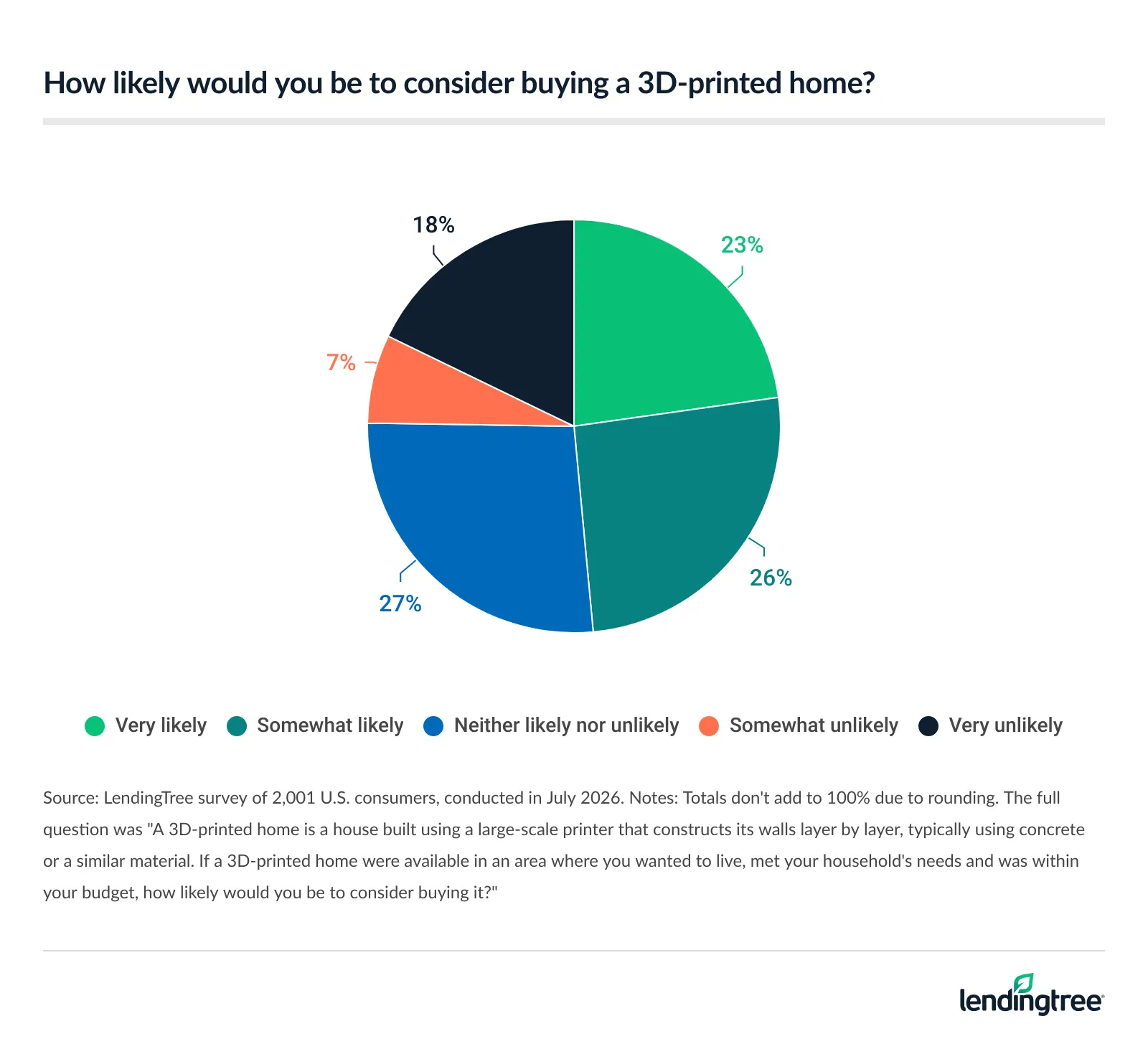
Looking further ahead, more than a third (36%) think this kind of construction could make homeownership more affordable over the next decade.
But even though buyers may be increasingly open to 3D-printed homes, that doesn’t mean financing them will be so simple.
“The challenge is often less about the printer itself and more about proving that the home behaves like a traditional home from a lending and resale standpoint,” Schulz says. “If the paperwork is clean, the inspections are complete, the appraiser has good information and the local market understands the property, financing may be much more straightforward. If any of those pieces are missing, buyers could run into delays, extra questions or a tougher appraisal process.”
Price alone is unlikely to address concerns about 3D-printed homes
The biggest concerns Americans have with 3D-printed homes are durability (40%), construction quality (39%), building code compliance (31%) and resale value (29%).
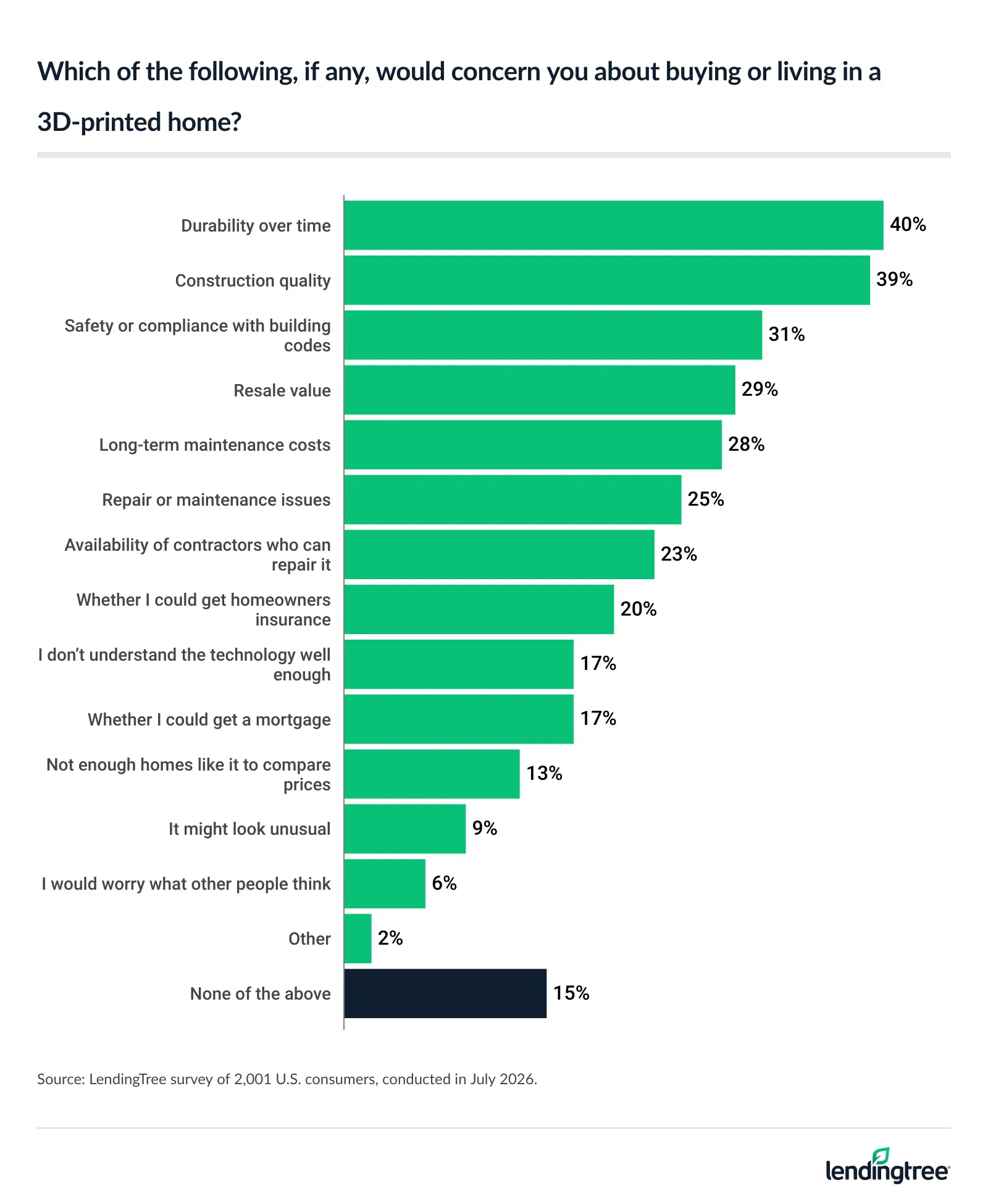
A price cut helps, but only to a point. Just over a quarter (26%) say they’d need at least a 20% price discount to consider buying one, while 27% say they’d need a 5% to 19% discount. Another 7% say they’d take a meager 1% to 4% discount.
Notably, just 9% say they wouldn’t require any discount to purchase one. Meanwhile, 30% say they wouldn’t consider purchasing a 3D-printed home at any discount.
That skepticism tracks closely with how lenders themselves evaluate the risk of 3D-printed homes.
“Concerns about durability, construction quality, code compliance and resale value matter so much because the home is the lender’s collateral,” Schulz says. “If the borrower stops making payments, the lender needs to know the property can be sold without major surprises. That’s harder to gauge with newer housing technologies when there may be fewer comparable sales, fewer long-term performance records and less familiarity among appraisers, insurers and local officials.”
Even with these concerns, “that doesn’t mean lenders are automatically going to reject 3D-printed homes,” Schulz says — though he notes “it does mean the loan may face more questions.”
“The more you can do to answer those questions early in the process, the less likely you are to run into costly delays or surprises near closing.”
Top expert tips for letting technology work for you while homebuying
Technology has made buying a home faster and more convenient than ever. The smartest buyers, however, know when to lean on digital tools and when to rely on human expertise.
While you can use technology to simplify the homebuying and selling process, it’s important to make sure you’re still doing your homework. We offer the following advice:
- Use AI to get organized — not to make decisions for you. “AI can help you narrow your home search, compare neighborhoods, estimate monthly payments and generate better questions for your lender or real estate agent,” Schulz says. “Just don’t let it replace your own research and judgment.”
- Shop around for your mortgage. “Mortgage rates, fees and loan terms can vary significantly from one lender to the next,” he says. “Comparing multiple offers could save you thousands of dollars over the life of your loan.”
- Verify the big stuff with real people. “AI is helpful, but it’s far from perfect,” he says. “Before you make an offer or sign anything, confirm key details with your lender, real estate agent or another trusted professional. There’s too much at stake to rely on technology alone.”
Methodology
LendingTree commissioned QuestionPro to conduct an online survey of 2,001 U.S. consumers ages 18 to 80 from July 2 to 8, 2026. The survey was administered using a nonprobability-based sample, and quotas were used to help ensure the sample reflected the overall population. Researchers reviewed all responses for quality control.
Generations were defined as the following age groups in 2026:
- Generation Z: 18 to 29
- Millennials: 30 to 45
- Generation X: 46 to 61
- Baby boomers: 62 to 80
View mortgage loan offers from up to 5 lenders in minutes