Borrowers With the Lowest Mortgage Rates Could Save Over $43,000 — Here’s What Sets Them Apart


A good mortgage rate can make a massive difference. Those with the lowest rates see serious savings in interest over the life of their loan. That means more money to save and invest.
So, who is landing rock-bottom rates? According to this LendingTree study, borrowers who have the lowest mortgage rates tend to have stronger credit, larger down payments and more lender offers to choose from. They’re also less likely to be first-time buyers.
Here’s a closer look at what the data shows.
To identify borrowers with the most competitive offers, we compared applicant credit profiles, down payments, loan amounts, loan-to-value (LTVs) ratios, the number of lender offers and other available metrics to understand what characteristics are most common.
The top 10% group consists of borrowers whose lowest offered mortgage rate ranked among the lowest 10% of rates received in their application month.
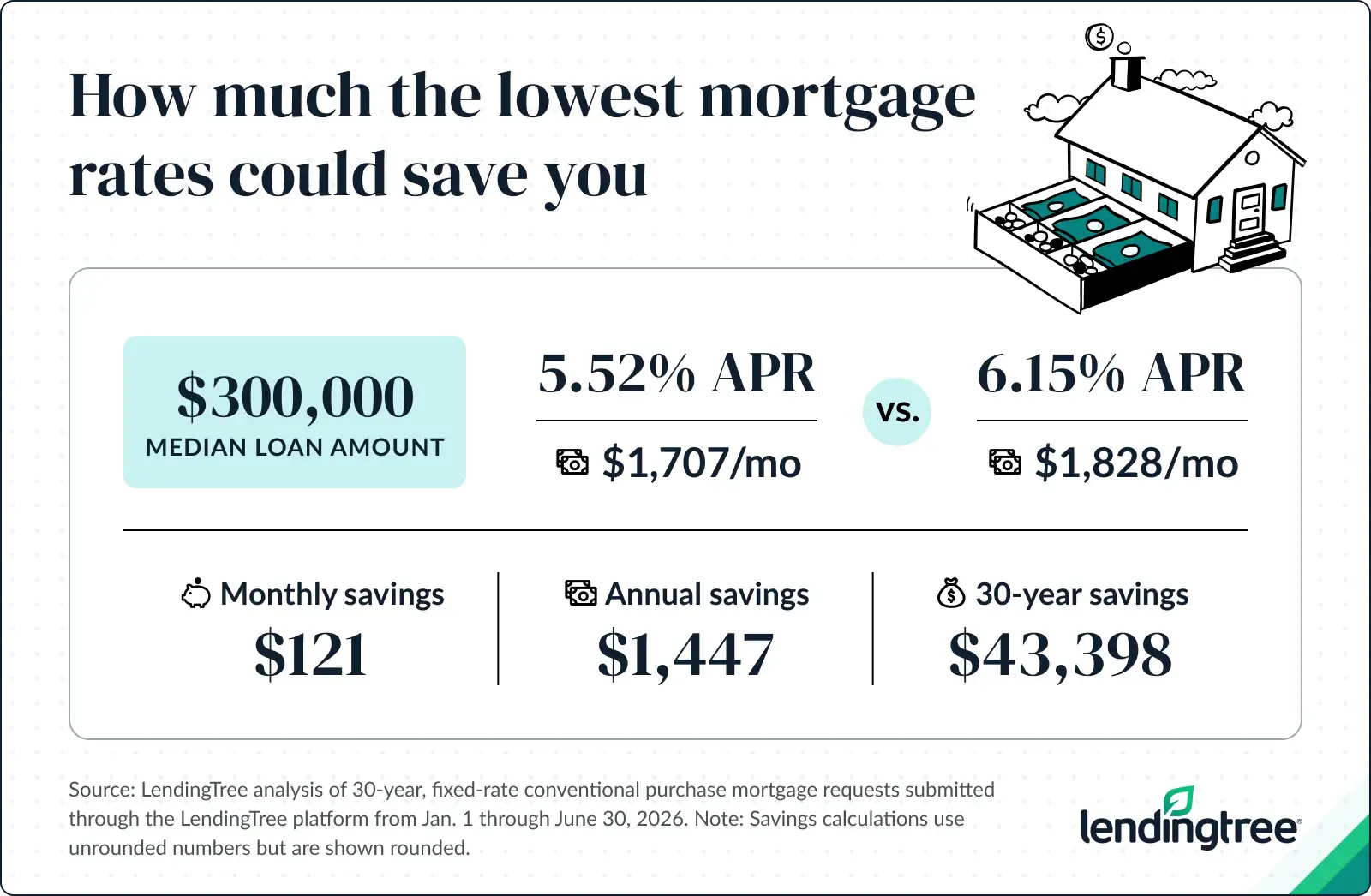
- Borrowers who receive the lowest mortgage rates could save $43,398 over the life of their loan. Borrowers receiving the lowest mortgage rates have an average APR of 5.52%, compared with an average APR of 6.15% for other borrowers — a difference of 0.63 percentage points. For a $300,000 mortgage (the median loan amount in our analysis), that rate difference means a savings of $121 a month.
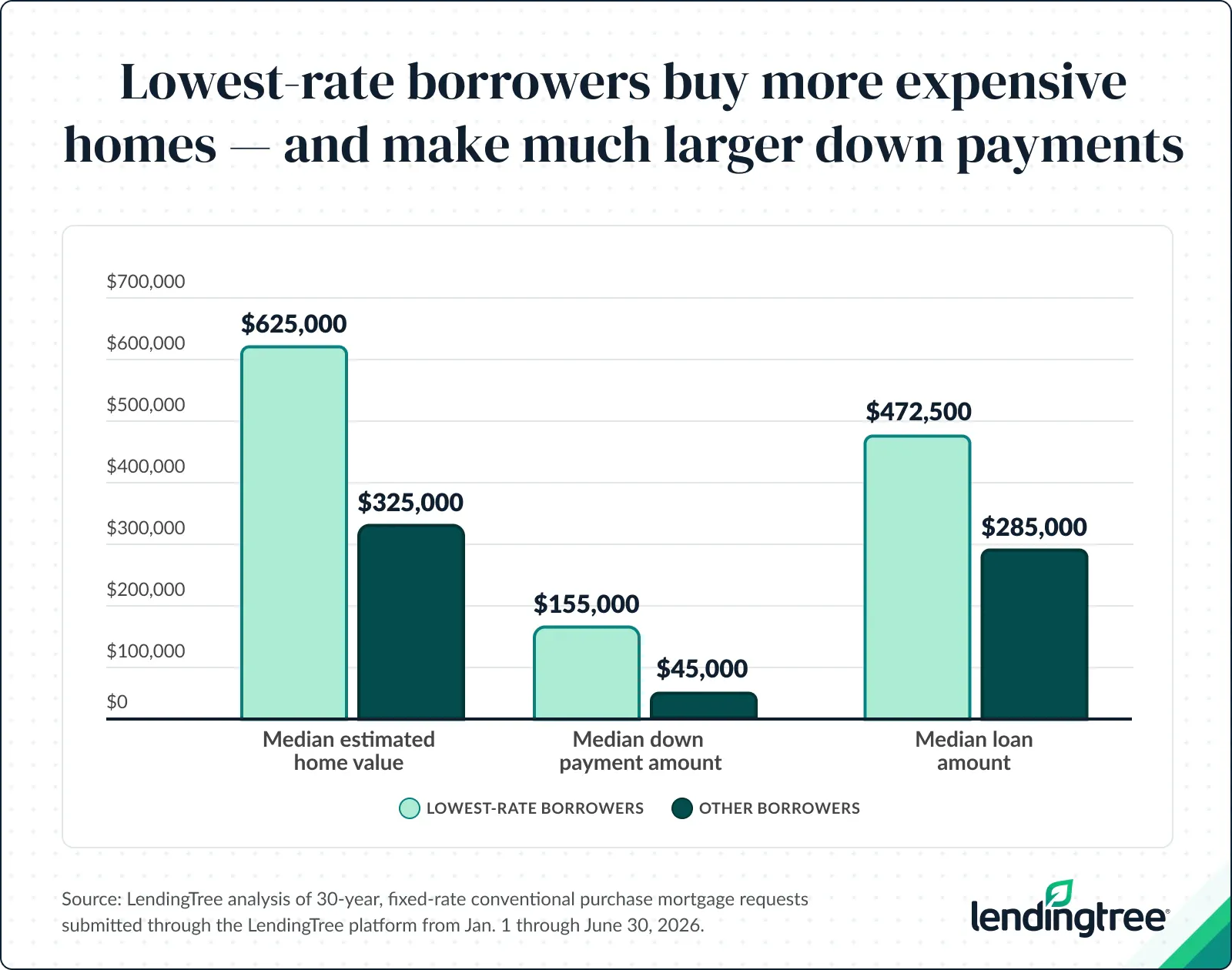
- Borrowers who secure the lowest mortgage rates tend to buy more expensive homes, but they also make much larger down payments. The median estimated value of their homes is $625,000 — nearly twice the $325,000 median for other borrowers. These borrowers also make a median down payment of $155,000, which is $110,000 more than other borrowers. Their median down payment is 20% of their home’s purchase price, compared with 15% for other borrowers.
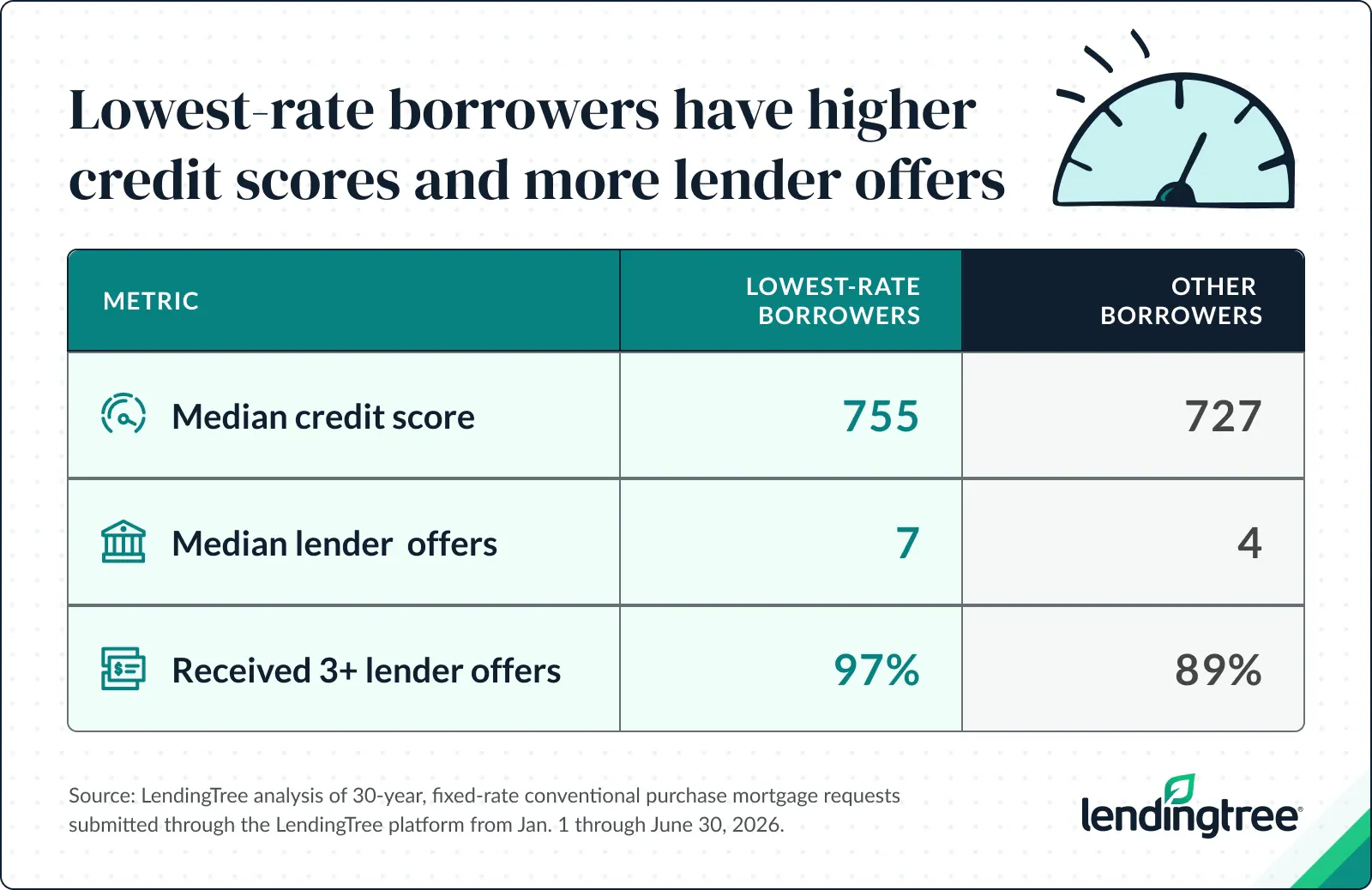
- The lowest-rate borrowers also have higher credit scores and receive more lender offers. Their median credit score is 755, compared with 727 for other borrowers. Further, 97% of lowest-rate borrowers receive at least three lender offers, versus 89% of other borrowers. They’re also more likely to apply with a co-borrower (47% versus 37%).
- Only 1 in 3 borrowers who receive the lowest mortgage rates are first-time homebuyers, compared with nearly 3 in 5 other borrowers. However, among first-time homebuyers, those who receive the lowest mortgage rates still stand out. They have a higher median credit score (747 versus 710) and make larger median down payments (20% versus 10%) than other first-time homebuyers.
The lowest rates could save borrowers more than $43,000 over the life of a loan
The gap between the best and average mortgage rates is more than a few basis points, and the difference adds up quickly.
Borrowers who secured the lowest mortgage rates have an average APR of 5.52%, versus 6.15% for everyone else — a 0.63 percentage point spread. Applied to a $300,000 mortgage — the median in our analysis — that gap translates to $121 in monthly savings and a whopping $43,398 over the 30-year life of a loan.
Matt Schulz, LendingTree chief consumer finance analyst and author of “Ask Questions, Save Money, Make More: How to Take Control of Your Financial Life,” says that while those savings are real, it’s worth bearing in mind that they don’t come automatically.
“The best mortgage rates generally go to borrowers who give lenders the fewest reasons to worry,” he says. “Those are typically people with strong credit, relatively low debt, steady income and a meaningful down payment. It’s easier said than done to accomplish those things, and it probably won’t happen overnight, but if you’re planning to buy a home in the near future, those should be your goals.”
As for the larger down payments these borrowers tend to make, Schulz also notes that a five-figure windfall isn’t easy to come by.
What is a relatively easy — and generally within reach — way to save, however, is to take the time to shop around and compare mortgage rates.
“Not everyone will save $40,000 or more by shopping around for the best mortgage rates,” Schulz says. “Your mileage will vary based on a bunch of different factors. However, you have nothing to lose and everything to gain in shopping around. After all, even if you only save $5,000 or $10,000 by shopping around, that’s an awful lot of money. That’s meaningful over time, and often all it requires is a little bit of time.”
The lowest-rate borrowers buy pricier homes, but they put far more down
Often, the best rates also mean bigger budgets and down payments. Homes purchased by the lowest-rate group carried a median estimated value of $625,000 — nearly twice the $325,000 median home value for other borrowers.
Down payments had a similarly stark difference: Lowest-rate borrowers put down a median of $155,000, which is $110,000 more than the $45,000 put down by other borrowers. As a share of purchase price, that works out to 20% for the lowest-rate borrowers, versus 15% for everyone else.
According to Schulz, that extra cash up front is doing a lot of the heavy lifting. “A larger down payment is big,” he says. “It reduces the lender’s risk because the buyer begins with more equity and borrows a smaller share of the home’s value. It may also help the buyer avoid private mortgage insurance and lower the monthly payment.”
That said, Schulz cautions against treating a 20% down payment as a universal goal. “Putting 20% down isn’t the right move for everybody,” he says. “Waiting could mean higher home prices, different mortgage rates or another year of rent. Buyers also shouldn’t empty their savings to reach a particular down payment percentage. Homeownership is expensive, and repairs have a funny way of showing up at the worst possible time.”
Stronger credit and more competing offers give the best borrowers an edge
Credit is another clear dividing line. The lowest-rate borrowers have a median credit score of 755, compared with 727 for other borrowers. They are also far more likely to have more options to choose from: Among lowest-rate borrowers, 97% received at least three lender offers, compared with 89% of other borrowers. The lowest-rate borrowers were also more likely to apply with a co-borrower, at 47% versus 37%.
Further, borrowers with the lowest mortgage rates also had stronger credit profiles beyond just their credit scores. Compared to other borrowers, they had lower median monthly debt payments excluding mortgages ($371 versus $505), longer credit histories (17 years versus 13 years for the oldest account) and lower median credit utilization (7% versus 12%).
Schulz says both pieces — the credit profile and the willingness to compare offers — matter enormously.
“Credit scores have a major influence on the mortgage rate a borrower ultimately receives,” he says. “It helps lenders understand how likely the borrower is to repay the loan. A few points can make a difference in whether someone gets the lowest rate or has to settle for a higher one.”
Rate shopping adds another layer of savings on top of that. “Shopping around makes a huge difference because offers can vary really widely among lenders,” he says. “Taking the time to shop around allows you to compare those offers and potentially play them off each other to score even better terms.”
First-time buyers are underrepresented among the lowest-rate borrowers
Low-rate buyers are more likely to have prior experiences with mortgages. Only 33% of borrowers who receive the lowest mortgage rates are first-time homebuyers, compared with 59% of other borrowers.
Schulz points to experience as the key differentiator for repeat buyers. “Repeat buyers often bring more resources and experience to the table,” he says. “They may be able to use equity from a previous home for a larger down payment, and they’ve already been through the mortgage process once. Those advantages can help them present the type of financial profile lenders tend to reward.”
Still, first-time buyers aren’t shut out of the best rates entirely. First-time buyers who did land the lowest rates outperformed their peers by a wide margin, with a higher median credit score (747 versus 710) and larger median down payments (20% versus 10%).
Full breakdown: Lowest-rate borrowers vs. other borrowers
Mortgage rate and offer comparison
| Metric | Lowest-rate borrowers | Other borrowers | Difference |
|---|---|---|---|
| Avg. best APR offered | 5.52% | 6.15% | 0.63 percentage points |
| Median credit score | 755 | 727 | 28 |
| Median offers | 7 | 4 | 3 |
| Received 3 or more offers | 97% | 89% | 8 percentage points |
Home purchase characteristics
| Metric | Lowest-rate borrowers | Other borrowers | Difference |
|---|---|---|---|
| Median down payment | $155,000 | $45,000 | $110,000 |
| Median loan amount | $472,500 | $285,000 | $187,500 |
| Median estimated home value | $625,000 | $325,000 | $300,000 |
| Median down payment | 20% | 15% | 5 percentage points |
| Median loan-to-value (LTV) ratio | 80% | 85% | 5 percentage points |
| First-time homebuyers | 33% | 59% | 26 percentage points |
| Co-borrower on the loan | 47% | 37% | 10 percentage points |
Credit profile
| Metric | Lowest-rate borrowers | Other borrowers | Difference |
|---|---|---|---|
| Median monthly debt payments (excluding mortgage) | $371 | $505 | $134 |
| Median oldest account age | 17 | 13 | 4 |
| Median recent inquiries | 1 | 2 | 1 |
| Median credit utilization | 7% | 12% | 5 percentage points |
| Median on-time payment % | 100% | 100% | None |
| Median # of open accounts | 7 | 7 | None |
Home purchase characteristics among first-time borrowers
| Metric | Lowest-rate borrowers | Other borrowers | Difference |
|---|---|---|---|
| Median credit score | 747 | 710 | 37 |
| Median down payment | $95,000 | $33,750 | $61,250 |
| Median loan amount | $451,250 | $261,250 | $190,000 |
| Median down payment | 20% | 10% | 10 percentage points |
| Median loan-to-value (LTV) ratio | 80% | 90% | 10 percentage points |
| Median lender offers | 7 | 4 | 3 |
Getting the best mortgage rate: Top expert tips
Getting a good mortgage rate can offer meaningful savings, especially over time. An excellent credit profile is a key piece of the puzzle when it comes to landing a good rate, but it’s not the only one. We offer the following advice:
- Manage your credit carefully. “Building good credit is a marathon, not a sprint, so the sooner you start improving your credit, the better,” Schulz says. “If you’re planning to apply for a mortgage in the next couple of months, avoid taking on new debt if possible. New credit accounts can temporarily affect your credit score, which could impact the loan offers you receive.”
- Shop aggressively. “One misconception is that mortgage rates are essentially the same everywhere,” Schulz says. “They aren’t. There can be massive differences among lenders, but you won’t know if you don’t look.” Take the time to get offers from at least three mortgage lenders and then compare their loan estimates.
- Don’t rely on interest rates alone. “Buyers also tend to focus exclusively on the interest rate, even though fees, points and other loan terms can change which offer is actually cheapest,” Schulz says. When comparing loan estimates from different lenders, make sure to see how they stack up in each of these areas, not just interest rate.
- Protect your cash cushion. “A larger down payment can strengthen your loan offer, but not if it leaves you without enough savings to cover repairs, moving costs and other unexpected expenses,” he says. “The best mortgage is one you can comfortably afford long after closing.”
Methodology
LendingTree analyzed a random sample of 50,000 users of LendingTree’s online loan marketplace who received at least one offer for a 30-year, fixed-rate conventional purchase mortgage between Jan. 1 and June 30, 2026.
Because mortgage rates fluctuated throughout the study period, borrowers were ranked within the month in which they received mortgage offers. Those whose lowest offered mortgage rate ranked in the lowest 10% for that month were classified as receiving the best offers.
LendingTree then compared those borrowers with all other borrowers in the sample across credit, financial and home purchase characteristics, including credit scores, down payments, loan amounts, lender offers and first-time homebuyer status.
View mortgage loan offers from up to 5 lenders in minutes