84% of Cardholders Who Asked for a Lower APR Got One — but Fewer People Are Asking


Fewer cardholders asked for a lower interest rate, a waived late fee, or a waived or reduced annual fee on a credit card in the past year, even as the success rates for most of those requests continued to climb.
This is the sixth straight year LendingTree has asked credit cardholders whether they’ve requested certain breaks — including reduced APRs and waived fees — from their credit card issuer and whether they were successful. Once again, our survey reveals that your chances of getting your request granted are sky-high, though too few people take advantage by asking.
I was surprised that fewer people asked this year than last. According to our survey, most cardholders say inflation has made them more likely to ask for breaks, and many even report getting their interest rate reduced or a fee waived without having to talk to an actual person.
Here’s what else we found.
- 84% of cardholders who asked for a lower interest rate on a credit card in the past year were successful, the highest in the six-year history of our report. That’s up a point from last year and is the highest percentage since we began tracking this data in 2021. The average reduction: 6.3 points.
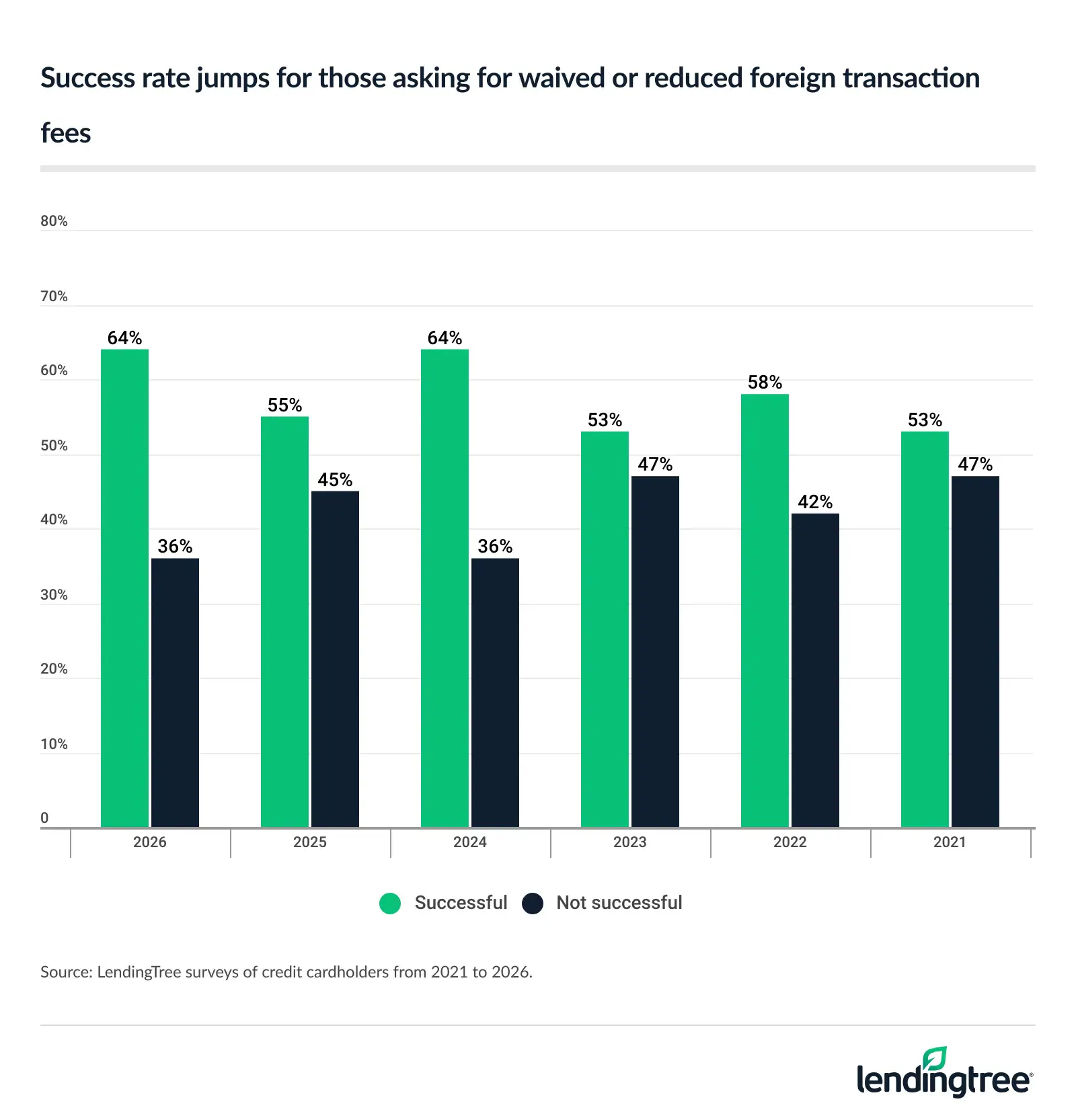
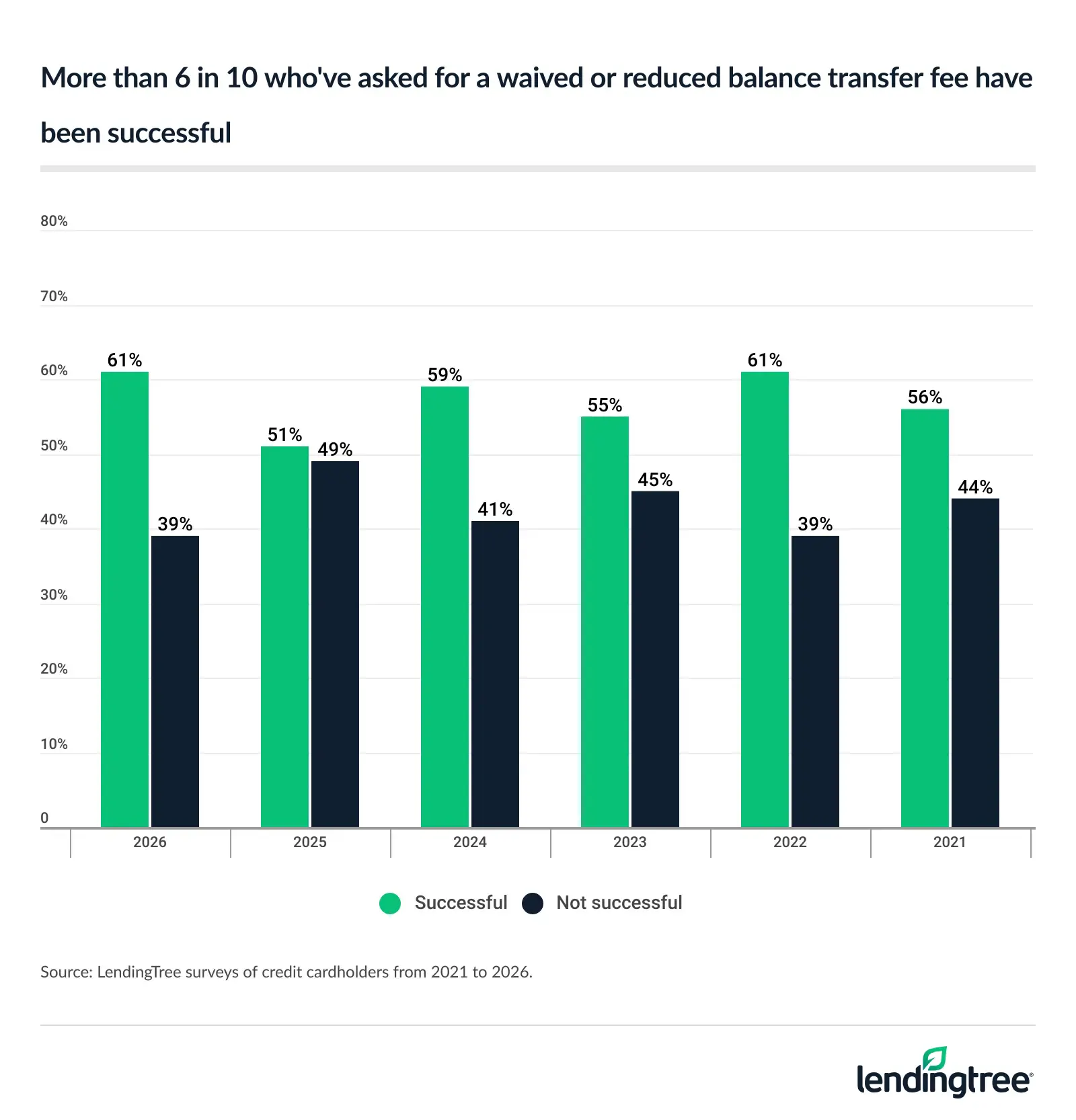
- Issuers are increasingly waiving late fees, foreign transaction fees and balance transfer fees. 92% of late fee waiver requests in the past year were granted, up from 89% in 2025. For foreign transaction fees, 64% of those who’ve ever asked to have one waived or reduced had their request granted (up from 55%). For balance transfer fees, 61% of those who’ve ever asked for a waived or reduced one were successful (up from 51%). The most recent percentages for all three fees either match or exceed previous highs.
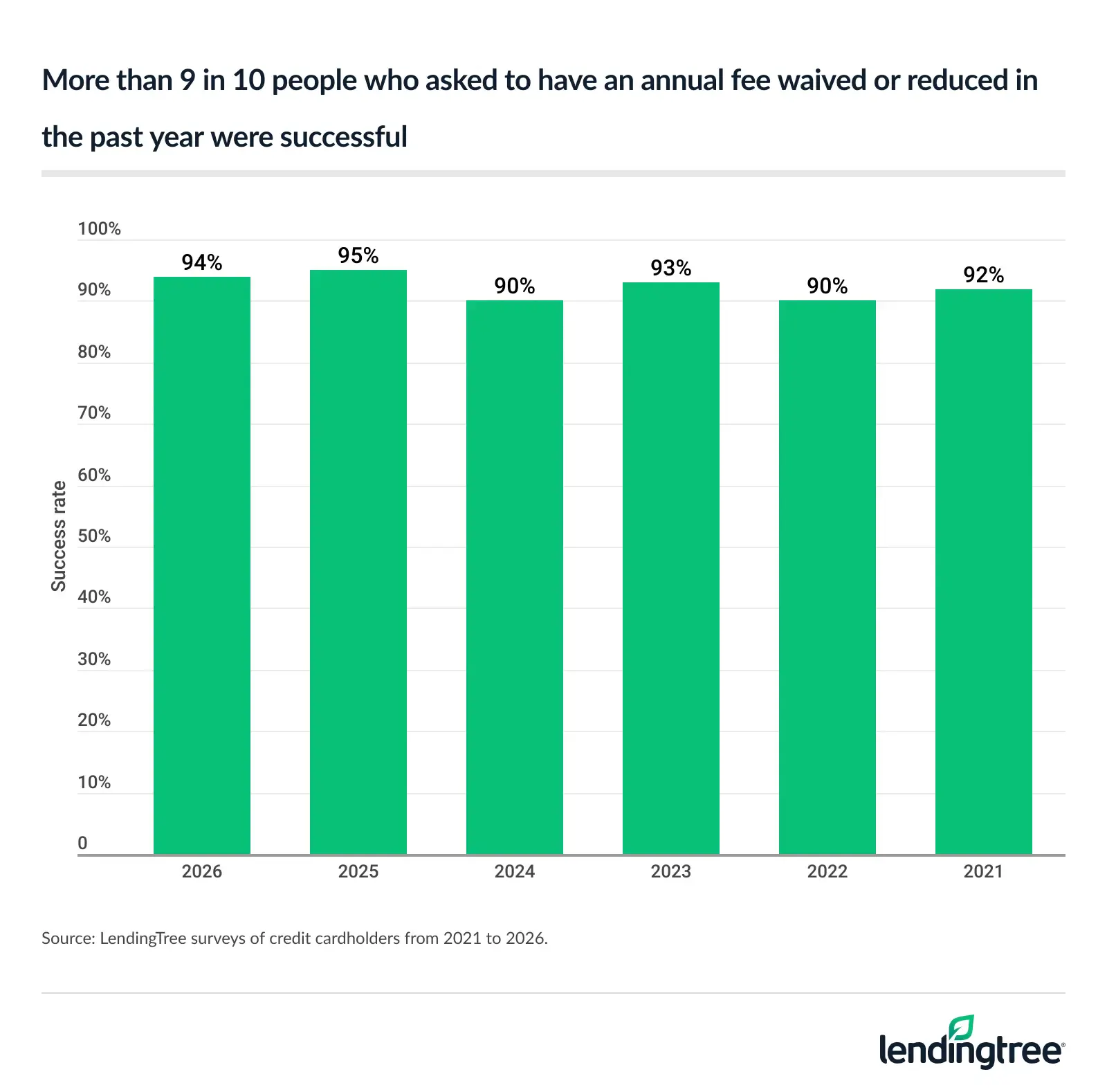
- Annual fees are slightly less likely to be waived or reduced than a year ago, but your chances are still sky-high. 94% of people who asked for a waived or reduced annual fee in the past year got their way, down from 95% in 2025.
- Nearly 4 in 10 cardholders (myself included) have had fees waived or rates lowered without talking to an actual person. 39% say they’ve done so, including 22% who say they’ve done it more than once. I’d be part of that 22%, having gotten two fees waived without speaking to anyone in the past year or so.
- Fewer cardholders asked for breaks, despite more than half saying inflation has made them more likely to ask. A smaller percentage of cardholders asked for a lower APR or a waived or reduced annual fee or a waived late fee this year than last. However, 52% of cardholders agree that inflation has made them more likely to ask, including 23% who strongly agree.
84% of cardholders who asked for a lower interest rate on a credit card in the past year were successful, the highest on record
Of all the requests on this list, none is potentially more impactful than asking for a lower interest rate on a credit card. It’s also one of the most likely to be successful.
If you’re willing to ask, your chances of success are likely far greater than you’d imagine. Our latest survey found that 84% of cardholders who asked for a lower rate in the past year got one. That success rate means that it isn’t just people with 800 credit scores and high incomes who are getting their way. Regular people are, too.
This isn’t a new phenomenon, either. Yes, this is the highest success rate we’ve seen since we started tracking this data in 2021, but the percentages have been high throughout the study’s six-year history. The success rate has dipped below 76% just once, falling to 70% in 2022.
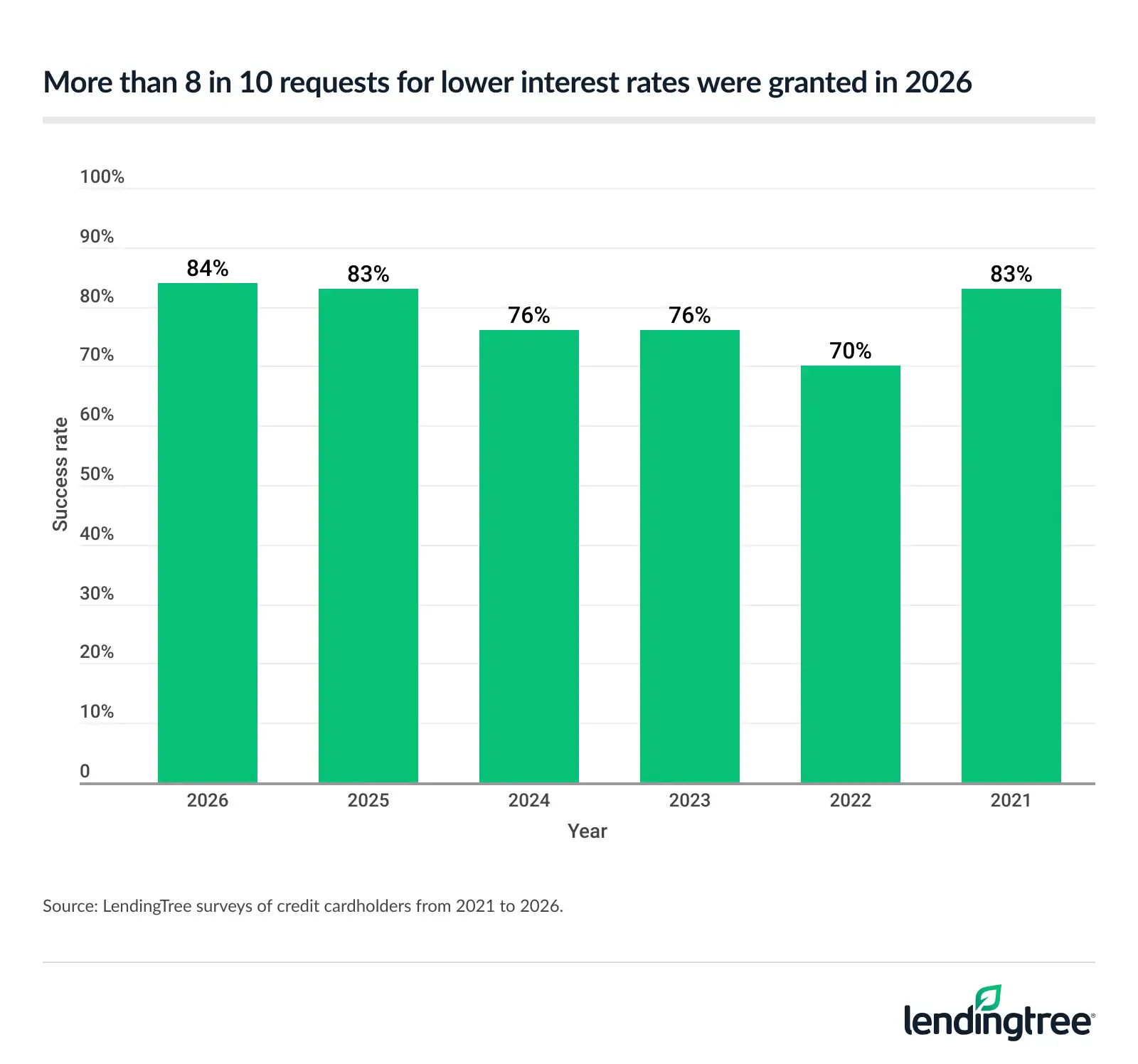
If you’re successful, it can save you $1,000 or more, depending on how much you owe.
Here’s how:
- The average APR reduction was 6.3 points. That’s like moving from 25.00% to less than 19.00%.
- If you have $7,000 in credit card debt, an APR of 25.00% and you pay $250 a month, you’ll pay $3,615 in interest and take 42 months to pay it off, according to LendingTree’s credit card interest calculator.
- Reduce that APR by 6.3 points to 18.7% while keeping everything else the same, and you’ll pay $2,269 in interest and take 37 months to pay it off.
That’s a savings of $1,346 from a single request — all from simply asking.
Issuers are increasingly waiving late fees, foreign transaction fees and balance transfer fees
Lower interest rates aren’t the only breaks credit card issuers are giving more often these days. They’re also waiving or reducing many different types of fees for those who ask.
More than 9 in 10 (92%) requests to waive a late fee were granted in the past year. That’s up three points from 2025 and is the highest percentage seen since we began tracking this data.
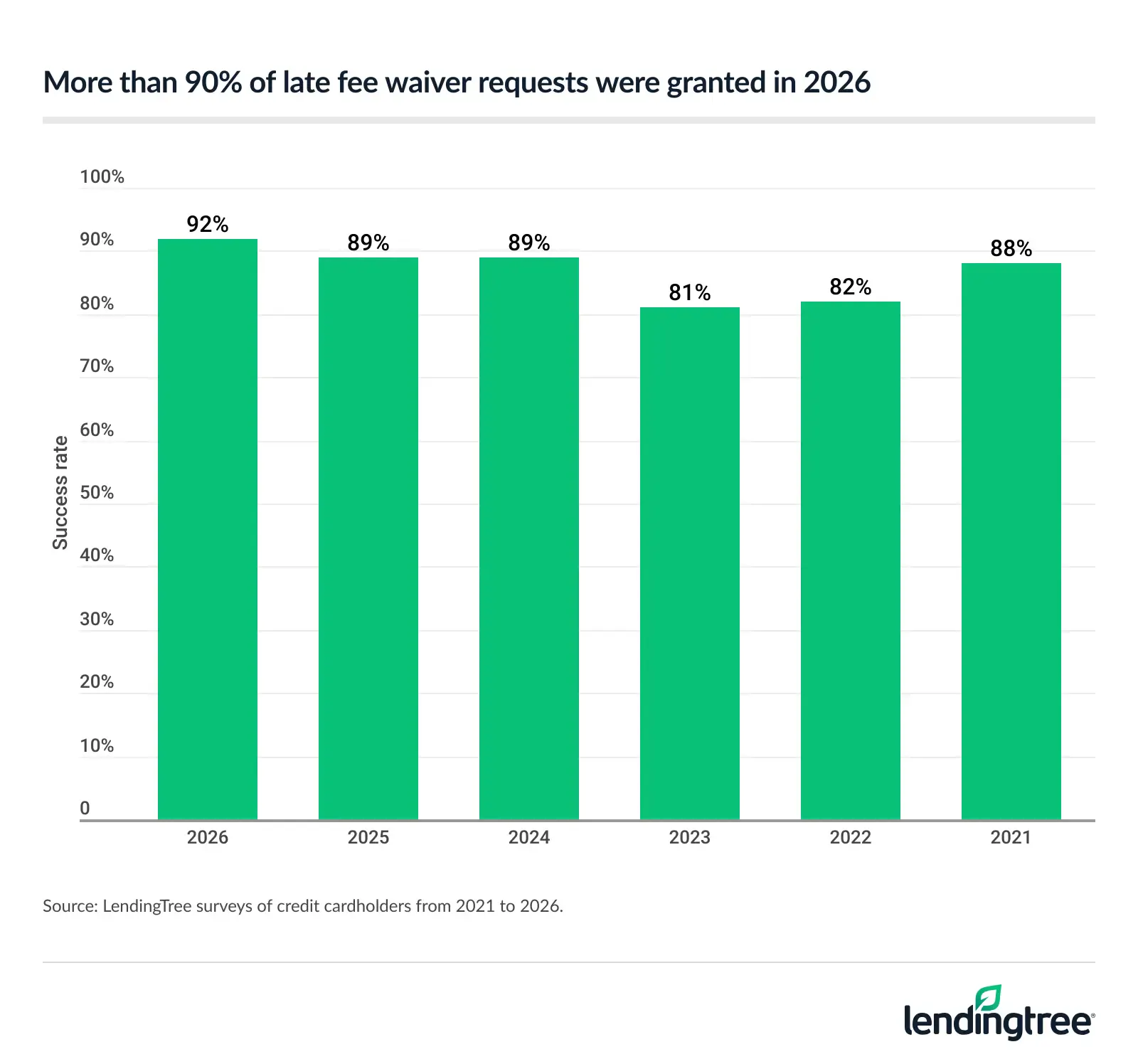
For the next two requests — waived or reduced foreign transaction fees and balance transfer fees — we asked whether cardholders had ever successfully made those requests. For all other categories, we asked about success in the past year.
Travelers will be happy to know that card issuers are becoming more willing to waive or reduce foreign transaction fees. Nearly two-thirds of people (64%) who’ve ever made that request have been successful, up nine points from last year and matching 2024’s record high.
A foreign transaction fee is an extra charge that some credit cards add when you buy something in another country or in a foreign currency. It typically amounts to 1% to 3% of the purchase amount, or $10 to $30 for every $1,000 spent. During an international vacation, those fees can add up quickly, so getting them waived can bring significant savings.
Card issuers are also increasingly waiving balance transfer fees. In this year’s survey, 61% of people who’ve ever asked for a waived or reduced balance transfer fee have been successful, up from 51% a year ago.
These fees can be even more costly than late fees or foreign transaction fees. The typical balance transfer fee is 3% to 5% of the transferred balance, or $30 to $50 for every $1,000. That means that someone who successfully gets the fee waived on a $5,000 balance transfer could save $150 to $250. For someone struggling with credit card debt, that can make a major difference.
Annual fees are slightly less likely to be waived or reduced than a year ago, but your chances are still sky-high
More than 9 in 10 cardholders (94%) who asked to have a credit card’s annual fee waived or reduced in the past year got their way.
That’s a stunningly high number, though it’s down a point from last year’s record high of 95%. Still, it’s the second-highest percentage in the six years we’ve asked the question. During that time, we’ve never seen a success rate lower than 90%.
Nearly 4 in 10 cardholders have had fees waived or rates lowered without talking to a real person
There are countless possible reasons for not asking to have your rate lowered or a fee waived, but often the most common ones are the simplest: People don’t know they can ask, don’t know how to ask or don’t think it’ll work if they do. Others don’t feel comfortable negotiating with people.
However, that last concern is becoming less and less relevant. Our latest survey found that 39% of cardholders have gotten a fee waived or an interest rate reduced without speaking to a real person. That includes 22% who say they’ve done it more than once.
My experience mirrors that of the 22%. I had two credit card late fees waived in 2025 without speaking to anyone. I called the number on the back of my card, intending to ask a representative to remove the fee. Before I could reach anyone, the automated system asked whether I was calling about a late fee. I answered yes, and the system told me that they’d be willing to waive the fee. After following a few additional prompts, the fee was removed.
Fewer cardholders asked for breaks, despite more than half saying inflation would make them more likely to ask
One of the goals of this report — and the myriad interviews I’ve done on this topic over the years — is to show people that asking for these types of breaks can work. Yes, it can be worth the time and the sweaty palms to contact your credit card issuer and ask for a lower rate or a waived fee.
For the past several years, it appeared that people were getting the message.
- In 2022, 41% of late payers asked to have their late fee waived. In 2025, it climbed to 60%.
- In 2022, just 21% of annual fee cardholders asked to have an annual fee waived or reduced. In 2025, that number hit 39%.
- In 2022, just 15% of cardholders asked for a lower APR on one of their credit cards. In 2025, 25% did.
There was still a long way to go, but the trend was moving unmistakably in the right direction. Until this year.
The percentage of late payers who asked to have a late fee waived fell from 60% to 54%. The percentage of annual fee cardholders who asked to have that fee waived or reduced dipped from 39% to 37%. And the percentage of cardholders who asked for a lower APR dipped from 25% to 23%.
The declines are somewhat surprising, given that more than half of cardholders (52%) agree that inflation has made them more likely to ask. That includes 23% who strongly agree.
Tips for successfully asking for a break from your card issuer
The good news is that you don’t need perfect credit, a huge income or years of negotiation experience to successfully ask for a break from your credit card issuer. In many cases, simply asking politely and being prepared can go a long way.
Here are a few tips that can improve your odds:
- Ask at the right time. Your chances are typically best if you’ve been a reliable customer who pays on time and has a solid history with the issuer. If you’ve recently improved your credit score or received competing offers from other cards, mention that as well.
- Be polite but direct. You don’t need a complicated script. Explain what you’re asking for and why. A calm, respectful approach will almost always work better than anger or threats.
- Practice the conversation beforehand. If asking for a lower rate or waived fee makes you nervous, try role-playing the conversation with a friend or rehearsing it out loud by yourself. Having a rough script in mind can help you feel more confident and make the call far less intimidating.
- Mention loyalty and competing offers. Credit card issuers want to keep good customers. If you’ve been with the issuer for years or received lower-rate offers elsewhere, there’s nothing wrong with politely pointing that out.
- Use automation to your advantage. As more issuers automate these requests, you may not even need to speak with a person. Calling the number on the back of your card or using your issuer’s chat feature may be enough to trigger an automated offer. It happened to me, and it’ll likely only get more and more common.
- Don’t accept the first “no.” Sometimes a second call, another representative or a different time of day can produce a different outcome. If your request is denied, it may still be worth trying again later.
- Know what you’re asking for. Whether it’s a lower APR, a waived late fee, a reduced annual fee or help with a balance transfer fee, being specific can make the conversation smoother and faster.
- Remember that the worst they can say is no. That’s especially important given how high the success rates are for people who ask. A five-minute phone call could potentially save you hundreds or even thousands of dollars.
Methodology
LendingTree commissioned QuestionPro to conduct an online survey of 2,000 U.S. consumers ages 18 to 80 on May 4-6, 2026. The survey was administered using a nonprobability-based sample, and quotas were used to ensure the sample base represented the overall population. Researchers reviewed all responses for quality control.
We defined generations as the following ages in 2026:
- Generation Z: 18 to 29
- Millennials: 30 to 45
- Generation X: 46 to 61
- Baby boomers: 62 to 80
Recommended Articles
83% of People Who Asked for Lower Credit Card Interest Rate in Past Year Got One — Highest Since Pandemic
You Miss 100% of the Shots You Don’t Take — Here Are Topics You Should Talk to Your Credit Card Issuers About
Despite Federal Reserve Rate Hikes, 76% of Lower Credit Card APR Requests Were Granted in Past Year