Rising Gas Prices Are Already Changing How Americans Spend or Save — and Many More Are Bracing to Adapt


Almost a third of Americans say they’ve made changes to their typical spending or savings habits as a result of higher gas prices, and another 35% say they will do so if prices remain high.
LendingTree surveyed 2,060 consumers, including 1,799 who operate a gas-powered vehicle, about the impact of rising gas prices on their personal finances. Though the conflict with Iran and the ensuing spike in gas prices are less than a month old, our survey — conducted from March 17 to 23 — clearly shows that American families are already feeling the effects.
Here’s what we found.
The conflict began on Feb. 28, 2026. According to AAA, the average price of a regular gallon of gas that week was $2.98. Our survey started fielding less than three weeks later, on March 17, 2026, when the average price of a gallon of regular gas was $3.79. By March 23, 2026, the final day of the survey, gas prices had risen further, reaching $3.96.
- Higher gas prices are already spurring Americans to change their behavior. About a third of Americans (31%) have made changes to their spending or savings habits because of higher gas prices, while another 35% say they will if prices remain high. Just 21% say they’re confident the spike won’t last long.
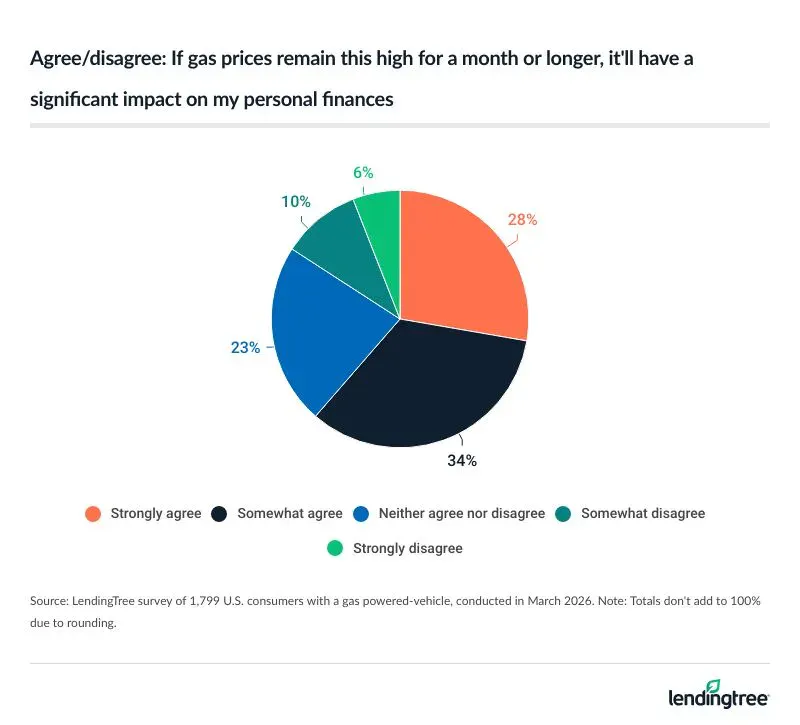
- 62% of Americans with a gas-powered vehicle agree that if gas prices remain high for a month or longer, it’ll have a significant impact on their personal finances. That includes 28% who strongly agree. Parents of young kids (73%) and millennials (71%) are the most likely to agree. The lower your income, the more likely you are to agree.
- Americans are trying to get ahead of rising gas prices. At the time of our survey, 51% of consumers with a gas-powered vehicle said they’ve gotten gas in the past week before they needed it because of rising prices. Parents of young kids and Gen Zers are the most likely to have done so.
Higher gas prices are already spurring changes in spending and savings
Nearly 1 in 3 Americans (31%) say they’ve already changed their spending or savings habits because of the gas price spike, while 35% more say they haven’t changed yet but will if prices remain high. Another 21% say they haven’t changed their habits and are confident the spike won’t last long, while 13% don’t operate a gas-powered vehicle.
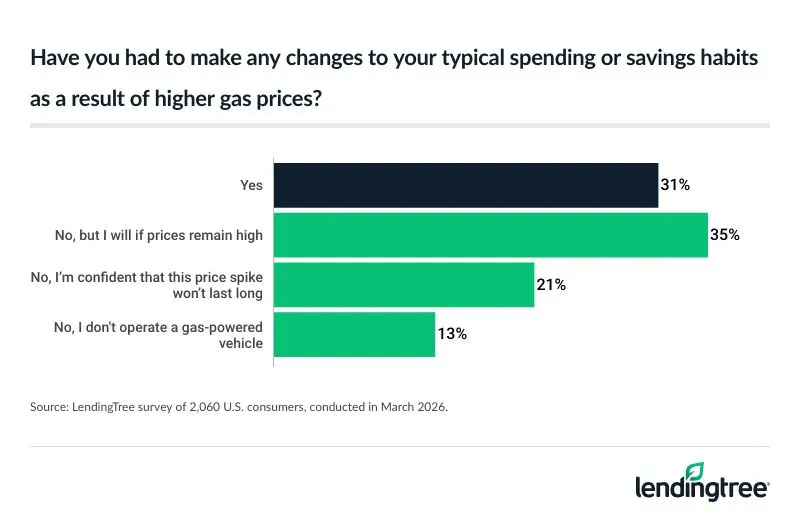
Parents with kids younger than 18 (46%) and millennials ages 30 to 45 (38%) are most likely to have already changed their spending or savings habits because of high prices. Republicans (35%) are more likely than Democrats (31%) and independents (30%) to say they’ve already made changes.If high gas prices linger, Americans say the impact on their personal finances will be significant
While only about a third of Americans say they’ve already made changes because of rising gas prices, there’s far more agreement on what would happen if high prices linger. More than 6 in 10 (62%) Americans with a gas-powered vehicle agree that if gas prices remain high for a month or longer, this would significantly affect their personal finances. That 62% figure includes 28% who say they strongly agree.
Some highlights:
- Parents of young kids (73%) and millennials (71%) are the most likely to agree
- The lower your income, the more likely you are to agree
- 69% of Democrats agree, compared with 63% of Republicans and 54% of independents
Half of Americans have tried to get ahead of rising gas prices
Having seen gas prices continue to climb, Americans aren’t sitting idly by. At the time of our survey, slightly more than half of Americans (51%) with a gas-powered vehicle said they’ve gotten gas in the past week before they needed it because of rising prices.
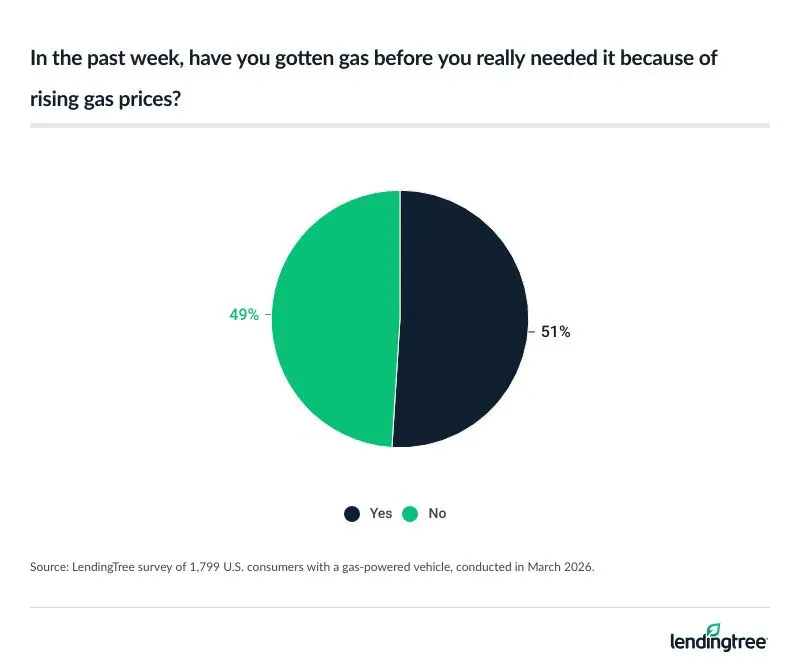
Parents of young kids (65%), Gen Zers ages 18 to 29 (61%), six-figure earners (59%), millennials (58%) and Democrats (56%) are the most likely to have done so.
Tips for managing high gas prices
It’s easy to feel powerless as you watch gas prices continue to climb. However, there are things that you can do to help yourself. As mentioned earlier, opting to fill up your tank a little earlier than you might have otherwise can help. Here are a few other possibilities.
- Shop around. This is almost always good advice. We can often be creatures of habit when it comes to filling up our vehicle, but that habit can be costly. Taking the time to compare costs in your area with tools like GasBuddy makes a lot of sense because there can be real price differences. That doesn’t mean you need to drive across town to save a nickel a gallon. It just means that it can be wise to leave your options open.
- Consider a credit card with gas rewards. The right credit card can save you real money at the pump. Depending on your particular driving and spending habits, either a general-purpose card that gives extra rewards for gas purchases or a gas-station-branded card can be a strong choice. However, there’s a big caveat: You should only get a gas-station-branded credit card if you’re confident that you’ll be able to pay your bill in full each month. These cards can have higher-than-normal APRs, some above 30%, so if you carry a balance, any rewards and gas discounts you get will quickly be outweighed by the interest you pay.
- Budget for it. If higher gas prices are hitting you hard, revisit your budget to allow for that extra cost. The best budgets are living, breathing, malleable documents that can be tweaked on an ongoing basis to handle shifting priorities, short-term price spikes and other unexpected events without putting yourself in too deep a hole.
- Share a ride. From carpooling to using public transportation, there are often ways to use your vehicle less than you do today. They may not be ideal solutions, but if gas prices are putting you in a bind, they may certainly be worth considering.
Methodology
LendingTree commissioned QuestionPro to conduct an online survey of 2,060 U.S. consumers ages 18 to 80 on Mar. 17-23, 2026. The survey was administered using a nonprobability-based sample, and quotas were used to ensure the sample base represented the overall population. Researchers reviewed all responses for quality control.
We defined generations as the following ages in 2026:
- Generation Z: 18 to 29
- Millennials: 30 to 45
- Generation X: 46 to 61
- Baby boomers: 62 to 80