Cheapest SR-22 Car Insurance in Illinois in 2027
Travelers, Progressive and Mercury have the cheapest insurance in Illinois if you need an SR-22


Advertising Disclosures
Loading Disclosures…
- An SR-22 is a form your insurance company files with the state to prove you have car insurance.
- SR-22s are usually needed to reinstate your license after a serious driving offense, such as a DUI conviction or at least three convictions for driving without insurance.
- Even if you don’t own a car, you’ll need to file an SR-22 to reinstate a suspended license.
Cost of SR-22 insurance with a DUI in Illinois
Car insurance companies generally charge more if you need an SR-22 because you have a history of being a risky driver. This means you’re not likely to find a truly cheap car insurance option.
An Illinois driver with a recent DUI and an SR-22 requirement can expect to pay more for minimum coverage
Minimum coverage usually includes liability insurance, which covers injuries and damage you cause to others. Some states require additional coverage.
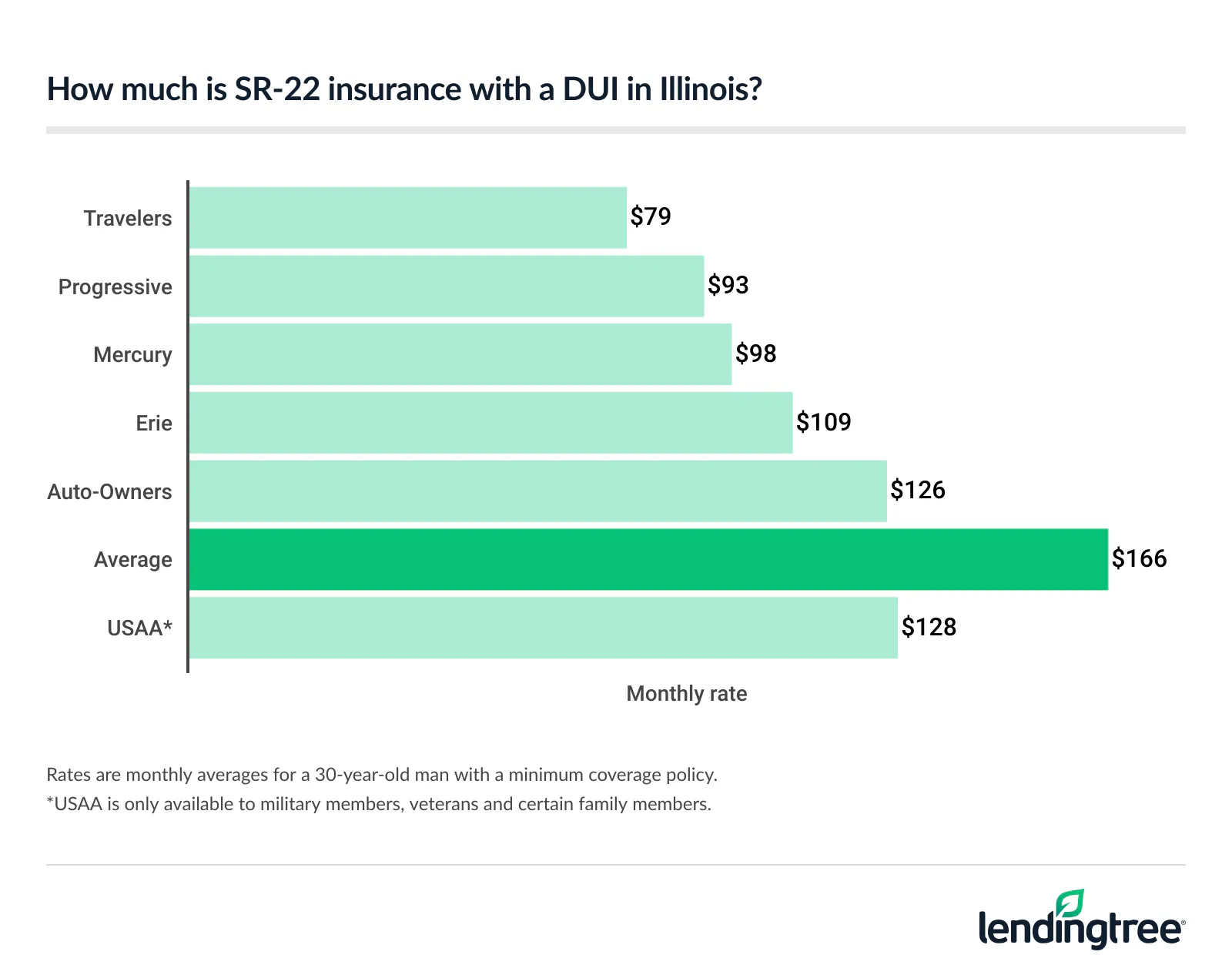
Illinois SR-22 rates after a DUI
| Company | Min. coverage | Full coverage | LendingTree rating | |
|---|---|---|---|---|
 | Travelers | $79 | $192 | Read Our Review |
 | Progressive | $93 | $223 | Read Our Review |
 | Mercury | $98 | $319 | Read Our Review |
 | Erie | $109 | $307 | Read Our Review |
 | Auto-Owners | $126 | $296 | Read Our Review |
 | Rockford Mutual | $142 | $327 | NA |
 | Westfield | $151 | $413 | Read Our Review |
 | The Hanover | $154 | $302 | Read Our Review |
 | Country Financial | $158 | $354 | Read Our Review |
 | Geico | $177 | $464 | Read Our Review |
 | Pekin | $202 | $525 | NA |
 | American Family | $224 | $542 | Read Our Review |
 | AAA | $227 | $525 | Read Our Review |
 | Nationwide | $233 | $601 | Read Our Review |
 | Allstate | $233 | $598 | Read Our Review |
 | Farmers | $290 | $657 | Read Our Review |
 | USAA* | $128 | $409 | Read Our Review |
It’s always a good idea to shop around for car insurance. Even with an SR-22 requirement and higher average rates, you may be able to find a cheaper rate if you compare quotes.
Cost of SR-22 insurance after driving without insurance in Illinois
You’ll need SR-22 coverage if you’re convicted of driving without insurance three or more times. The average cost of coverage after your third conviction is $123 per month, which is 35% higher than with a clean record.
Erie has the cheapest rates at $58 per month.
Illinois SR-22 rates after driving without insurance
| Company | Min. coverage | Full coverage | LendingTree rating |
|---|---|---|---|
| Erie | $58 | $179 | Read Our Review |
| Rockford Mutual | $65 | $149 | NA |
| Westfield | $66 | $238 | Read Our Review |
| Pekin | $73 | $207 | NA |
| Mercury | $79 | $258 | Read Our Review |
| Progressive | $95 | $230 | Read Our Review |
| Travelers | $98 | $254 | Read Our Review |
| AAA | $116 | $339 | Read Our Review |
| Auto-Owners | $126 | $296 | Read Our Review |
| Country Financial | $144 | $319 | Read Our Review |
| Nationwide | $159 | $403 | Read Our Review |
| American Family | $166 | $393 | Read Our Review |
| The Hanover | $171 | $363 | Read Our Review |
| Allstate | $187 | $499 | Read Our Review |
| Geico | $191 | $506 | Read Our Review |
| Farmers | $194 | $466 | Read Our Review |
| USAA* | $106 | $343 | Read Our Review |
Cost of SR-22 insurance in Illinois after an accident without insurance
The average rate for SR-22 coverage for Illinois drivers who are in an at-fault accident without insurance is $158 per month. The cheapest rates are offered by Erie, at $58 per month, and Travelers, at $72 per month.
You’ll pay more because of the accident and driving without insurance. Average rates go up by 66%.
Illinois SR-22 rates after an accident without insurance
| Company | Min. coverage | Full coverage | LendingTree rating |
|---|---|---|---|
| Erie | $58 | $179 | Read Our Review |
| Travelers | $72 | $189 | Read Our Review |
| Auto-Owners | $79 | $204 | Read Our Review |
| Westfield | $79 | $279 | Read Our Review |
| Progressive | $109 | $278 | Read Our Review |
| Mercury | $117 | $347 | Read Our Review |
| Rockford Mutual | $125 | $287 | NA |
| Pekin | $131 | $367 | NA |
| AAA | $134 | $340 | Read Our Review |
| Nationwide | $149 | $377 | Read Our Review |
| Country Financial | $153 | $345 | Read Our Review |
| Geico | $176 | $464 | Read Our Review |
| The Hanover | $200 | $389 | Read Our Review |
| Allstate | $280 | $693 | Read Our Review |
| American Family | $288 | $634 | Read Our Review |
| Farmers | $306 | $690 | Read Our Review |
| USAA* | $116 | $362 | Read Our Review |
How do I get SR-22 insurance in Illinois?
Getting SR-22 insurance in Illinois is similar to purchasing normal auto insurance. Your current car insurance company might be able to file an SR-22 for you. But if that’s not an option, you’ll need to shop around.
-
Find an insurance company or contact your current company.
If you’re trying to get a new policy online, over the phone or in person with an agent, you’ll typically have the option to say you need an SR-22. Not all insurance companies in Illinois offer SR-22 insurance, so you might have to get coverage from a company that sells high-risk car insurance. -
Pay for at least a month of coverage and the SR-22 filing fee.
Your policy has to be active for the insurance company to file the SR-22, so you need to pay for at least one month of coverage. Insurance companies also usually charge a fee of about $25 to file the form, although the specific fee might change depending on the company you pick. -
Confirm the insurance company will send the SR-22 to the state.
Your insurer will send the SR-22 form to the Illinois Secretary of State, since you can’t submit it yourself. Processing the form can take up to 30 days. -
Receive confirmation.
You can verify your SR-22 form was received by calling 217-782-3720 (select option 1) and providing your driver’s license number and Social Security number. The system is automated, but it will confirm whether your license is active or still suspended. You can drive again as soon as your license is confirmed as valid.
You have to maintain an SR-22 for three straight years, which means you can’t let your insurance lapse. You should also renew your SR-22 insurance at least 45 days before your policy expires. If you haven’t renewed your policy by at least 15 days before its expiration date, your insurance company is legally required to notify the state of Illinois.
If your policy lapses, your license and registration will be suspended. You’ll need to reinstate your policy and have your company update the SR-22 with the state before you can drive again.
Once your three years are up and you’ve confirmed you don’t need an SR-22 anymore, you can shop around for a new policy that doesn’t include the filing. You’ll likely pay a cheaper rate once you don’t need the SR-22 anymore. That’s partly because you won’t have to pay the filing fee, but your driving record will also improve once the issue that triggered the SR-22 is at least three years old.
What is an SR-22 in Illinois?
An SR-22 is a form an insurance company sends to the state of Illinois to confirm you have an active auto insurance policy that meets or exceeds the minimum liability insurance requirements in Illinois.
If you need an SR-22, you’re required to have car insurance with at least these limits:
- $25,000 for personal injury liability per person
- $50,000 for personal injury liability per accident
- $20,000 for property damage
The limits indicate your policy will pay up to $25,000 for any person you injure in a car accident, up to $50,000 total for all injuries. You’ll also have coverage for up to $20,000 for any damage you cause to someone else’s property, such as a car, building or fence.
What offenses can lead to an SR-22 in Illinois?
You might need an SR-22 for a variety of reasons:
- Driver’s license suspension or revocation after a DUI conviction
- Three or more convictions of driving without insurance
- Driver’s license suspension after getting into an accident without insurance
- Driver’s license suspension for not paying a court-ordered penalty after a car accident
- Mandatory court supervision for driving without insurance
Non-owner SR-22 insurance
If you need an SR-22 to get your license back but you don’t own a car, you can get a non-owner insurance policy.
Non-owner SR-22 insurance is usually cheaper than a regular policy because it only gives you liability coverage and protects you while driving someone else’s car, if you use it occasionally. There’s no coverage for the car you’re driving, which is why the rates tend to be lower.
However, to be able to get non-owner SR-22 coverage, you can’t own a car. And if you live with someone who lets you borrow their car often, like a roommate or family member, you should be added to their policy. That insurance company should file the SR-22.
Alternatives to SR-22 insurance
If you don’t want to file an SR-22, you can deposit $70,000 in cash, securities, a surety bond or a real estate bond with the state. You also still have to maintain at least the minimum required levels of car insurance.
Additionally, if you move out of state, you can file an affidavit that waives your responsibility of filing an SR-22 in Illinois. However, most states have SR-22 or similar requirements, so chances are you’ll still need to purchase SR-22 coverage in your new home. And if you move back to Illinois within three years, you’ll need to file an SR-22 with the state again.
Methodology
To find the average cost of SR-22 insurance in Illinois, LendingTree gathered rates for a 30-year-old man with a minimum and full coverage policy. Average rates for SR-22 policies come from Quadrant Information Services, which gets its data from publicly available insurance company filings.
Quotes are based on a policy with Illinois’ minimum liability limits. Full coverage rates include higher liability limits plus comprehensive and collision coverage:
- Bodily injury liability: $50,000 per person and $100,000 per accident
- Property damage liability: $50,000 per accident
- Uninsured and underinsured motorist bodily injury: $50,000 per person and $100,000 per accident
- Comprehensive and collision coverage: $500 deductible
How we evaluated car insurance companies
Our team of insurance experts rated insurance companies based on several categories. These categories include average rates, discounts, coverage options, third-party customer service ratings and app/website experience. We weighted these categories based on what customers value in an insurance company.
For third-party customer service ratings, we included Complaint Index scores from the National Association of Insurance Commissioners (NAIC) and financial strength ratings from A.M. Best. NAIC Complaint Index scores are used to determine how satisfied customers are with their claims, while financial strength ratings from A.M. Best reflect the ability to pay out claims.
See our car insurance ratings methodology and full editorial guidelines for further details.
—
*USAA is only available to military members, veterans and certain family members.