Cheapest SR-22 Car Insurance in Texas in 2027
State Farm, AAA and USAA have the cheapest insurance in Texas if you need SR-22 coverage


Advertising Disclosures
Loading Disclosures…
- Texas drivers may be required to get SR-22 insurance if they get certain tickets, such as driving while intoxicated (DWI).
- Your rates could more than double if you need SR-22 insurance, mostly because of the violations that require the SR-22.
- If you don’t own a car, you can still meet this requirement by getting non-owner SR-22 insurance, which is typically cheaper than an owner’s policy.
How much does SR-22 insurance cost in Texas after a DUI?
An SR-22 insurance policy costs an average $207 per month for minimum coverage after a DUI, which is 82% higher than with a clean record. The DUI raises your rates, not the SR-22 filing itself. Each company in Texas determines SR-22 rates using different methods.
Among major, widely available insurance companies in Texas, State Farm offers the lowest average SR-22 policy rate of $98 per month, while on the high end, Nationwide charges an average $489 per month.
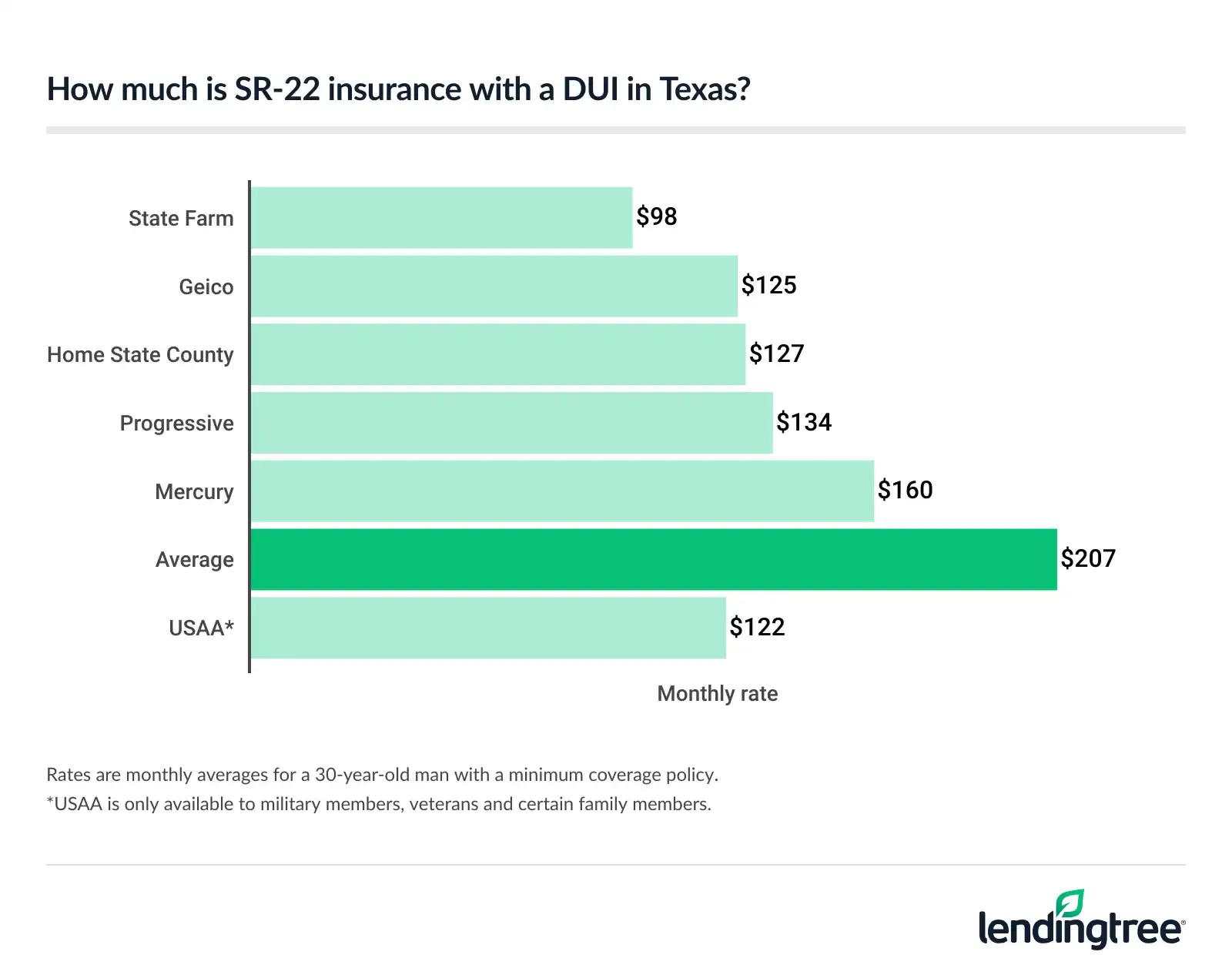
SR-22 rates after driving with a DUI in Texas
| Company | Min. coverage | Full coverage | LendingTree rating | |
|---|---|---|---|---|
 | State Farm | $98 | $223 | Read Our Review |
 | Geico | $125 | $313 | Read Our Review |
 | Home State County | $127 | $586 | NA |
 | Progressive | $134 | $361 | Read Our Review |
 | Mercury | $160 | $458 | Read Our Review |
 | AAA | $167 | $485 | Read Our Review |
 | Dairyland | $183 | $490 | NA |
 | Germania | $281 | $449 | NA |
 | Allstate | $387 | $881 | Read Our Review |
 | Nationwide | $489 | $1,049 | Read Our Review |
 | USAA* | $122 | $366 | Read Our Review |
The average cost of minimum liability auto insurance in Texas with a clean record is $113 per month. The rate increases to $207 per month after a DUI that requires an SR-22 insurance policy.
To get cheaper rates for SR-22 insurance in Texas, you should compare quotes from multiple insurers. Since each insurance company evaluates drivers differently, you can help ensure you get your best rates by getting competing quotes.
When getting an SR-22 insurance quote, make sure to ask about the discounts an insurer offers. There are some you can only qualify for based on your vehicle or driving record, but you can get others, such as defensive driver course discounts, by completing some simple steps.
How much does SR-22 insurance cost in Texas after driving with a suspended licence?
SR-22 coverage after getting caught driving with a suspended license costs an average of $184 per month. That’s an increase of 62% from a clean record.
State Farm and AAA have the cheapest rates available to most drivers, at $84 per month and $110 per month, respectively.
SR-22 rates after driving with a suspended license in Texas
| Company | Min. coverage | Full coverage | LendingTree rating |
|---|---|---|---|
| State Farm | $84 | $195 | Read Our Review |
| AAA | $110 | $321 | Read Our Review |
| Geico | $125 | $313 | Read Our Review |
| Progressive | $151 | $417 | Read Our Review |
| Home State County | $157 | $631 | NA |
| Mercury | $160 | $458 | Read Our Review |
| Germania | $218 | $359 | NA |
| Dairyland | $246 | $648 | NA |
| Nationwide | $301 | $636 | Read Our Review |
| Allstate | $387 | $881 | Read Our Review |
| USAA* | $88 | $266 | Read Our Review |
How much does Texas SR-22 cost if you’re caught driving without insurance?
The average rate for SR-22 coverage after getting cited for driving without insurance in Texas is $146 per month. You’ll need an SR-22 if you’re ticketed twice for getting behind the wheel without coverage.
The rate is 29% higher than what drivers pay with a clean record. State Farm has the cheapest rates at $58 per month. Some companies might not raise your rates if you’re caught driving without insurance.
SR-22 rates after driving without insurance in Texas
| Company | Min. coverage | Full coverage | LendingTree rating |
|---|---|---|---|
| State Farm | $58 | $144 | Read Our Review |
| AAA | $65 | $189 | Read Our Review |
| Germania | $112 | $209 | NA |
| Geico | $117 | $312 | Read Our Review |
| Mercury | $128 | $370 | Read Our Review |
| Progressive | $138 | $377 | Read Our Review |
| Home State County | $157 | $631 | NA |
| Dairyland | $227 | $607 | NA |
| Allstate | $228 | $581 | Read Our Review |
| Nationwide | $301 | $636 | Read Our Review |
| USAA* | $73 | $235 | Read Our Review |
How to file an SR-22 with the Texas DPS
To file an SR-22 certificate with the Texas Department of Public Safety (DPS), you’ll have to take a few steps. The certificate is just a form that confirms you have the minimum amount of required coverage.
- Find an insurance company that offers SR-22. Some insurers do not provide SR-22 coverage for drivers who need it, so first confirm with your current company whether it can file the form on your behalf. If it won’t, then you can get quotes at other standard insurers or reach out to a high-risk car insurance company.
- Pay the required SR-22 fee. The insurance company might charge a flat fee — often between $15 and $50 — to file the form for you. To get your driver’s license reinstated, you also need to pay a reinstatement fee of $100 (or $125 if you failed or refused a blood or breath test). You can do this either online or by mail to the Texas DPS in Austin.
- Ask your insurer to file the form, or file it yourself. Your insurance company can electronically file the SR-22 on your behalf. Or, the insurer can send you the form and you can email or fax it to the DPS.
- Get confirmation. Once the fees are paid and SR-22 document is sent in, you can check your driver eligibility status online via the Texas DPS website. Your status should be updated from “ineligible” to “eligible” after your documents have been processed.
You may also need to show proof you’ve completed a repeat-offender DWI program if you were found guilty of driving while intoxicated and this was required by the court. If there are any changes to your license status, the DPS will notify you by mail, so make sure it has your current mailing address on file.
What is an SR-22 in Texas?
If you’ve been convicted of certain moving violations in Texas, such as driving under the influence, or you have committed too many traffic offenses within a certain period of time, the state may require you to file an SR-22 form with the Texas DPS. Getting SR-22 insurance is often required to reinstate your license if it has been suspended because of high-risk tickets.
An SR-22 auto insurance policy includes at least Texas’ minimum liability insurance requirements. The insurer or you file a certificate directly with the state to show your policy is in line with Texas’ financial responsibility laws. Although an SR-22 form is essentially proof of coverage, the state won’t accept your insurance card or your policy as alternatives.
In order to meet the Texas liability insurance requirements, your SR-22 insurance must have limits of at least:
- $30,000 of bodily injury coverage per person injured in an accident
- $60,000 of bodily injury coverage per accident
- $25,000 of property damage coverage per accident
The period of time you’ll need to have SR-22 insurance varies, but it typically extends for two years after the date of your conviction in Texas.
If your policy lapses or is canceled during this period, your insurance company is required to notify the state.
If you fail to file a new SR-22 after cancellation or nonrenewal, your license and registration can be suspended again. You’ll not only have to buy a new auto insurance policy, but you’ll also have to pay the reinstatement fees a second time, so it’s important to avoid a gap in coverage.
Once you’ve had an SR-22 policy for the period required by court order, it’s your responsibility to notify your insurer the form no longer needs to be filed. Otherwise, your insurance company will continue filing the SR-22 with the Texas DPS.
What is SR-22A insurance?
Instead of SR-22 insurance, the court might require you to get SR-22A insurance in order to reinstate your license. SR-22A insurance, which is specific to a few states, including Texas, requires payments in six-month installments rather than the usual monthly billing for a standard SR-22.
An SR-22A requirement is typically only imposed if you have been involved in a crash without valid insurance that causes injury, death and/or more than $1,000 in property damage.
Non-owner SR-22 insurance in Texas
If you need an SR-22 filing to reinstate your license, but you don’t have a vehicle registered in your name, you can get a non-owner insurance policy to meet the state’s requirement. Non-owner SR-22 insurance in Texas provides liability coverage that meets the state’s requirements and provides coverage whenever you drive someone else’s car.
Since it’s limited to liability coverage, and you presumably drive less regularly if you don’t own a car, non-owner SR-22 insurance tends to have much lower rates than owner’s SR-22 insurance.
Methodology
To find the cheapest SR-22 car insurance rates in Texas, ValuePenguin collected thousands of quotes from top companies across every ZIP code in the state, across all residential ZIP codes. Rates are for a 30-year-old, single man with good credit who drives a 2015 Honda Civic EX. Policies include the minimum required coverage in Texas.
Quotes are based on a policy with Texas’ minimum liability limits. Full coverage rates include higher liability limits plus comprehensive and collision coverage:
- Bodily injury liability: $50,000 per person and $100,000 per accident
- Property damage liability: $50,000 per accident
- Uninsured and underinsured motorist bodily injury: $50,000 per person and $100,000 per accident
- Comprehensive and collision coverage: $500 deductible
Rate analysis was compiled using Quadrant Information Services rate data. Quotes are publicly sourced from insurer filings. They should be used only for comparative purposes, as your quotes will likely be different.
How we evaluated car insurance companies
Our team of insurance experts rated insurance companies based on several categories. These categories include average rates, discounts, coverage options, third-party customer service ratings and app/website experience. We weighted these categories based on what customers value in an insurance company.
For third-party customer service ratings, we included Complaint Index scores from the National Association of Insurance Commissioners (NAIC) and financial strength ratings from A.M. Best. NAIC Complaint Index scores are used to determine how satisfied customers are with their claims, while financial strength ratings from A.M. Best reflect the ability to pay out claims.
See our car insurance ratings methodology and full editorial guidelines for further details.
—
*USAA is only available to current and former members of the military as well as certain family members.