59% of Mortgage Holders Say They’re ‘House Poor,’ and Half Have Struggled to Pay Their Mortgage in Full


Homeownership has always come with costs beyond the mortgage payment itself, but for many Americans, those costs are climbing faster than they can keep up with.
This LendingTree survey finds that half of mortgage holders have seen their monthly payments rise in the past two years, and most had no idea it was coming. Here’s a closer look.
- 50% of Americans with a mortgage say their payment increased in the past two years. That includes 22% who say it increased significantly. Among those whose payments increased, 87% say they were surprised, including 44% who were extremely surprised. As for the cause, among those who saw an increase, 59% cite higher property taxes, 40% cite escrow shortages and 39% cite higher homeowners insurance costs.
- Some mortgage holders are struggling to make their payments. 50% say they’ve been unable to make their full mortgage payment at least once in the past year. That strain is also reflected in the 59% who consider themselves “house poor,” with 32% saying they’re definitely house poor.
- Younger mortgage borrowers are feeling the most pressure. 81% of Gen Zers and 59% of millennials have been unable to make their full mortgage payment at least once in the past year, compared with 43% of Gen Xers and 14% of baby boomers. Similarly, 73% of Gen Zers and 67% of millennials say they’re house poor, compared with 49% of Gen Xers and 41% of baby boomers.
- Higher costs are forcing mortgage holders to make significant financial trade-offs and take on debt. Among those with an increased payment, 27% have cut back on everyday spending, 21% have worked additional hours or taken a second job and 20% have reduced or skipped vacations or travel. Overall, 41% of those with higher payments saw increases of $200 or more.
Rising payments are catching homeowners off guard
Half (50%) of Americans with a mortgage say their payment has gone up over the past two years, and for 22%, that increase has been significant.
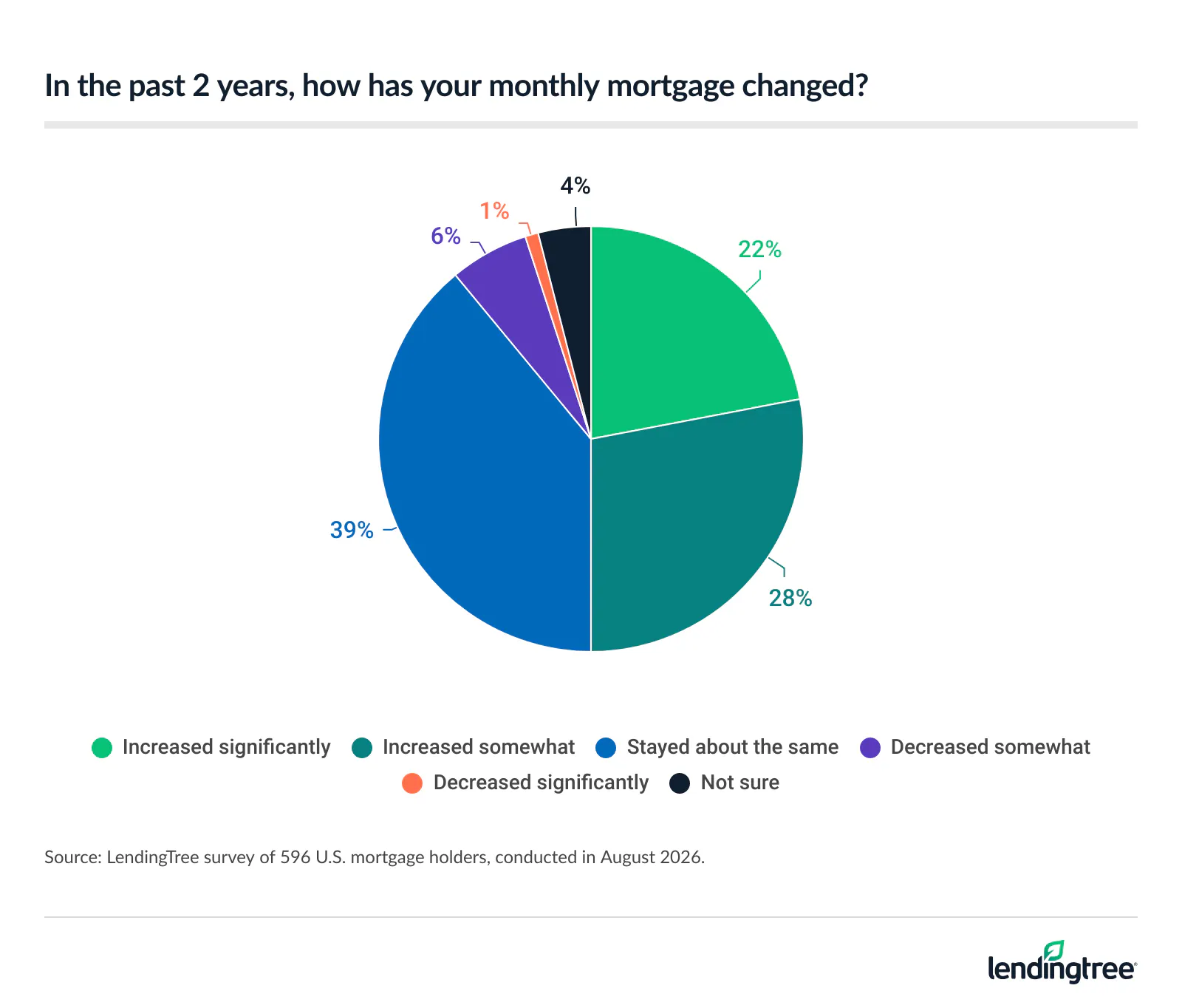
Notably, 87% of mortgage holders whose payments increased say they didn’t see it coming, and 44% describe themselves as extremely surprised. Property taxes are the most common culprit, cited by 59% of those affected, followed by escrow shortfalls (40%) and higher homeowners insurance premiums (39%). Other common reasons include:
- Their adjustable-rate mortgage interest rate increased (20%)
- Private mortgage insurance (PMI) was added or increased (14%)
- Their flood insurance or another required insurance premium increased (12%)
- A temporary payment reduction, forbearance or assistance arrangement ended (9%)
- Their loan was modified (6%)
- Another required charge increased (4%)
- Unsure why their payment increased (2%)
- Other (1%)
Even so, a slim majority of mortgage holders — 53% — say they understood very well when they took out their mortgage that their payment could shift because of taxes, insurance or escrow. Another 28% say they somewhat understood, while 11% heard it could happen but didn’t understand it.
When asked which factor is most responsible for driving the increases they’ve experienced, 44% point to property taxes, 32% to homeowners insurance and 9% to escrow shortages. Property taxes are also the cost that mortgage holders most often say they underestimated (22%), followed by homeowners insurance (21%) and home maintenance and repairs (17%).
Matt Schulz, LendingTree chief consumer finance analyst and author of “Ask Questions, Save Money, Make More: How to Take Control of Your Financial Life,” says changes in mortgage payments are an unfortunate reality that more mortgage holders should anticipate.
“So many people just assume that their mortgage payments don’t change, so they just don’t pay that much attention to it,” he says. “Unfortunately, little could be further from the truth, which many people are finding out the hard way. One of the best ways to soften the blow is to have a home expenses fund that you can tap into. You might think a fund like that would be more for repairs and maintenance, but there’s nothing that says those funds can’t help you handle mortgage payment increases, too.”
Looking ahead, 40% of mortgage holders expect their payment to hold steady over the next two years, but 29% expect a moderate bump. Another 16% are bracing for a significant one. Still, most mortgage holders (68%) have a fixed-rate loan that shields them from rate-driven swings, though 19% have an adjustable-rate mortgage, which leaves them more exposed.
Half of mortgage holders have fallen behind at least once
Higher payments seem to be affecting mortgage holders’ ability to pay. Half (50%) of mortgage holders say they’ve missed a full payment at least once in the past year, with 13% missing payments three or more times.
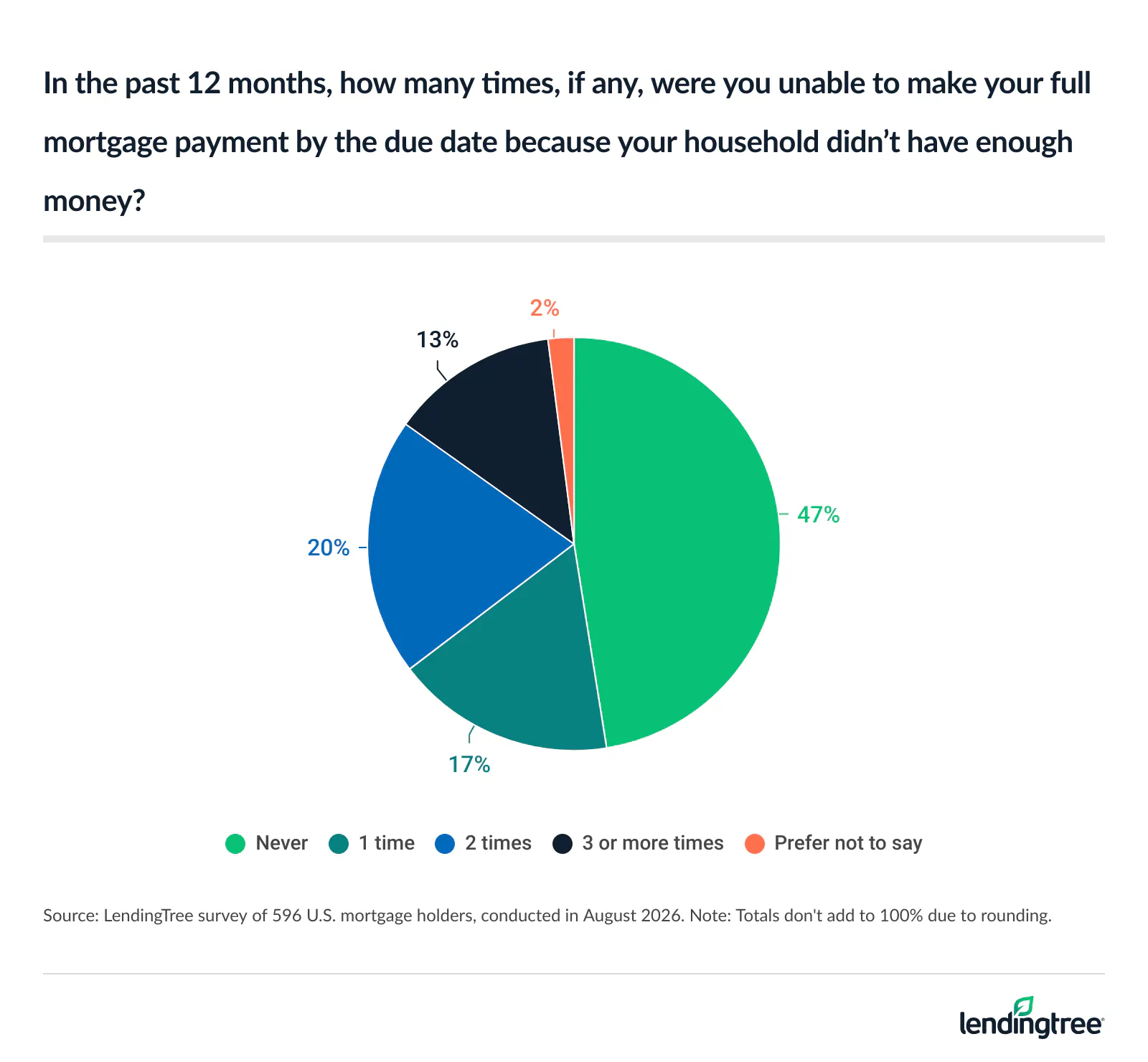
Meanwhile, 59% now consider themselves “house poor” — including 32% who say they’re definitely house poor, not just occasionally stretched thin.
Schulz believes that’s just further proof that many Americans are really struggling in the wake of high prices and high interest rates.
“These things have shrunk many people’s financial margin for error down to next to nothing, and that’s a scary spot to be in,” he says. “If you’re struggling to make a full payment, seek help. Reach out to your lender. They likely have programs to help people struggling with a short-term financial pinch, but you won’t know if you don’t seek them. The sooner you reach out, the better. Lenders are much more likely to work with you in anticipation of future missed payments than in the wake of multiple already-late payments.”
Gen Z and millennial mortgage holders are bearing the brunt
Younger generations are shouldering a disproportionate share of the pain. A whopping 81% of Gen Z mortgage holders ages 18 to 29 and 59% of millennials ages 30 to 45 say they’ve missed a full payment at least once in the past year, compared with just 43% of Gen Xers ages 46 to 61 and 14% of baby boomers ages 62 to 80.
The house-poor gap is similar, with 73% of Gen Zers and 67% of millennials saying they’re house poor, versus 49% of Gen Xers and 41% of baby boomers.
Parents with children younger than 18 are similarly struggling, with 64% saying they’ve missed a full payment and 46% conclusively calling themselves house poor.
Schulz believes there are a few reasons why younger mortgage holders might be struggling.
“These age groups might be at greater risk because they’re not making as much money and don’t have as strong credit as their older counterparts,” he says. “That’s a challenging combination, and the lower credit scores are a particular problem. Lower scores mean worse terms on mortgages, possibly including higher interest rates, more fees, bigger monthly payments and so on. Combine that with lower incomes and less financial margin for error, and things can get dicey in a hurry.”
Homeowners are cutting back, working more and rethinking how they bought
Faced with steeper bills, mortgage holders are making real sacrifices. Among those whose payments have gone up, 27% have cut back on everyday spending, 21% have picked up extra hours or a second job and 20% have scaled back or skipped vacations and travel.
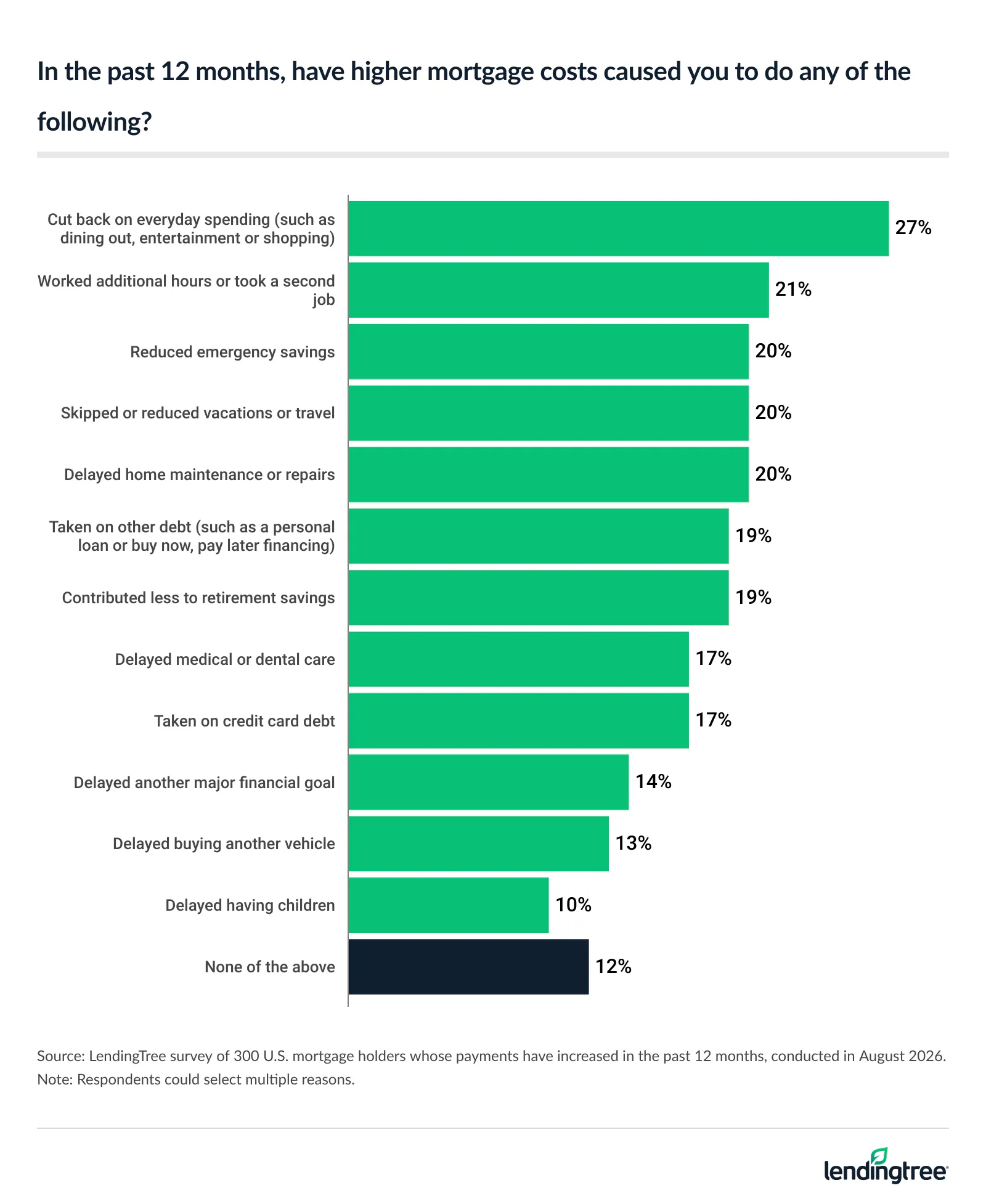
Schulz says that regardless of what you do, you’ve got to find that cash somewhere. “Maybe that means cutting back on some spending, or maybe it means needing to find a way to generate new income,” he says. “The answer will be different in every household. However, what you can’t do is bury your head in the sand and wish the problem away. That’ll only make things worse.”
For 41% of those who saw increases, the increase wasn’t small either — it amounted to $200 or more a month. Meanwhile, 24% saw increases between $100 and $199, and 33% saw increases of $99 or less.
Looking back at the homebuying decision itself, only 28% of mortgage holders say they’d buy the same home again. The rest have regrets: 18% would have waited longer to buy, 17% would have chosen a less expensive home and 17% would have put more money down. Meanwhile, 11% would have chosen a different mortgage or loan terms, 5% would have bought a different home and 4% say they just wouldn’t have bought a home altogether.
Making room for a higher mortgage payment: Top expert tips
When your mortgage payment rises, strengthening your financial cushion and reducing other monthly costs can make the increase easier to manage. A few proactive moves can help free up cash and reduce the chances of relying on expensive debt to cover everyday expenses:
- Build your savings. “Put a little money from each paycheck into a high-yield savings account,” Schulz says. “Even small contributions can add up when you’re consistent, giving you a cushion to absorb higher mortgage costs without turning to credit cards.”
- Lower the cost of other debts. “Consider whether a 0% balance transfer card or lower-interest personal loan could reduce the interest you’re paying on existing debt,” he says. “Paying down those balances faster can free up more money for your mortgage.”
- Review your monthly budget. Look for recurring expenses you can reduce, renegotiate or temporarily eliminate. Redirecting even modest savings toward your housing costs can help make a higher payment more manageable.
Methodology
LendingTree commissioned QuestionPro to conduct an online survey of 2,000 U.S. consumers ages 18 to 80 from Aug. 5 to 9, 2026. The survey was administered using a nonprobability-based sample, and quotas were used to help ensure the sample reflected the overall population. Researchers reviewed all responses for quality control.
Generations were defined as the following age groups in 2026:
- Generation Z: 18 to 29
- Millennials: 30 to 45
- Generation X: 46 to 61
- Baby boomers: 62 to 80
View mortgage loan offers from up to 5 lenders in minutes