1 in 3 Businesses Expect to Raise Prices in the Next 6 Months


While businesses remain more likely to expect price hikes than cuts in the coming months, that expectation has cooled somewhat since December — even as the cost pressures businesses face appear to be intensifying. Nearly a third of businesses, or 32.3%, expect to raise prices before year’s end. During that same time frame, 54.9% of businesses expect the prices they pay for goods and services to increase.
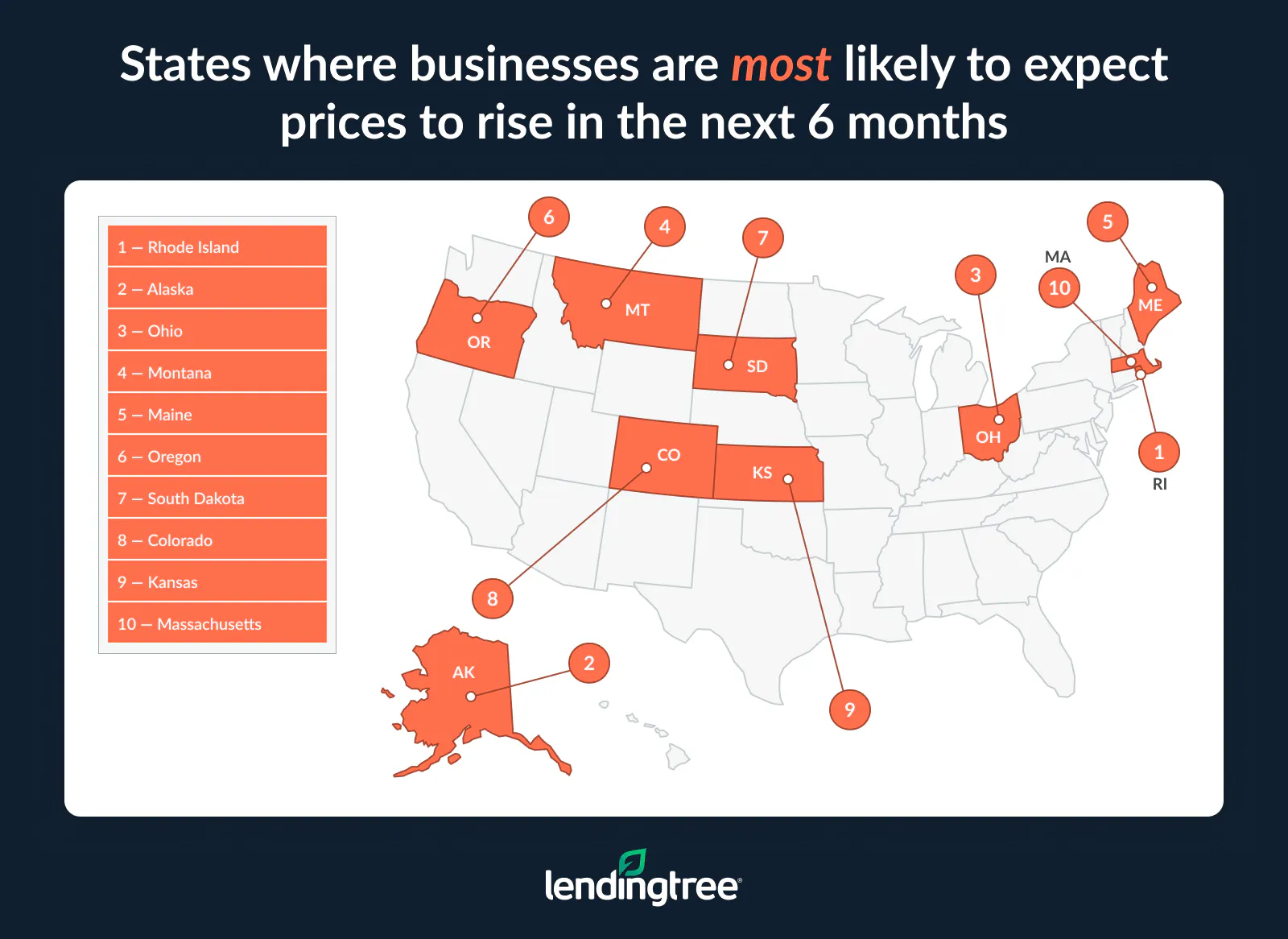
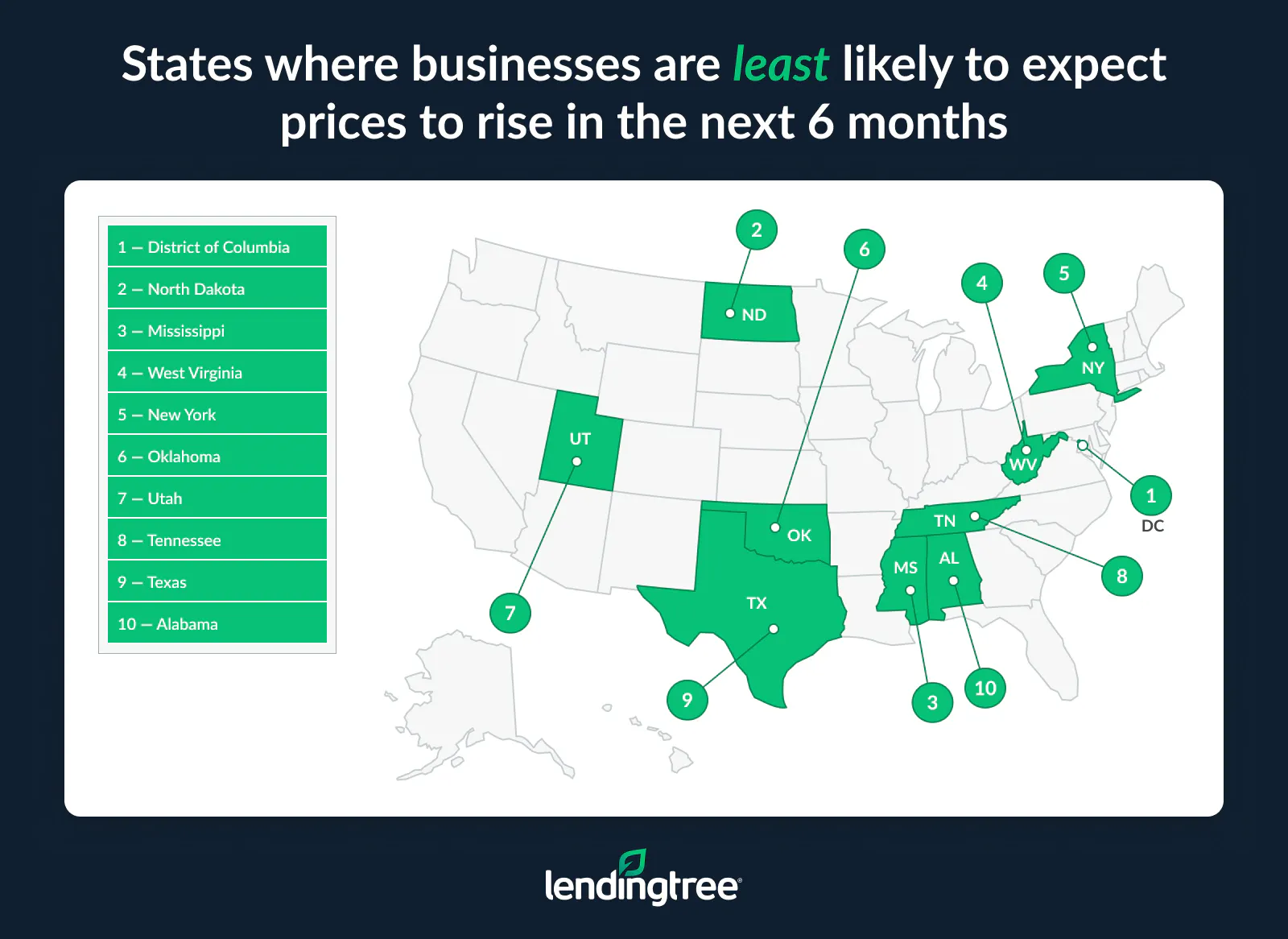
By state, Rhode Island businesses are the most likely to expect price increases, while businesses in the District of Columbia are the least likely. The full findings, including tips for businesses navigating increasing prices, are below.
- Businesses remain far more likely to expect price increases than decreases, though expectations have eased since December. The share of businesses expecting to raise prices over the next six months stands at 32.3%, down from 36.3% in December 2025 but slightly above the 30.9% reported a year ago. Only 3.8% expect to lower prices.
- Businesses appear to be facing greater margin pressure than a year ago. While 32.3% expect to raise the prices they charge customers over the next six months, 54.9% anticipate the prices they pay for goods and services will increase. That share is up from 50.7% a year earlier, indicating input costs are rising faster than businesses’ expectations for passing those costs on to customers.
- Businesses in Rhode Island are the most likely to expect price increases. In Rhode Island, 50.9% of businesses expect to raise prices over the next six months, the highest share of any state. Alaska (41.8%) and Ohio (41.1%) rank next.
- Businesses in the District of Columbia are the least likely to expect price increases. Just 15.0% expect to raise prices over the next six months, the lowest share among all states and the District. North Dakota (20.7%) and Mississippi (21.2%) have the next-lowest shares.
Price-hike expectations have eased but remain elevated
While price-increase expectations have moderated somewhat since our last analysis, they remain widespread — suggesting that inflation pressures have eased rather than disappeared.
Over the next six months, 32.3% of businesses expect to raise their prices, down from the 36.3% that expected such increases in December 2025. Still, that’s slightly up from the 30.9% reported a year ago. (Meanwhile, only 3.8% expect to lower prices before the end of 2026.)
6 months from now, how do you think the prices this business charges for its own goods or services will have changed?
| Increased | 32.3% |
| Decreased | 3.8% |
| No change | 63.9% |
“I’m not at all surprised that businesses continue to expect to raise prices,” admits Matt Schulz, LendingTree chief consumer finance analyst and author of “Ask Questions, Save Money, Make More: How to Take Control of Your Financial Life.”
“While inflation has cooled from its worst levels, it’s still high enough to be a real problem, especially for small and midsize businesses that often have less negotiating power with suppliers and less room to absorb cost increases. Unfortunately, it isn’t likely to get a whole lot better anytime soon.”
Margin pressure is building
Although overall inflation may have eased, most businesses are still anticipating price increases for the goods and services they buy. This suggests margin pressure is building, not falling.
While, again, 32.3% of businesses expect to raise the prices they charge their customers over the next six months, more than half — 54.9% — expect their back-end prices to increase. That’s up from 50.7% a year ago.
6 months from now, how do you think the prices this business pays for goods or services will have changed?
| Increased | 54.9% |
| Decreased | 1.9% |
| No change | 43.1% |
“If more than half of businesses expect their own costs to rise but only about a third expect to raise the prices they charge customers, a lot of businesses are probably preparing to eat at least some of those higher costs,” Schulz explains.
But, he says, this may be a sign of business optimism. “Businesses are likely more willing to eat higher costs if they don’t think the higher costs will last very long,” says Schulz, “so perhaps those running these businesses believe that some of the external factors driving these costs up might be resolved, or at least significantly improved, sooner rather than later.”
In other words, these entrepreneurs may see recent inflation cooling as the beginning of a longer economic turn in their favor.
Rhode Island leads in price-hike expectations
Figures do vary at the state level. And when it comes to expected price increases, the smallest state is in the lead. About half (50.9%) of Rhode Island business owners expect to raise their prices over the next six months — the highest share of any state. Runners-up are Alaska, where 41.8% of business owners expect to increase their prices, and Ohio (41.1%).
While it’s difficult to determine why specific states see higher trends in this regard, Rhode Island is the 13th highest cost-of-living state in the union, according to MERIC data. Higher prices overall could make it more difficult for businesses to scrape by without passing costs on to their customers.
And in Alaska, Schulz points out, “logistics can be kind of a nightmare. That’s because Alaska is so far from most other states that transporting goods there takes longer and costs more than it does for other states. Throw higher gas prices into the mix, and that gets even more challenging, leading to higher prices for many, many things. That puts a real burden on businesses in that state.”
Ohio, for its part, is the third-leading state in manufacturing after only California and Texas. The increasing price of raw manufacturing materials, as well as tariffs, may impact business margins there.
Meanwhile, at the other end of the spectrum, the District of Columbia has the smallest share of businesses expecting price increases: Only 15.0% of D.C. business owners say they’ll increase the prices they charge customers before the end of the year, despite the fact that it’s a very high-cost-of-living area.
Following it are North Dakota (20.7%) and Mississippi (21.2%), which may benefit from lower overall living costs.
The lack of price increases in these states is “clearly welcome news for residents of those areas,” Schulz says. “However,” he clarifies, this prediction “doesn’t necessarily mean prices will fall. It may just mean consumers are less likely to see another wave of increases in the next few months. Anyone thinking that affordability is going to dramatically improve in the next few months is likely to be disappointed.”
Full rankings: Where businesses are most/least likely to expect prices to rise in the next 6 months
| Rank | State | % that expect to charge more, June 2026 | % that expect to charge more, December 2025 | % point change | % that expect to pay more for goods, June 2026 |
|---|---|---|---|---|---|
| 1 | Rhode Island | 50.9% | 23.5% | 27.4 | 79.5% |
| 2 | Alaska | 41.8% | 38.4% | 3.4 | 56.7% |
| 3 | Ohio | 41.1% | 43.6% | -2.5 | 61.1% |
| 4 | Montana | 40.4% | 40.9% | -0.5 | 58.2% |
| 5 | Maine | 40.2% | 46.9% | -6.7 | 60.5% |
| 6 | Oregon | 39.9% | 44.9% | -5.0 | 65.5% |
| 7 | South Dakota | 38.0% | 49.3% | -11.3 | 61.5% |
| 8 | Colorado | 37.3% | 39.6% | -2.3 | 60.9% |
| 9 | Kansas | 37.1% | 40.8% | -3.7 | 60.5% |
| 10 | Massachusetts | 36.9% | 38.0% | -1.1 | 64.2% |
| 11 | Vermont | 36.8% | 50.3% | -13.5 | 68.2% |
| 12 | Washington | 35.8% | 40.0% | -4.2 | 61.0% |
| 13 | Georgia | 35.7% | 32.5% | 3.2 | 56.1% |
| 14 | Delaware | 35.5% | 36.3% | -0.8 | 46.7% |
| 14 | Virginia | 35.5% | 42.6% | -7.1 | 57.0% |
| 16 | New Mexico | 35.2% | 43.9% | -8.7 | 68.7% |
| 17 | Connecticut | 34.9% | 40.3% | -5.4 | 60.0% |
| 18 | Minnesota | 34.8% | 40.7% | -5.9 | 54.9% |
| 19 | Wisconsin | 34.7% | 36.7% | -2.0 | 59.6% |
| 20 | Illinois | 34.6% | 38.1% | -3.5 | 54.8% |
| 21 | Pennsylvania | 33.7% | 40.5% | -6.8 | 59.5% |
| 22 | Florida | 33.6% | 33.1% | 0.5 | 52.0% |
| 23 | Missouri | 33.5% | 39.4% | -5.9 | 61.1% |
| 24 | Idaho | 33.4% | 34.1% | -0.7 | 59.9% |
| 24 | Maryland | 33.4% | 33.1% | 0.3 | 62.1% |
| 26 | Michigan | 32.6% | 37.1% | -4.5 | 51.4% |
| 27 | Nevada | 32.5% | 29.8% | 2.7 | 52.9% |
| 28 | Iowa | 32.4% | 34.4% | -2.0 | 54.4% |
| 29 | Arizona | 32.3% | 29.9% | 2.4 | 57.2% |
| 30 | South Carolina | 32.1% | 40.1% | -8.0 | 55.6% |
| 31 | Wyoming | 32.0% | 39.1% | -7.1 | 61.5% |
| 32 | New Hampshire | 31.8% | 41.6% | -9.8 | 60.2% |
| 32 | New Jersey | 31.8% | 37.3% | -5.5 | 55.9% |
| 34 | Arkansas | 30.5% | 26.9% | 3.6 | 50.9% |
| 35 | Indiana | 30.4% | 37.6% | -7.2 | 59.3% |
| 36 | Kentucky | 30.1% | 32.8% | -2.7 | 55.5% |
| 37 | North Carolina | 29.9% | 36.7% | -6.8 | 50.2% |
| 38 | Hawaii | 29.7% | 48.7% | -19.0 | 50.1% |
| 39 | Nebraska | 29.6% | 44.3% | -14.7 | 49.3% |
| 40 | California | 29.5% | 33.2% | -3.7 | 53.5% |
| 40 | Louisiana | 29.5% | 25.8% | 3.7 | 47.8% |
| 42 | Alabama | 29.2% | 25.2% | 4.0 | 47.2% |
| 43 | Texas | 29.1% | 34.4% | -5.3 | 52.2% |
| 44 | Tennessee | 28.4% | 40.2% | -11.8 | 48.0% |
| 45 | Utah | 28.2% | 33.8% | -5.6 | 48.2% |
| 46 | Oklahoma | 27.9% | 32.1% | -4.2 | 56.2% |
| 47 | New York | 26.8% | 36.8% | -10.0 | 48.3% |
| 48 | West Virginia | 23.3% | 44.8% | -21.5 | 46.3% |
| 49 | Mississippi | 21.2% | 30.9% | -9.7 | 52.2% |
| 50 | North Dakota | 20.7% | 42.9% | -22.2 | 40.4% |
| 51 | District of Columbia | 15.0% | 25.9% | -10.9 | 31.0% |
Tips for businesses navigating rising costs
If you’re a small business owner (or an aspiring entrepreneur), you understand the complexity of riding the margins: You have to increase prices enough to make a profit, but not so much as to alienate customers. When costs are rising in general, this delicate dance can become a challenge — but these expert tips can help.
- Know your numbers in real time. “Business owners should have a clear view of which costs are rising, which products or services are most profitable and where margins are getting squeezed,” Schulz says. “You can’t manage rising costs well if you’re relying on outdated assumptions.” AI tools may be able to help you stay up-to-date with ease.
- Get nuanced with price increases. “Don’t default to across-the-board price hikes,” Schulz suggests. “In many cases, targeted increases, tiered pricing, bundled services, minimum order sizes or revised discount policies can protect margins without alienating every customer.”
- Communicate clearly. “Customers may not love higher prices, but they’re more likely to accept them when the value is clear and the business is transparent about why changes are happening,” Schulz explains.
- Renegotiate. It’s more possible than you may think. “Talk to suppliers, landlords, lenders, insurers and vendors,” Schulz says. “Even modest savings on recurring expenses can matter a lot when margins are thin.”
- Protect cash flow. “Rising costs can create a timing problem, especially when businesses have to pay more for inventory, payroll or supplies before they collect from customers,” Schulz says. “Owners should review credit lines, payment terms, emergency reserves and invoicing practices before they are under pressure.”
Methodology
LendingTree researchers analyzed U.S. Census Bureau Business Trends and Outlook Survey (BTOS) data.
This survey asks: “Six months from now, how do you think the prices this business charges for its own goods or services will have changed?” States were ranked from highest to lowest based on the percentage of businesses that said they expect to increase prices.
We also highlight responses to: “Six months from now, how do you think the prices this business pays for goods or services will have changed?”
We analyzed the survey that was fielded from June 1 to June 14, 2026, and compared this to the survey six months earlier from Dec. 1 to Dec. 14, 2025, and one year earlier from June 2 to June 15, 2025.
Compare business loan offers