1 in 3 Homeowners Put Off Needed Repairs; 34% of Those With Outstanding Repairs Say Delays Increased Costs


Home maintenance is a financial balancing act for many Americans.
According to a LendingTree survey, a third of homeowners have put off needed repairs in the past two years. Some say those delays have increased repair costs or caused further damage to their homes.
Here’s a closer look.
- A third of homeowners have recently put repairs on hold, largely because of cost. In the past two years, 34% delayed at least one repair or maintenance task. Among homeowners who currently need repairs, 34% are saving money for the work, 32% can’t afford it and 23% say contractor quotes are too high. The most common delays involve flooring, wall or ceiling repairs (30%), bathroom or kitchen repairs (29%) and plumbing, water heater or sewer/septic work (27%).
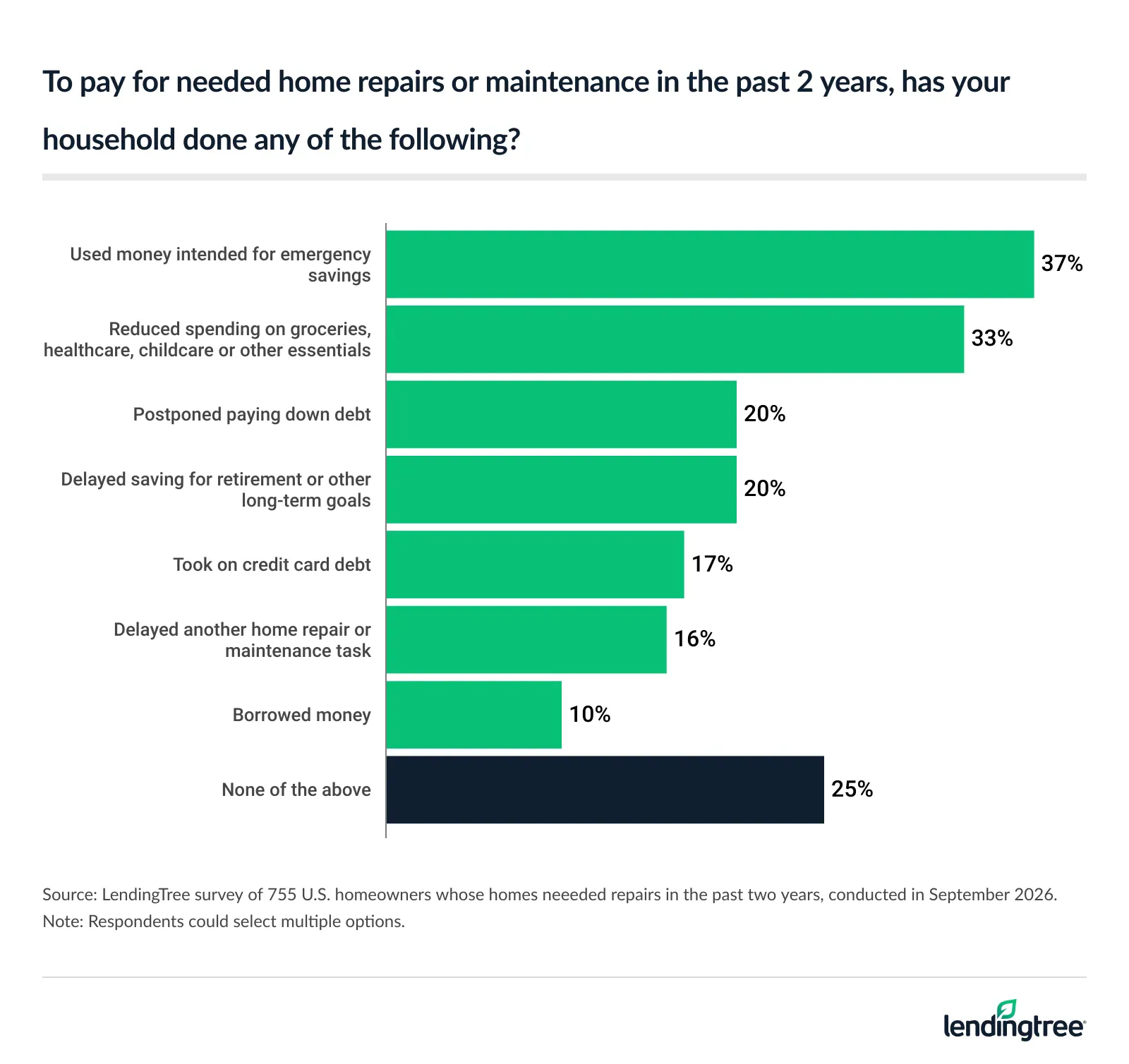
- Repair costs force significant financial trade-offs. Among homeowners who needed repairs in the past two years, 37% tapped emergency savings, 33% cut spending on essentials like groceries, healthcare and childcare, and 20% delayed saving for retirement or paying down debt. Faced with a surprise $5,000 repair, 30% of homeowners say they could cover it only by significantly reducing their savings, while 25% say they couldn’t cover it at all.
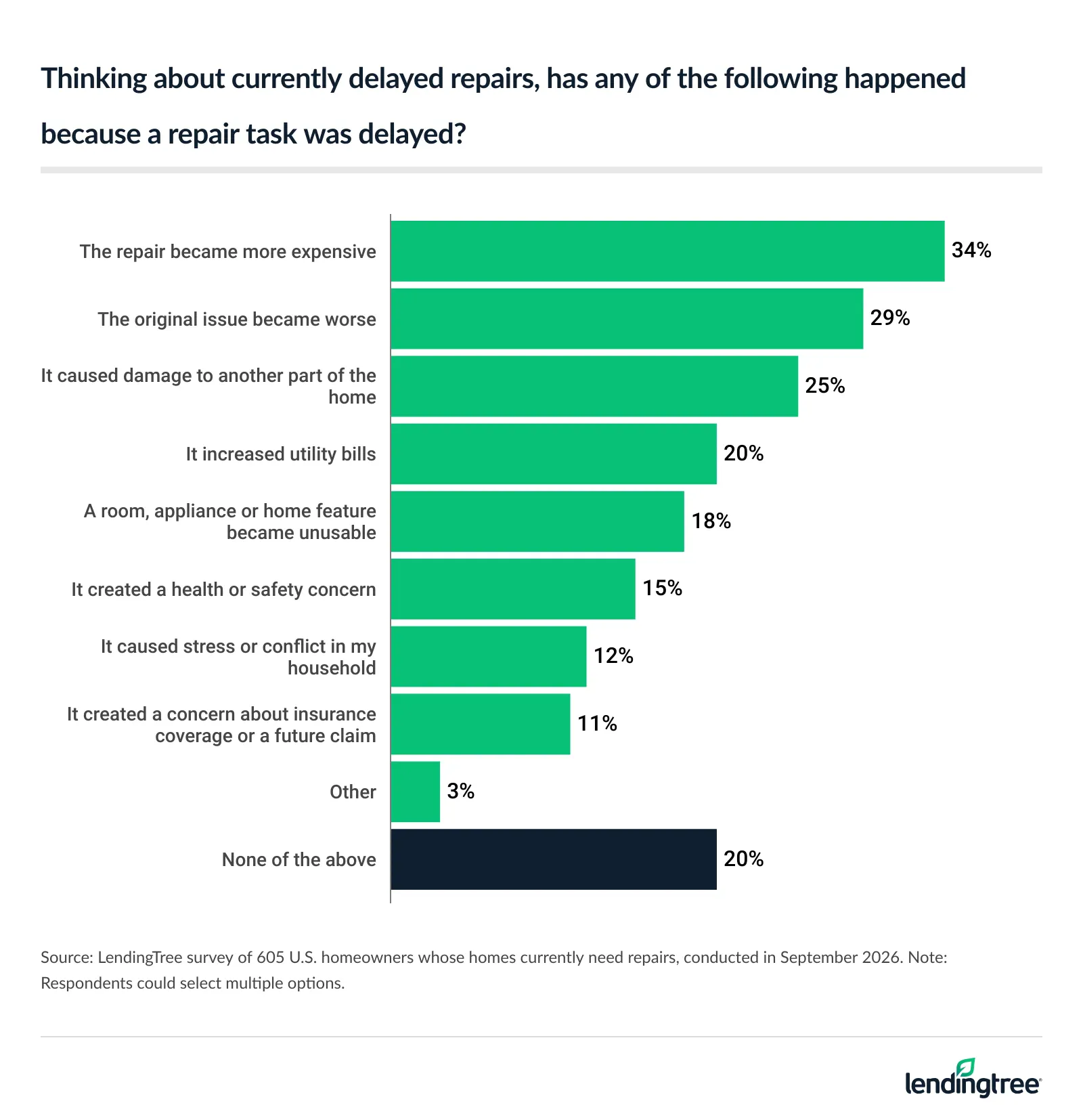
- Delayed repairs can become more costly and cause further damage. Among homeowners who currently need repairs, 34% say a delay has made repairs more expensive, 29% say the original problem worsened and 25% say it caused damage elsewhere in their homes.
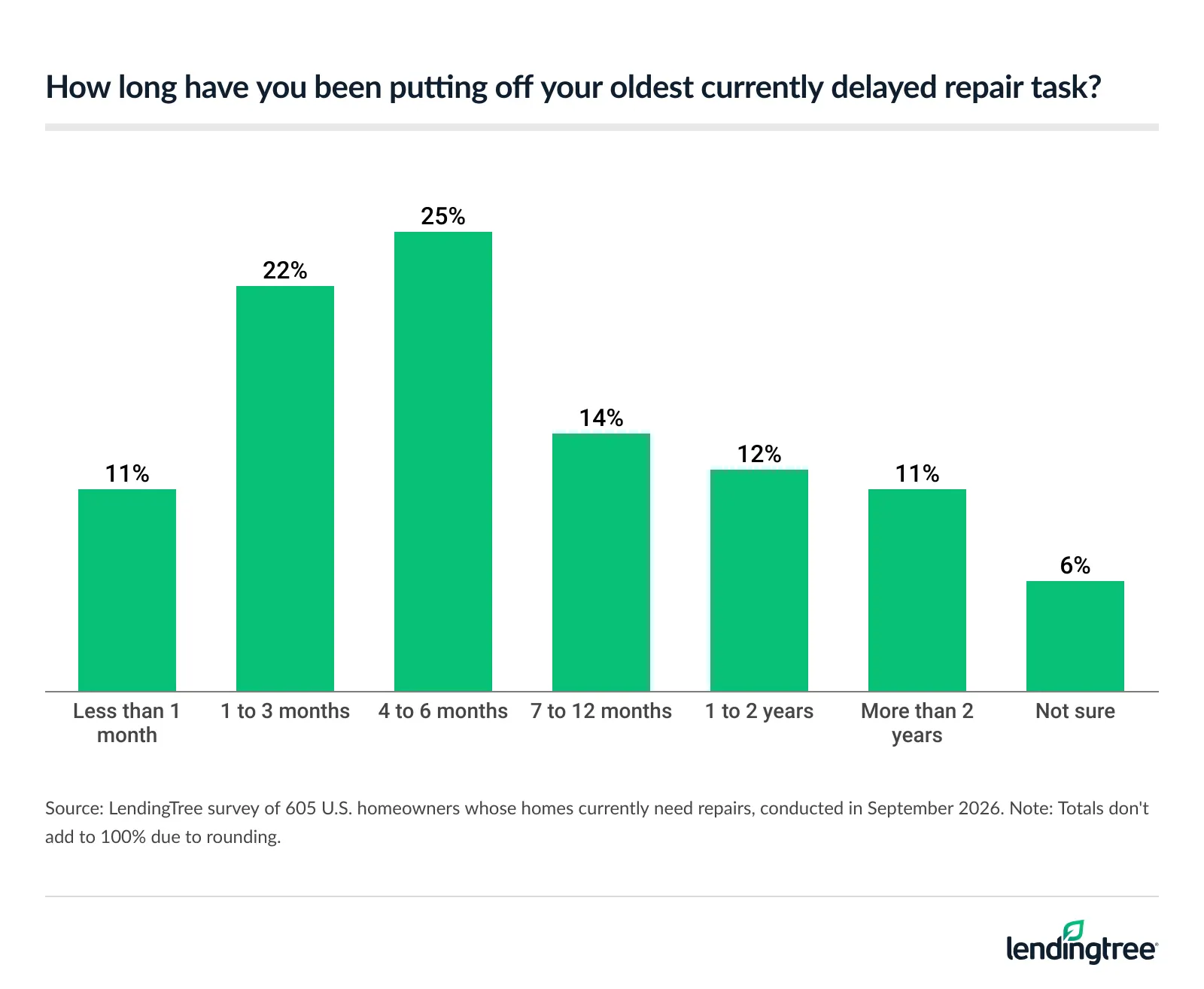
- Some repairs go unaddressed for years. Among homeowners who currently need repairs, 25% have put off their longest-delayed repair for four to six months, 22% for one to three months and 24% for a year or more. Among baby boomers who currently need repairs, 46% have delayed their oldest repair for at least a year.
- DIY is helping homeowners manage costs. Among homeowners who needed repairs in the past two years and completed at least some of them, 60% did some of the work themselves because they couldn’t afford professional help. This is especially common among millennials (72%), compared with 29% of baby boomers.
Cost is the top reason homeowners are putting off repairs
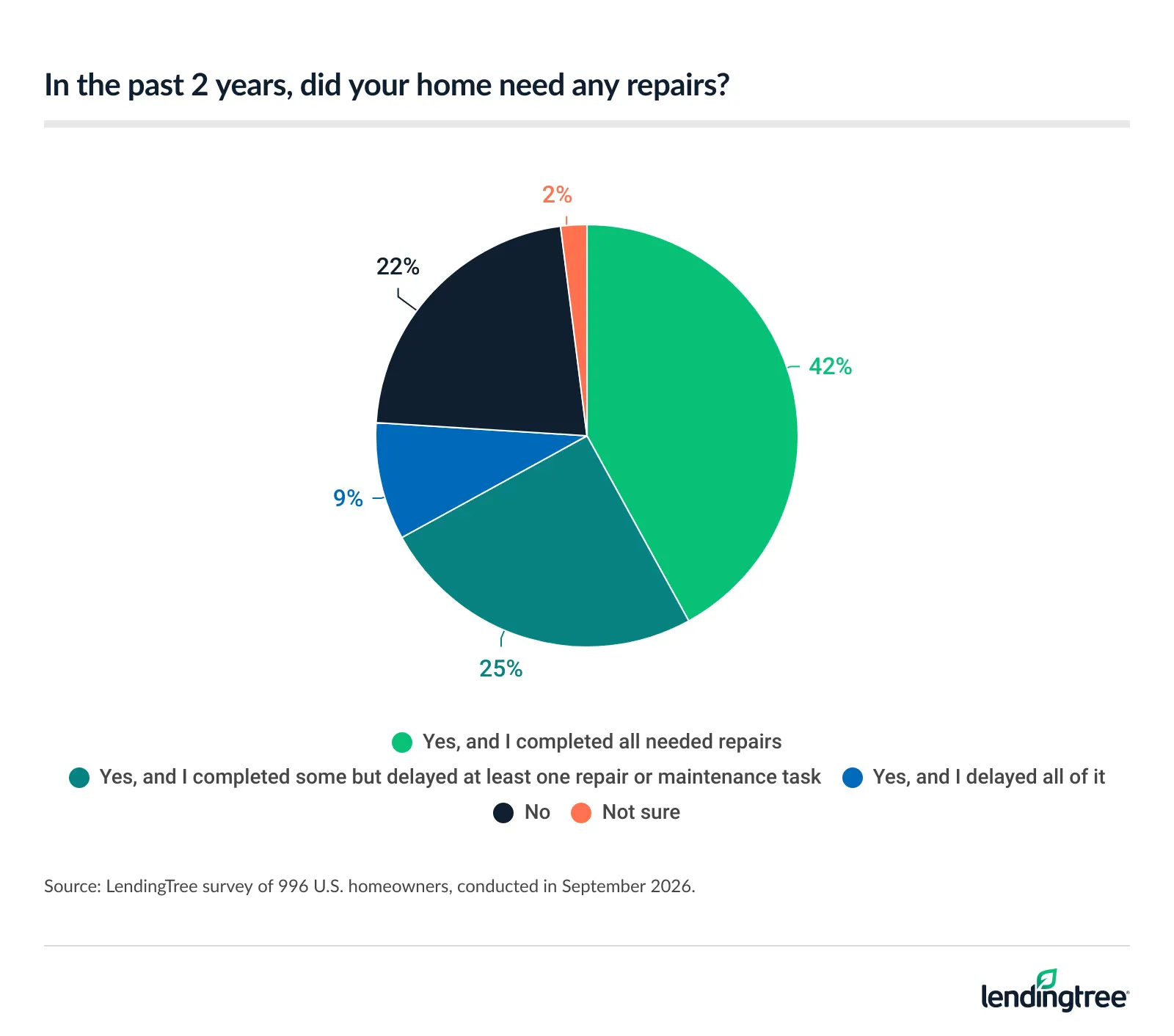
Roughly one-third of homeowners (34%) say they’ve delayed at least one repair or maintenance task in the past two years. Among all homeowners surveyed, 25% have completed some repairs but delayed at least one and 9% have delayed all repairs. Another 42% say they completed all needed repairs.
Among homeowners who’ve needed repairs in the past two years, 36% say their most serious outstanding repair is important but not urgent, while 27% say theirs is urgent or safety-related. Millennials ages 30 to 45 (39%) and Gen Zers ages 18 to 29 (34%) are more likely than Gen Xers ages 46 to 61 (26%) or baby boomers ages 62 to 80 (12%) to have urgent or safety-related repairs.
Among those who currently have unaddressed repairs, 34% are saving up for the work, 32% say they can’t afford it and 23% cite high contractor quotes. Other common reasons for delays include:
- Waiting for an insurance decision or payment (21%)
- Difficulty finding an available or affordable contractor (16%)
- Planning to do the work themselves but not having gotten to it yet (15%)
- Not having time to handle it (12%)
- Not thinking the issue is urgent (12%)
- Believing the work would be too disruptive (9%)
- Not being sure who to hire or how to begin (9%)
- Waiting to see whether the issue gets worse (4%)
- Waiting for another household member, a homeowners association (HOA) or another party (4%)
- Inability to get financing (3%)
Matt Schulz, LendingTree chief consumer finance analyst and author of “Ask Questions, Save Money, Make More: How to Take Control of Your Financial Life,” says these struggles show that housing affordability challenges extend beyond the cost of buying a home.
“Maintenance and upkeep on your home costs a ton, so it’s crucial that you plan for them,” he says. “You can do that by building your emergency fund as well as by leaving a line item in your budget for ongoing home repair and maintenance costs. That way, those little and not-so-little repairs won’t lead you immediately into more debt.”
The repairs most likely to be delayed involve flooring, walls or ceilings (30%), followed by bathroom or kitchen work (29%) and plumbing, water heater or sewer/septic issues (27%). Other delayed repairs include:
- Roof, chimney or gutters (25%)
- Heating or air conditioning (23%)
- Water damage, leaks or mold (19%)
- Windows or exterior doors (16%)
- Electrical system (15%)
- Major household appliance (12%)
- Foundation or other structural issue (12%)
- Exterior siding, paint, deck or fencing (12%)
- Routine maintenance, such as HVAC servicing, gutter cleaning or sealing (9%)
- Smoke alarms, carbon monoxide detectors or another safety feature (6%)
- Pest or termite problem (6%)
- Other (5%)
- Accessibility or mobility-related repair or modification (4%)
Paying for repairs is eating into savings and everyday budgets
When repair bills come due, homeowners are making financial sacrifices to cover them. Among homeowners who needed repairs in the past two years, 37% have dipped into emergency savings, a third (33%) have cut back on essentials like groceries, healthcare or childcare, and 20% have put retirement savings or debt repayment on hold.
Schulz says major, unexpected home repairs are exactly the kind of expense emergency funds are designed to handle.
“Emergency funds minimize your need to take that money from other priorities or to put it on your credit card and run up a bunch of debt,” he says. “It isn’t always easy to build up an emergency fund, especially with today’s high inflation, but it needs to be a priority, even when you have credit card debt. That’s because if you pay your card debt off in full but don’t have an emergency fund, the next surprise expense will just have to go on your card, putting you right back in debt.”
Younger homeowners are more likely to cut essential spending to cover repairs. Among those who needed repairs in the past two years, 61% of Gen Z homeowners and 46% of millennial homeowners have trimmed essential spending to pay for them. That compares with 18% of Gen X and 16% of baby boomer homeowners who needed repairs.
Parents are also making financial trade-offs. Among homeowners with children younger than 18 who needed repairs in the past two years, 48% have cut essential spending and 48% have tapped emergency savings to cover repair costs.
A surprise $5,000 repair would pose another financial challenge: Across all homeowners, 30% say they could cover it only by significantly reducing their savings and a quarter (25%) say they couldn’t cover it at all.
Waiting too long can turn a small fix into a big bill
Delaying home repairs can come at a cost. Among homeowners who currently need repairs, 34% say delays have made repairs more expensive, 29% say the original problem has gotten worse and 25% say the delays have caused damage elsewhere in the home.
Schulz says these consequences aren’t surprising.
“Putting off repairs can turn a small problem into a far bigger, more significant one,” he says. “For example, a small roof leak can become water damage, mold or structural trouble. That can be a big deal when it comes time to sell the house. The longer homeowners wait, the greater the chance that they’ll have to fix the problem at the worst possible time and with fewer options.”
Even without additional damage, the estimated costs are substantial. Among homeowners who currently need repairs, 68% estimate their outstanding repairs will cost at least $1,000 and 26% expect a bill of $5,000 or more. Beyond the financial burden, 61% are at least somewhat worried their needed repairs will become more expensive or pose a safety risk the longer they’re delayed.
Some repairs have been delayed for years
Delays aren’t always short-term. Among homeowners who currently need repairs, 25% have let their oldest needed repair go unaddressed for four to six months, 22% for one to three months and nearly a quarter (24%) for a year or longer.
Baby boomers are especially likely to have long-standing outstanding repairs, with 46% of those who currently need repairs having delayed their oldest needed one for at least a year. Homeowners earning less than $30,000 (35%) are also among those most likely to have delayed a repair for a year or longer.
While cost is likely a major reason these repairs linger, Schulz says it isn’t the only one.
“Homeowners may be overwhelmed, unsure whom to hire or reluctant to take on debt,” he says. “For some baby boomers, living on a fixed income or wanting to preserve retirement savings likely plays a role, too. The key is not to ignore the problem. Even if you can’t afford the full repair today, a professional may be able to recommend a smaller step that prevents further damage.”
Over the next 12 months, 38% of those who currently need repairs expect to complete all their delayed repair or maintenance work, while 48% expect to complete some or most of it.
DIY is helping homeowners manage repair costs
When professional help isn’t in the budget, many homeowners are tackling repairs themselves. Among those who’ve needed repairs in the past two years and completed at least some of the work, 60% did at least some of it themselves because they couldn’t afford a professional.
Millennials are the most likely age group to take on repairs themselves because of cost, at 72%, compared with 29% of baby boomers. Those with children younger than 18 (73%) are more likely to do so than those without children (59%) or those with children 18 or older (43%). Men (68%) are also more likely to take on repairs themselves because of cost than women (49%).
Schulz says DIY can make sense for low-risk, cosmetic work, such as painting or caulking.
“It’s never been easier to learn how to do these things, thanks to countless how-to videos available online,” he says. “However, homeowners should be very cautious with electrical, gas, structural, roofing and major plumbing work, along with anything involving mold, asbestos, permits or serious fall risks. If something goes wrong in making those repairs, you can be seriously hurt, cause far more expensive damage and create problems with insurance or a future sale. Hiring a licensed and insured professional may sting financially, but sometimes you’re paying to ensure that the job is done safely and correctly the first time.”
Preparing for home repairs before they happen
Unexpected home repairs can put a significant dent in your budget, but planning ahead can make them easier to afford. Here are three ways to prepare:
- Build a repair fund. “Make home repairs part of your budget before something breaks,” Schulz says. “Even a small automatic transfer into a separate fund can give you more breathing room when an unexpected expense comes up.”
- Catch problems early. “Inspect your home regularly and address water, electrical, gas or structural issues quickly,” he says. “Finding a problem early can prevent a relatively minor repair from becoming a much bigger and more expensive one.”
- Shop around for repairs and financing. “Get at least three written estimates from contractors before committing to the work,” he says. “If you need financing, compare home improvement or home equity loan offers from multiple lenders, too. Rates and costs can vary significantly, and shopping around can help you avoid paying more than necessary.”
Methodology
LendingTree commissioned QuestionPro to conduct an online survey of 2,000 U.S. consumers from Sept. 2 to 7, 2026. The survey was administered using a nonprobability-based sample, and quotas were used to help ensure the sample reflected the overall population. Researchers reviewed all responses for quality control.
Generations were defined as the following age groups in 2026:
- Generation Z: 18 to 29
- Millennials: 30 to 45
- Generation X: 46 to 61
- Baby boomers: 62 to 80