Cheapest SR-22 Car Insurance in Minnesota in 2027
Western National has the cheapest insurance in Minnesota, at $55 per month, if you’ve had a DWI and need an insurance certification


Advertising Disclosures
Loading Disclosures…
- Unlike many states, Minnesota does not require you to file an SR-22 form after certain driving violations. Instead, drivers need to file an “insurance certification” with the Minnesota Driver and Vehicle Services (DVS).
- You may need to file the certification if you’ve had your license revoked for issues such as driving without insurance.
- Your insurance company can submit the insurance certification as proof you have the minimum amount of coverage to drive legally in Minnesota.
Cost of SR-22 insurance in MN
The biggest cost of having to file an insurance certification in Minnesota is the cost of your insurance. Your rates will probably go up, depending on why you need the certification.
Monthly insurance certification rates after a DUI in Minnesota
Western National has the cheapest minimum coverage rates for drivers who have to file proof of insurance after a DUI, at $55 per month, on average. That’s $96 cheaper than the average in Minnesota.
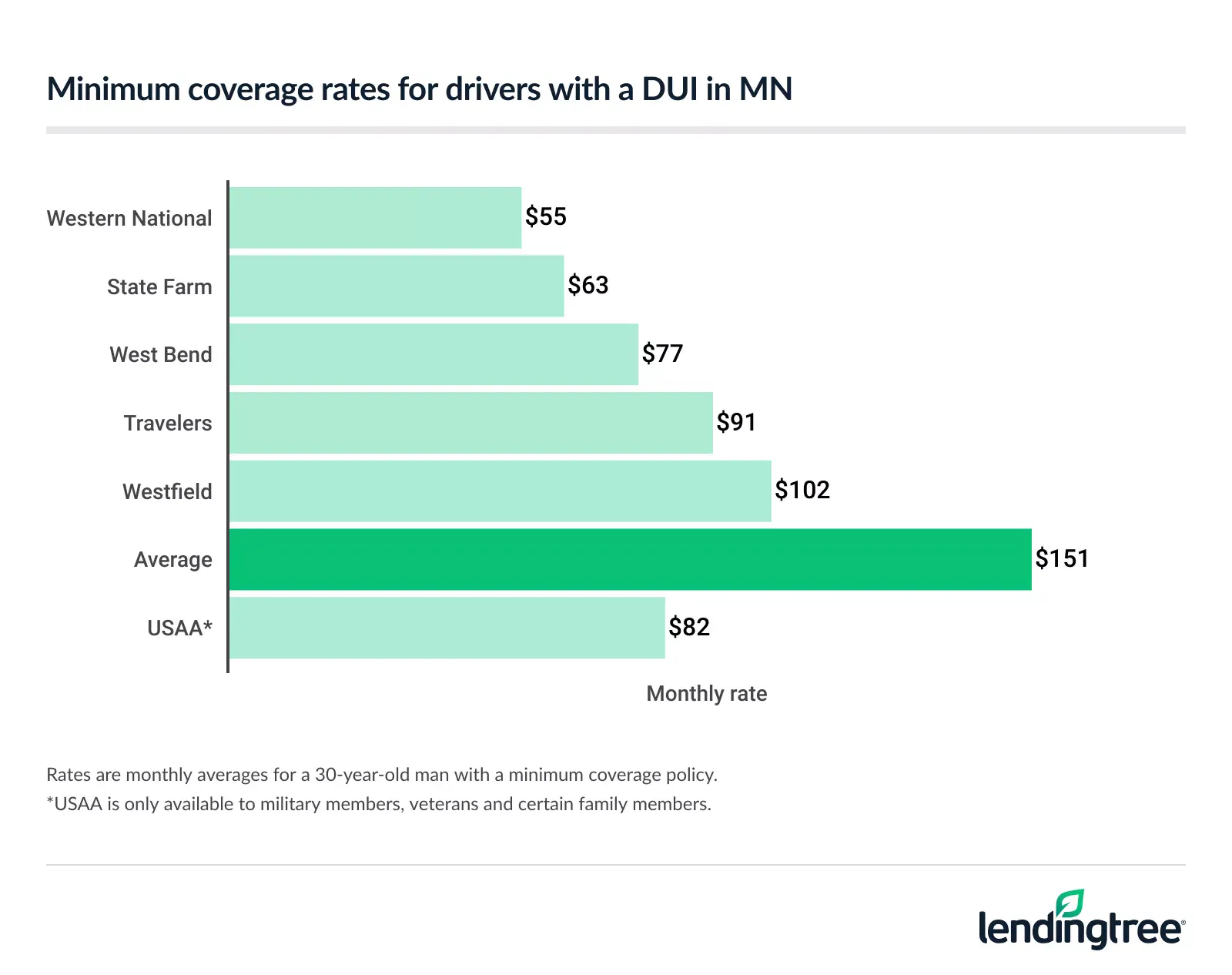
Cheapest SR-22 rates after DUI
| Company | Min. coverage | Full coverage | LendingTree rating | |
|---|---|---|---|---|
 | Western National | $55 | $187 | |
 | State Farm | $63 | $148 | Read Our Review |
 | West Bend | $77 | $280 | |
 | Travelers | $91 | $217 | Read Our Review |
 | Westfield | $102 | $387 | Read Our Review |
 | Farm Bureau | $116 | $299 | Read Our Review |
 | Auto-Owners | $126 | $296 | Read Our Review |
 | North Star Mutual | $153 | $888 | |
 | American Family | $154 | $485 | Read Our Review |
 | Nationwide | $191 | $533 | Read Our Review |
 | Farmers | $216 | $482 | Read Our Review |
 | AAA | $245 | $569 | Read Our Review |
 | Allstate | $248 | $648 | Read Our Review |
 | Geico | $340 | $976 | Read Our Review |
 | USAA* | $82 | $272 | Read Our Review |
Monthly insurance certification rates after driving without insurance in MN
North Star Mutual has the cheapest minimum coverage rates if you’re caught driving without insurance, at $44 per month.
Cheapest SR-22 rates after driving without insurance
| Min. coverage | Full coverage | LendingTree rating | |
|---|---|---|---|
| North Star Mutual | $44 | $242 | |
| Westfield | $50 | $263 | Read Our Review |
| Western National | $55 | $187 | |
| Auto-Owners | $57 | $167 | Read Our Review |
| State Farm | $63 | $148 | Read Our Review |
| Farm Bureau | $66 | $169 | Read Our Review |
| Travelers | $71 | $173 | Read Our Review |
| West Bend | $77 | $280 | |
| AAA | $104 | $271 | Read Our Review |
| American Family | $110 | $331 | Read Our Review |
| Nationwide | $123 | $330 | Read Our Review |
| Geico | $126 | $355 | Read Our Review |
| Farmers | $198 | $427 | Read Our Review |
| Allstate | $228 | $550 | Read Our Review |
| USAA* | $55 | $181 | Read Our Review |
Each car insurance company calculates rates differently. It’s important to compare car insurance quotes from multiple companies to find the cheapest Minnesota car insurance for you.
Do I need SR-22 insurance in Minnesota?
Minnesota requires drivers with certain violations to submit an insurance certification, which is similar to an SR-22 in that it proves to the state you have insurance.
You may need a certificate of insurance after certain violations, such as when you’re caught driving without insurance, or as part of specific license reinstatement requirements. Drivers participating in the state’s ignition interlock program may also need a certificate, depending on their circumstances.
If your license was revoked but you don’t own a car, you still need to file a certificate of insurance to have your license reinstated. This means you’ll likely need to buy what’s called a non-owner insurance policy, which protects you if you get in an accident while driving a car you don’t own.
How long do I need SR-22 insurance in MN?
Minnesota typically requires drivers to have an insurance certification on file for one year from the filing date.
After one year, check with the Minnesota Driver and Vehicle Services (DVS) to see if you can remove the filing. If you get that confirmed, you can contact your insurance company and let them know.
However, most insurance companies raise rates for three to five years after a driving violation, so you might not see your rates go down just because you no longer need an insurance certification.
How to get an SR-22 insurance certification in Minnesota
If you need to have proof of insurance on file with the Minnesota DVS, you need to ask your insurance company to fill out the Minnesota insurance certification form. Your insurer will submit the form to the state on your behalf.
Before you can drive legally, you’ll usually have to pay a license reinstatement fee, which varies depending on your violation.
If your license was revoked because of a DWI, refusing to take an alcohol test or other serious violations, such as vehicular homicide, you can expect to pay $680 to have your license reinstated. Otherwise, you’ll typically pay $30. If your license was suspended instead of revoked, the reinstatement fee is $20.
What is Minnesota SR-22 insurance?
Minnesota’s version of SR-22 insurance is called a certificate of insurance. The certification is a form your insurance company files to confirm your policy meets the minimum coverage required by law in Minnesota.
The minimum liability coverage requirements in Minnesota are:
- Bodily injury liability: $30,000 per person and $60,000 per accident
- Property damage liability: $10,000 per accident
- Personal injury protection (PIP): $40,000 per person/accident
- Uninsured and underinsured motorist coverages: $25,000 per person and $50,000 per accident
Frequently asked questions
Minnesota doesn’t require SR-22 insurance, but drivers with certain violations on their records may need to file an insurance certification. Your insurance company submits this form to the state, and it acts as proof you have at least the minimum amount of coverage required by law in Minnesota.
After you’ve had a certificate of insurance for one year and you’ve confirmed with the DVS you no longer need it, call your car insurance company and ask them to remove it.
Western National has the cheapest rates for drivers who need to file an insurance certification after a DUI, with minimum coverage at an average of $55 per month. North Star Mutual has the cheapest rates after you’ve been caught driving without insurance, at $44 per month on average for minimum coverage.
You can find the Minnesota insurance certification form online. Your insurance company can fill out the form and mail or fax it to the Minnesota Department of Public Safety Driver and Vehicle Services.
Methodology
To find the average rate for Minnesota drivers with a certificate of insurance, LendingTree compared quotes from major insurance companies in the state across every residential ZIP code. Rates are for a 30-year-old man with good credit who drives a 2018 Honda Civic EX.
Quotes are based on a policy with the minimum liability limits required in Minnesota. Full coverage rates include higher liability limits plus comprehensive and collision coverage:
- Bodily injury liability: $50,000 per person and $100,000 per accident
- Property damage liability: $50,000 per accident
- Uninsured and underinsured motorist bodily injury: $50,000 per person and $100,000 per accident
- Comprehensive and collision coverage: $500 deductible
LendingTree’s analysis used insurance rate data from Quadrant Information Services. These rates were publicly sourced from insurer filings and should be used for comparative purposes only. Your own quotes may be different.
How we evaluated car insurance companies
Our team of insurance experts rated insurance companies based on several categories. These categories include average rates, discounts, coverage options, third-party customer service ratings and app/website experience. We weighted these categories based on what customers value in an insurance company.
For third-party customer service ratings, we included Complaint Index scores from the National Association of Insurance Commissioners (NAIC) and financial strength ratings from A.M. Best. NAIC Complaint Index scores are used to determine how satisfied customers are with their claims, while financial strength ratings from A.M. Best reflect the ability to pay out claims.
See our car insurance ratings methodology and full editorial guidelines for further details.
—
*USAA is listed differently because its rates are only available to military members, veterans and certain military family members.